
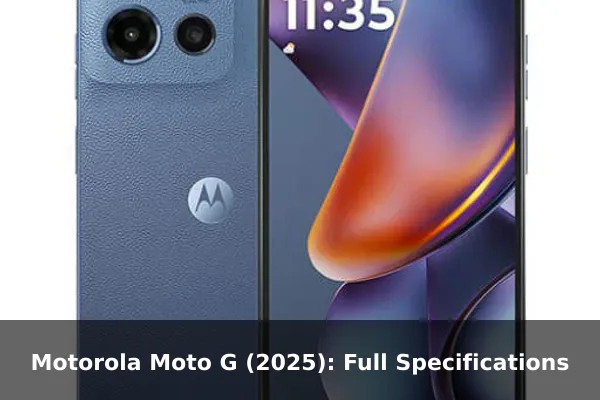
The Motorola Moto G (2025) is a budget 5G Android phone built around practical daily-use features rather than flashy flagship extras. Its main appeal is the combination of a large 120Hz display, Dimensity 6300 chipset, 5000mAh battery, expandable storage, stereo speakers, and a familiar Moto G design language.
For buyers comparing affordable Android phones, this model sits in a useful middle ground: it keeps essentials such as NFC, a headphone jack, eSIM support, and a dedicated microSD slot, while making clear compromises in screen resolution, memory, and video recording.
Full Specifications
Network
| Technology: | GSM / HSPA / LTE / 5G |
| 2G bands: | GSM 850 / 900 / 1800 / 1900 |
| 3G bands: | HSDPA 850 / 900 / 1700(AWS) / 1900 / 2100 |
| 4G bands: | 1, 2, 3, 4, 5, 7, 8, 12, 13, 14, 17, 18, 20, 25, 26, 28, 29, 30, 38, 39, 40, 41, 48, 66, 71 |
| 5G bands: | 2, 5, 7, 12, 14, 25, 26, 29, 30, 41, 48, 66, 70, 71, 77, 78 SA/NSA/Sub6 |
| Speed: | HSPA, LTE, 5G |
Launch
| Announced: | 2025, January 14 |
| Status: | Available. Released 2025, January 30 |
Body
| Dimensions: | 167.1 x 76.3 x 8.2 mm (6.58 x 3.00 x 0.32 in) |
| Weight: | 193 g (6.81 oz) |
| Build: | Glass front (Gorilla Glass 3), silicone polymer (eco leather) back, plastic frame |
| SIM: | Nano-SIM + eSIM |
| Water-repellent design |
Display
| Type: | IPS LCD, 120Hz |
| Size: | 6.7 inches, 108.2 cm2 (~84.9% screen-to-body ratio) |
| Resolution: | 720 x 1604 pixels, 20:9 ratio (~262 ppi density) |
| Protection: | Corning Gorilla Glass 3 |
Platform
| OS: | Android 15, up to 2 major Android upgrades |
| Chipset: | Mediatek Dimensity 6300 (6 nm) |
| CPU: | Octa-core (2×2.4 GHz Cortex-A76 & 6×2.0 GHz Cortex-A55) |
| GPU: | Mali-G57 MC2 |
Memory
| Card slot: | microSDXC (dedicated slot) |
| Internal: | 64GB 4GB RAM, 128GB 4GB RAM |
Main Camera
| Dual: | 50 MP, f/1.8, (wide), 0.61µm, PDAF, OIS 2 MP, f/2.4, (macro) |
| Features: | LED flash, HDR, panorama |
| Video: | 1080p@30fps |
Selfie camera
| Single: | 16 MP, f/2.4, (wide), 1.0µm |
| Video: | 1080p@30fps |
Sound
| Loudspeaker: | Yes, with stereo speakers (with Dolby Atmos) |
| 3.5mm jack: | Yes |
Comms
| WLAN: | Wi-Fi 802.11 a/b/g/n/ac, dual-band |
| Bluetooth: | Yes |
| Positioning: | GPS, GALILEO, GLONASS |
| NFC: | Yes |
| Radio: | Unspecified |
| USB: | USB Type-C 2.0 |
Features
| Sensors: | Fingerprint (side-mounted), accelerometer, gyro, proximity, compass, barometer |
Battery
| Type: | 5000 mAh |
| Charging: | 30W wired |
Misc
| Colors: | Forest Gray, Sapphire Blue |
| Price: | $ 174.90 |
Price and Availability
The Motorola Moto G (2025) offers a compelling combination of features and performance. While the base price is around $175, the actual cost may vary depending on your location and retailer. Below, you’ll find the approximate price of the Motorola Moto G (2025) converted into various currencies. Please note that these are estimates based on recent exchange rates as of July 18, 2026 and may not reflect the exact price you’ll find at a retailer.
- United States: $175
- Japan: ¥28,404
- United Kingdom: £130
- Australia: A$250
- Canada: C$245
- Taiwan: NT$5,660
- Denmark: kr1.142
- Saudi Arabia: ﷼656
- South Korea: ₩260,054
- Germany: €153
- Brazil: R$892
- Vietnam: ₫4.582.910
- Kenya: KSh 22,619
- India: ₹16,862
- Indonesia: Rp 3.142.402
- Nigeria: ₦241,438
- Pakistan: ₨48,625
- Philippines: ₱10,786
- Bangladesh: ৳২১,৫৫৬
Value Position
The Motorola Moto G (2025) is aimed at shoppers who want 5G connectivity without moving into mid-range pricing. Based on the listed source price of $174.90, it competes in the entry-level 5G segment, where long battery life, dependable network support, and basic camera quality matter more than premium materials or high-end gaming power. Its strongest value points are the 120Hz display, optical image stabilization on the main camera, stereo speakers with Dolby Atmos, NFC, and the inclusion of both Nano-SIM and eSIM support.
The value story is not about maximum specifications on paper. Instead, Motorola appears to focus on everyday usability: a large screen for streaming and browsing, a battery capacity that should suit a full day of normal use, and storage expansion for users who keep photos, music, or offline media. The 4GB RAM configurations are modest, so heavy multitasking is not the main use case here.
Design And Build
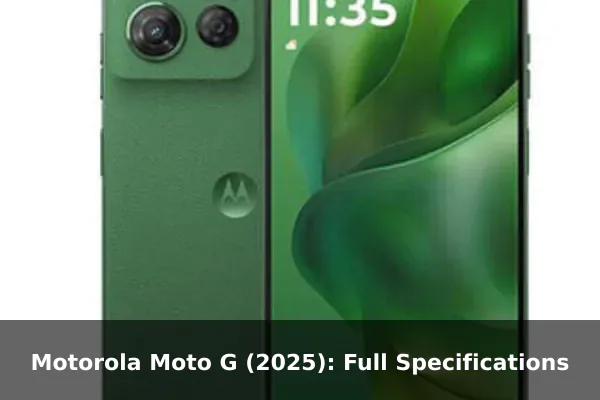
The phone has a fairly large body at 167.1mm tall and weighs 193g, which puts it firmly in big-screen territory. The silicone polymer back with an eco-leather finish gives it a different texture from glossy plastic phones and should help with grip. The plastic frame keeps the construction budget-friendly, while the Gorilla Glass 3 front adds basic scratch resistance for the display surface.
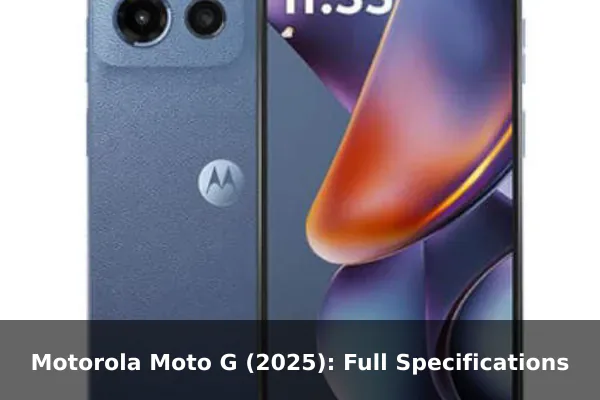
Motorola also lists a water-repellent design. That wording should be read carefully: it suggests protection against everyday splashes rather than full waterproofing. The Forest Gray and Sapphire Blue color options keep the styling simple and practical, with enough distinction for buyers who prefer a phone that does not look overly generic.
Display Experience
The 6.7-inch IPS LCD is one of the phone’s headline features because it supports a 120Hz refresh rate. That can make scrolling, app navigation, and supported animations feel smoother than standard 60Hz panels. For social media, web browsing, messaging, and general interface use, the high refresh rate is a meaningful advantage at this price level.
The compromise is resolution. At 720 x 1604 pixels and around 262ppi, this is not a sharp display by modern mid-range standards. Text, icons, and fine details may look less crisp than on Full HD+ screens, especially on such a large panel. Buyers who prioritize smoothness over pixel density may be satisfied, but anyone who reads a lot of small text or watches high-resolution video should note this limitation.
Performance And Hardware
The MediaTek Dimensity 6300 is a 6nm chipset with two Cortex-A76 performance cores and six Cortex-A55 efficiency cores. In practical terms, it is designed for affordable 5G phones that need responsive everyday performance without flagship-class processing. Messaging, browsing, maps, video streaming, light editing, and casual games should be the natural workload for this device.
The Mali-G57 MC2 GPU is suitable for basic gaming, but this is not a performance-first phone. The 4GB RAM listed for both storage versions means users should expect app reloads if they switch between many apps at once. The better long-term choice is the 128GB version, especially because Android, apps, photos, and messaging media can quickly reduce usable space on the 64GB model. The dedicated microSDXC slot is a major practical advantage for media storage.
Camera Setup
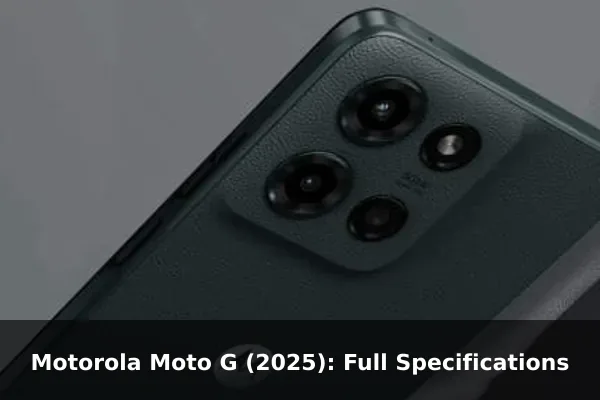
The rear camera system is led by a 50MP wide camera with phase-detection autofocus and optical image stabilization. OIS is especially useful in this class because it can help reduce blur from hand movement in still photos, particularly indoors or in lower light. The second rear camera is a 2MP macro unit, which is more of a niche close-up tool than a flexible secondary camera.
Video recording is capped at 1080p at 30fps on both the rear and front cameras. That is adequate for casual clips, video calls, and social sharing, but it is not aimed at users who want 4K capture or advanced video options. The 16MP selfie camera is a straightforward wide camera for portraits and calls, and its value will depend heavily on Motorola’s image processing in real-world lighting.
Battery And Charging
The 5000mAh battery is one of the safest reasons to consider the Moto G (2025). Combined with a 720p-class display and an efficient 6nm chipset, the phone should be well suited to all-day use for typical tasks such as messaging, browsing, music playback, navigation, and streaming. Battery life will vary with 5G use, screen brightness, gaming, and camera recording, but the hardware choices point toward endurance rather than raw speed.
Charging is rated at 30W wired, which is solid for a budget phone. It is not the fastest charging available in the Android market, but it should be noticeably better than older 10W or 15W entry-level devices. There is no wireless charging listed, which is expected in this price class.
Software Outlook
The phone ships with Android 15 and is listed with up to two major Android upgrades. That gives it a clearer software path than many older budget models, though long-term security update timing can still vary by market and carrier. For buyers who keep a phone for several years, the upgrade promise is an important part of the ownership equation.
Motorola’s Android approach is usually close to stock Android in layout, with added Moto utilities layered on top. For this model, the key point is that the software should feel familiar and lightweight enough for the modest 4GB RAM hardware, as long as the phone is not overloaded with demanding background apps.
Connectivity And Everyday Extras
Connectivity is a major strength for the Moto G (2025). The phone supports GSM, HSPA, LTE, and sub-6GHz 5G, with a broad list of 4G and 5G bands. That makes it better equipped for modern network coverage than many low-cost phones that are limited to LTE or narrower band support. The inclusion of Nano-SIM plus eSIM also gives users more flexibility for carrier switching and travel plans where supported.
Other practical extras include dual-band Wi-Fi, GPS with GALILEO and GLONASS, NFC, USB Type-C 2.0, a side-mounted fingerprint reader, a compass, a barometer, and a 3.5mm headphone jack. Stereo speakers with Dolby Atmos are also notable for media playback. The Bluetooth version is not specified in the supplied data, so it is best described only as Bluetooth support.
Who Should Buy It?
The Motorola Moto G (2025) makes the most sense for buyers who want an affordable 5G phone with strong everyday basics: a big smooth screen, long battery life, expandable storage, NFC, a headphone jack, and a main camera with OIS. It is also a good fit for students, first-time 5G users, secondary-phone buyers, or anyone replacing an older LTE-only handset.
It is less suitable for users who want a sharper Full HD+ display, more RAM for demanding multitasking, high-end gaming performance, ultrawide photography, or 4K video recording. In those areas, a higher-tier Moto G model or a competing mid-range phone may be a better match.
Conclusion
The Motorola Moto G (2025) is a practical budget 5G phone with a large 120Hz display, 5000mAh battery, expandable storage, NFC, stereo speakers, and a stabilized 50MP main camera. Its main trade-offs are the 720p-class display resolution, 4GB RAM, basic secondary camera, and 1080p video limit. Recommended for buyers who want affordable 5G and daily reliability over premium performance.
References
- Motorola Support US – moto g – 2025 Specifications – Primary Motorola specification sheet for the moto g – 2025, covering display, chipset, memory, battery, cameras, dimensions, IP rating, sensors, bands, Wi-Fi, Bluetooth, NFC, and SIM details.
- Motorola US – moto g – 2025 Product Tech Specs – Official product page with Motorola's current public tech specs, storage variants, feature claims, and product positioning for the US model.
- Motorola News – New moto g and moto g power Announcement – Official launch announcement for the moto g – 2025, useful for announcement date, MSRP, availability, market context, and headline features.
- MediaTek – Dimensity 6300 – Official chipset reference for the processor used in the Motorola Moto G (2025), including CPU configuration, GPU, modem, display support, and connectivity capabilities.
- FCC Equipment Authorization System – FCC ID IHDT56AT9 (fcc.gov) – Primary US regulatory source for radio certification, FCC ID, SAR/RF exposure details, wireless bands, and compliance documents associated with the device hardware.
