
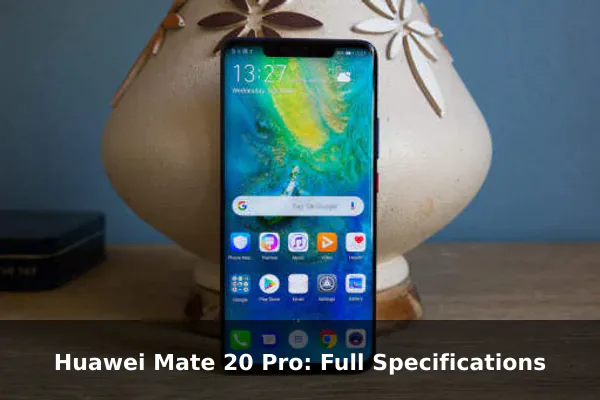
The Huawei Mate 20 Pro remains one of Huawei’s most technically ambitious flagship phones, combining a high-resolution OLED display, Kirin 980 performance, Leica-branded triple cameras, fast wired charging, wireless charging, and premium water-resistant construction.
This article focuses on what the Mate 20 Pro offers from a specs-first perspective, especially for readers comparing older flagship phones against newer mid-range options. The full specifications table is provided separately, so the sections below explain the practical value behind the headline hardware.
Full Specifications
Network
| Technology: | GSM / HSPA / LTE |
| 2G bands: | GSM 850 / 900 / 1800 / 1900 |
| 3G bands: | HSDPA 800 / 850 / 900 / 1700(AWS) / 1900 / 2100 |
| 4G bands: | 1, 2, 3, 4, 5, 6, 7, 8, 9, 12, 17, 18, 19, 20, 26, 28, 32, 34, 38, 39, 40 |
| Speed: | HSPA 42.2/5.76 Mbps, LTE Cat21 1400/200 Mbps |
Launch
| Announced: | 2018, October 16. Released 2018, October 31 |
| Status: | Discontinued |
Body
| Dimensions: | 157.8 x 72.3 x 8.6 mm (6.21 x 2.85 x 0.34 in) |
| Weight: | 189 g (6.67 oz) |
| Build: | Glass front (Gorilla Glass 5), glass back (Gorilla Glass 5), aluminum frame |
| SIM: | Nano-SIMNano-SIM + Nano-SIM |
| IP68 dust tight and water resistant (immersible up to 2m for 30 min) |
Display
| Type: | OLED, HDR10 |
| Size: | 6.39 inches, 100.2 cm2 (~87.9% screen-to-body ratio) |
| Resolution: | 1440 x 3120 pixels, 19.5:9 ratio (~538 ppi density) |
| Protection: | Corning Gorilla Glass 5 |
Platform
| OS: | Android 9.0 (Pie), EMUI 9.1 |
| Chipset: | Kirin 980 (7 nm) |
| CPU: | Octa-core (2×2.6 GHz Cortex-A76 & 2×1.92 GHz Cortex-A76 & 4×1.8 GHz Cortex-A55) |
| GPU: | Mali-G76 MP10 |
Memory
| Card slot: | Nano Memory (uses shared SIM slot) |
| Internal: | 128GB 6GB RAM, 128GB 8GB RAM, 256GB 8GB RAM |
| UFS 2.1 |
Main Camera
| Triple: | 40 MP, f/1.8, 27mm (wide), 1/1.7″, PDAF 8 MP, f/2.4, 80mm (telephoto), 1/4.0″, PDAF, OIS, 3x optical zoom 20 MP, f/2.2, 16mm (ultrawide), 1/2.7″, PDAF |
| Features: | Laser AF, Leica optics, dual-LED dual-tone flash, panorama, HDR |
| Video: | 4K@30fps, 1080p@60fps, 1080p@30fps (gyro-EIS), 720p@960fps |
Selfie camera
| Single: | 24 MP, f/2.0, 26mm (wide), 1/2.8″, 0.9µm |
| Features: | HDR |
| Video: | 1080p@30fps |
Sound
| Loudspeaker: | Yes, with stereo speakers |
| 3.5mm jack: | No |
| 32-bit/384kHz audio |
Comms
| WLAN: | Wi-Fi 802.11 a/b/g/n/ac, dual-band, DLNA, Wi-Fi Direct |
| Bluetooth: | 5.0, A2DP, aptX HD, LE |
| Positioning: | GPS (L1+L5), GLONASS (L1), BDS (B1), GALILEO (E1+E5a), QZSS (L1+L5) |
| NFC: | Yes |
| Infrared port: | Yes |
| Radio: | No |
| USB: | USB Type-C 3.1, OTG |
Features
| Sensors: | Face ID, fingerprint (under display, optical), accelerometer, gyro, proximity, barometer, compass |
Battery
| Type: | Li-Po 4200 mAh, non-removable |
| Charging: | 40W wired, 70% in 30 min 15W wireless 2.5W reverse wireless |
Misc
| Colors: | Emerald Green, Midnight Blue, Twilight, Pink Gold, Black |
| Models: | LYA-L09, LYA-L29, LYA-AL00, LYA-AL10, LYA-TL00, LYA-L0C |
| Price: | About 800 EUR |
Our Tests
| Performance: | AnTuTu: 273913 (v7), 391046 (v8) GeekBench: 9712 (v4.4) GFXBench: 17fps (ES 3.1 onscreen) |
| Display: | Contrast ratio: 254000:1 (nominal), 4.965 (sunlight) |
| Camera: | Photo / Video |
| Loudspeaker: | -28.9 LUFS (Average) |
| Audio quality: | Noise -87.7dB / Crosstalk -87.8dB |
| Battery (old): | Endurance rating 85h |
Price and Availability
The Huawei Mate 20 Pro offers a compelling combination of features and performance. While the base price is around €800, the actual cost may vary depending on your location and retailer. Below, you’ll find the approximate price of the Huawei Mate 20 Pro converted into various currencies. Please note that these are estimates based on recent exchange rates as of September 21, 2026 and may not reflect the exact price you’ll find at a retailer.
- United States: $918
- Japan: ¥144,220
- United Kingdom: £686
- Australia: A$1,290
- Canada: C$1,285
- Taiwan: NT$29,223
- Denmark: kr5.981
- Saudi Arabia: ﷼3,443
- South Korea: ₩1,272,303
- Germany: €800
- Brazil: R$4.720
- Vietnam: ₫23.845.461
- Kenya: KSh 119,680
- India: ₹87,996
- Indonesia: Rp 16.290.545
- Nigeria: ₦1,246,673
- Pakistan: ₨255,023
- Philippines: ₱57,671
- Bangladesh: ৳১,১২,৬৫০
Why Should You Buy the Huawei Mate 20 Pro?
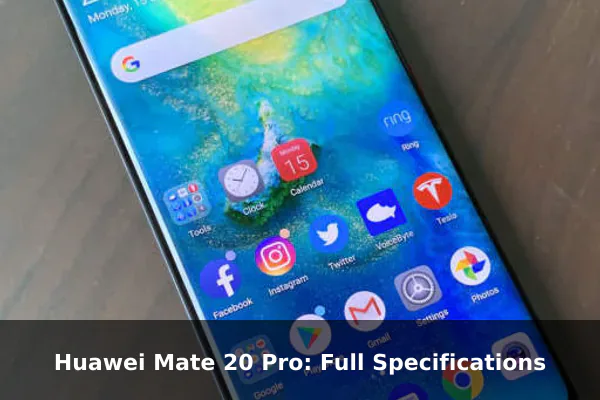
The Huawei Mate 20 Pro is worth considering if you want an older flagship with genuinely high-end hardware rather than a basic modern budget phone. Its strongest appeal is balance: it has a sharp OLED screen, a capable triple camera system, a premium glass-and-metal body, IP68 protection, stereo speakers, wireless charging, reverse wireless charging, and fast 40W wired charging.
Because it launched as a premium device, the Mate 20 Pro still carries features that many cheaper phones skip. The under-display fingerprint sensor, advanced positioning support, infrared port, USB Type-C 3.1, and 1440p-class display all help it feel more complete than a simple entry-level Android handset. The main trade-off is age. Buyers should think carefully about battery condition, software support, app compatibility, and whether they need 5G.
Design and Build Quality
The Mate 20 Pro uses a curved glass front and back with an aluminum frame, giving it the kind of polished flagship feel Huawei was known for in its Mate series. Gorilla Glass 5 protection is listed for both the front and back, and the 189 g weight keeps the phone substantial without making it unusually heavy for its size.
Its IP68 dust and water resistance rating is an important strength, especially for a device built around glass. The phone is rated for immersion up to 2 meters for 30 minutes under specified test conditions. That does not make it damage-proof, particularly after years of use, but it is still a valuable durability feature compared with phones that lack official water resistance.
Display Experience
The 6.39-inch OLED display is one of the Mate 20 Pro’s defining features. Its 1440 x 3120 pixel resolution gives it very high pixel density, making text, photos, maps, and video look crisp. HDR10 support also helps the panel fit its flagship positioning, especially for compatible video content.
The screen-to-body ratio is high for its generation, and the tall 19.5:9 aspect ratio makes the phone suitable for web browsing, reading, and split-screen use. Compared with many newer mid-range phones that use lower-resolution 1080p panels, the Mate 20 Pro’s display remains a key reason to consider it, provided the individual unit has no burn-in, discoloration, or touch issues.
Performance and Hardware
The Kirin 980 chipset was Huawei’s 7 nm flagship platform, paired here with an octa-core CPU and Mali-G76 MP10 graphics. In everyday use, that means the Mate 20 Pro was designed for demanding multitasking, high-end camera processing, and premium Android performance rather than basic smartphone duties.
Memory options include 128GB storage with 6GB or 8GB RAM, plus a 256GB version with 8GB RAM. Storage uses UFS 2.1, which is appropriate for its class and helps app loading and file handling feel quicker than phones with slower eMMC storage. Expansion is available through Huawei’s Nano Memory format using the shared SIM slot, but that format is less common than microSD, so it should not be treated as equally convenient.
Camera System
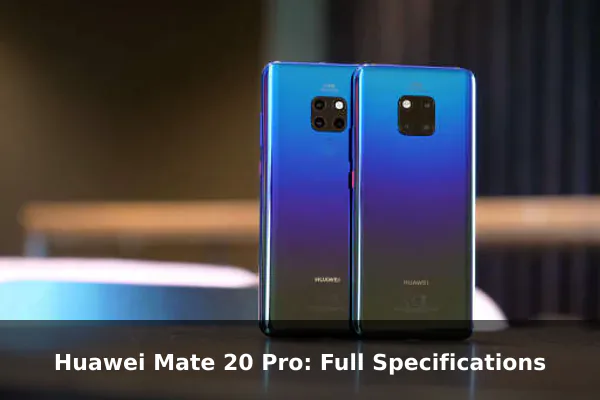
The rear camera setup is one of the Mate 20 Pro’s most distinctive areas. It combines a 40 MP wide camera, an 8 MP telephoto camera with 3x optical zoom and optical image stabilization, and a 20 MP ultrawide camera. That gives the phone a practical focal range for landscapes, portraits, architecture, travel, and closer framed subjects.
Huawei also included Laser AF, Leica optics branding, HDR, panorama, and a dual-LED dual-tone flash. Video recording reaches 4K at 30 fps, while 1080p recording supports 60 fps and gyro-assisted stabilization at 30 fps. The 720p 960 fps slow-motion mode is another flagship-era feature, though real-world quality depends heavily on lighting.
The 24 MP front camera is straightforward but useful for selfies and video calls, with HDR support and 1080p video recording. It is not a modern creator-focused selfie camera, but it fits the phone’s premium 2018 positioning well.
Battery and Charging
The 4200 mAh battery was large for a flagship of its launch period and is supported by Huawei’s 40W wired charging. The source data lists charging up to 70% in 30 minutes, which remains competitive for quick top-ups even by more recent standards.
The phone also supports 15W wireless charging and 2.5W reverse wireless charging. Reverse wireless charging is not meant to replace a real charger, but it can be useful for topping up small accessories or helping another phone in a pinch. For used units, battery health is the biggest unknown; the original endurance rating was strong, but real performance now depends on age, cycles, and replacement history.
Software and User Experience
The Mate 20 Pro shipped with Android 9.0 Pie and EMUI 9.1. That software base matters because the phone’s hardware is still capable, but its long-term experience depends on the updates available for the exact region and model variant. Buyers should check the current software version before relying on it for security-sensitive use.
EMUI on this generation focused heavily on battery controls, camera modes, gesture navigation, and Huawei ecosystem features. The interface may feel different from stock Android, but it also gives the phone a dense feature set. For users who prefer a clean Google Pixel-like interface, the Mate 20 Pro may feel more customized than expected.
Connectivity and Extras
The Mate 20 Pro supports GSM, HSPA, and LTE, with LTE Cat21 speeds listed up to 1400 Mbps downlink under ideal network conditions. It does not include 5G, so buyers who specifically want next-generation mobile network support should look elsewhere.
Its connectivity package is otherwise rich. Wi-Fi ac, Bluetooth 5.0 with aptX HD, NFC, infrared, USB Type-C 3.1, OTG, and multi-system satellite positioning are all included. The infrared port is especially useful for remote-control functions, while NFC helps with payments and pairing where supported. There is no 3.5mm headphone jack and no FM radio, so wired audio users will need USB-C or wireless options.
Who Should Buy This Phone?
The Huawei Mate 20 Pro makes the most sense for buyers who value flagship display quality, versatile cameras, premium materials, water resistance, and fast charging at a lower used-market cost. It is also interesting for Huawei fans who want one of the brand’s most complete pre-5G flagship designs.
It is less ideal for users who need guaranteed long-term software updates, 5G connectivity, a fresh battery, or simple microSD expansion. Anyone considering it today should prioritize a clean unit with good battery health, no display damage, and the right regional model for their network bands.
Conclusion
The Huawei Mate 20 Pro is an aging but still impressive flagship, with a sharp OLED display, strong triple cameras, premium durability, and excellent charging features. Buy it if the price is right and the unit is in good condition; skip it if current software support and 5G matter more.
References
- Huawei Consumer – HUAWEI Mate 20 Pro Specifications – Official manufacturer specifications for dimensions, display, chipset, memory, cameras, battery, network bands, sensors, GPS, and in-box contents.
- Huawei Global Support – HUAWEI Mate 20 Pro – Official support page for the device, useful for confirming product identity, manuals, downloads, and after-sales support context.
- Huawei – Mate 20 Series Launch Announcement – Official launch announcement with release context and key claimed features such as Kirin 980, battery, charging, GPS, and camera system.
- GSMArena – Huawei Mate 20 Pro Full Phone Specifications – Well-known mobile device specification database for cross-checking model variants, release date, network bands, hardware, camera, and battery details.
- PhoneArena – Huawei Mate 20 Pro Full Specifications – Established phone reference site useful for secondary verification of specifications, launch timing, dimensions, hardware, and camera details.
