
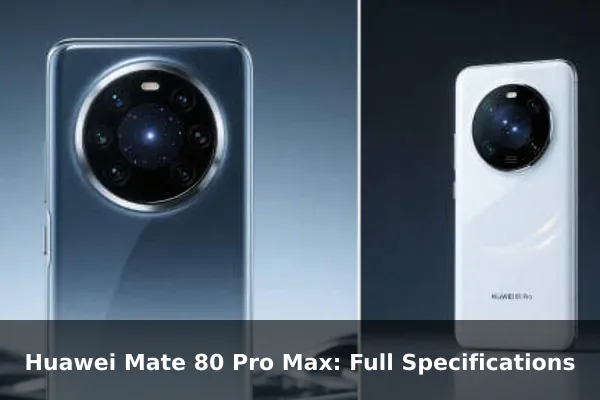
The Huawei Mate 80 Pro Max is a large-format flagship built around a high-end display, a multi-focal camera system, fast wired and wireless charging, and Huawei’s HarmonyOS ecosystem. It sits in the premium tier with a 6.9-inch LTPO OLED panel, Kirin 9030 Pro chipset, 16GB RAM configurations, and a 6000 mAh battery.
This article focuses on what the specifications mean in daily use rather than repeating the full spec sheet. The dedicated Full Specifications table can be used for exact bands, dimensions, camera details, and configuration data.
Full Specifications
Network
| Technology: | GSM / CDMA / HSPA / CDMA2000 / LTE / 5G |
| 2G bands: | GSM 850 / 900 / 1800 / 1900 |
| CDMA 800 | |
| 3G bands: | HSDPA 800 / 850 / 900 / 1700(AWS) / 1900 / 2100 |
| CDMA2000 1x | |
| 4G bands: | LTE |
| 5G bands: | SA/NSA |
| Speed: | HSPA, LTE, 5G |
Launch
| Announced: | 2025, November 25 |
| Status: | Available. Released 2025, November 25 |
Body
| Dimensions: | 164.4 x 79 x 8.3 mm (6.47 x 3.11 x 0.33 in) |
| Weight: | 239 g (8.43 oz) |
| Build: | Glass front, aluminum alloy frame, aluminum alloy back |
| SIM: | Nano-SIM + Nano-SIM |
| IP68/IP69 dust tight and water resistant (high pressure water jets; immersible up to 6m for 30 min) |
Display
| Type: | LTPO OLED, 1B colors, 120Hz, 1440Hz PWM, HDR Vivid, 8000 nits (peak) |
| Size: | 6.9 inches, 117.2 cm2 (~90.2% screen-to-body ratio) |
| Resolution: | 1320 x 2848 pixels, 19.5:9 ratio (~455 ppi density) |
| Protection: | Huawei Kunlun Glass 2 |
Platform
| OS: | HarmonyOS 6.0 |
| Chipset: | Kirin 9030 Pro (6 nm) |
| CPU: | 9-core (1×2.75 GHz & 4×2.27 GHz & 4×1.72 GHz) |
| GPU: | Maleoon 935 |
Memory
| Card slot: | No |
| Internal: | 512GB 16GB RAM, 1TB 16GB RAM |
Main Camera
| Quad: | 50 MP, f/1.4-f/4.0, 24mm (wide), PDAF, OIS 50 MP, f/2.1, 91mm (periscope telephoto), PDAF, OIS, 4x optical zoom 50 MP, f/3.2, 140mm (periscope telephoto), PDAF, OIS, 6.2x optical zoom 40 MP, f/2.2, 13mm, 120˚ (ultrawide), PDAF |
| Features: | Laser AF, color spectrum sensor, LED flash, panorama, HDR |
| Video: | 4K, 1080p@960fps, HDR, gyro-EIS, OIS, HDR Vivid |
Selfie camera
| Single: | 13 MP, f/2.0, 18mm (ultrawide), AF TOF 3D, (depth/biometrics sensor) |
| Features: | HDR, panorama |
| Video: | 4K, 1080p, HDR, gyro-EIS |
Sound
| Loudspeaker: | Yes, with stereo speakers |
| 3.5mm jack: | No |
| High-definition audio |
Comms
| WLAN: | Wi-Fi 802.11 a/b/g/n/ac/6/7, dual-band, Wi-Fi Direct |
| Bluetooth: | 6.0, A2DP, LE, L2HC |
| Positioning: | GPS (L1+L5), GLONASS (L1), BDS (B1I+B1c+B2a+B2b), GALILEO (E1+E5a+E5b), QZSS (L1+L5), NavIC |
| NFC: | Yes |
| Infrared port: | Yes |
| Radio: | No |
| USB: | USB Type-C 3.1, OTG, DisplayPort 1.2 |
Features
| Sensors: | Face ID, fingerprint (side-mounted), accelerometer, gyro, proximity, barometer, compass |
| BDS Satellite Calling and Messaging – China only |
Battery
| Type: | 6000 mAh |
| Charging: | 100W wired 80W wireless 20W reverse wireless 18W reverse wired |
Misc
| Colors: | Black, Silver, Blue, Gold |
| Models: | SGT-AL10 |
| Price: | About 980 EUR |
Price and Availability
The Huawei Mate 80 Pro Max offers a compelling combination of features and performance. While the base price is around €980, the actual cost may vary depending on your location and retailer. Below, you’ll find the approximate price of the Huawei Mate 80 Pro Max converted into various currencies. Please note that these are estimates based on recent exchange rates as of October 12, 2026 and may not reflect the exact price you’ll find at a retailer.
- United States: $1,095
- Japan: ¥173,552
- United Kingdom: £828
- Australia: A$1,572
- Canada: C$1,563
- Taiwan: NT$34,971
- Denmark: kr7.325
- Saudi Arabia: ﷼4,105
- South Korea: ₩1,461,937
- Germany: €980
- Brazil: R$5.471
- Vietnam: ₫28.366.668
- Kenya: KSh 142,252
- India: ₹1,04,799
- Indonesia: Rp 19.606.149
- Nigeria: ₦1,458,909
- Pakistan: ₨303,169
- Philippines: ₱68,722
- Bangladesh: ৳১,৩৪,৮৮৮
Value Position
The Mate 80 Pro Max is clearly positioned as a feature-heavy flagship rather than a simple performance phone. Its value depends on whether you will use the parts that make it unusual: the dual periscope telephoto setup, the very bright LTPO OLED display, high-capacity battery, satellite communication support in China, and Huawei’s broader device ecosystem. For buyers comparing it against other ultra-premium phones, the strongest appeal is not one single headline spec but the way Huawei combines display, imaging, durability, charging, and storage into one large device.
The source pricing places it in premium territory, so expectations should be high. It is best judged against other camera-focused flagships, especially models that offer long-range optical zoom, fast wireless charging, and rugged water resistance. Buyers outside China should also pay close attention to regional software, warranty, and network compatibility before treating the listed price as a final buying guide.
Design And Durability
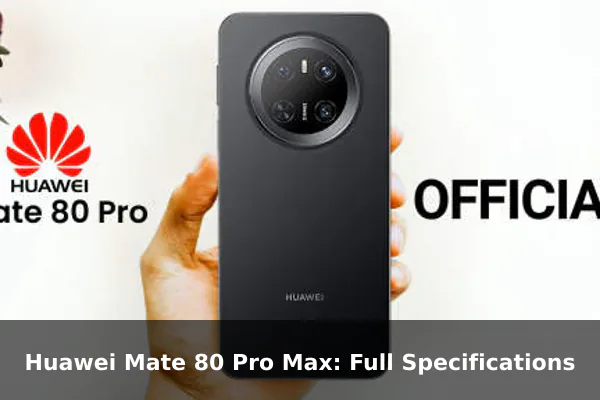
The phone is physically large and substantial, measuring 164.4 x 79 x 8.3 mm and weighing 239 g. That makes it better suited to users who prefer a big screen and a serious camera system over compact one-handed handling. The glass front, aluminum alloy frame, and aluminum alloy back give it a premium construction profile, while the available Black, Silver, Blue, and Gold colors keep the design choices fairly classic.
Durability is one of the more notable parts of the package. The IP68/IP69 rating means the Mate 80 Pro Max is listed as dust tight, resistant to high-pressure water jets, and rated for immersion up to 6 meters for 30 minutes. That does not make it invincible, but it does give the phone stronger environmental protection than many ordinary premium handsets. Huawei Kunlun Glass 2 adds another practical layer for users who keep a phone for several years.
Display Experience
The 6.9-inch LTPO OLED display is one of the phone’s core attractions. It supports 1 billion colors, a 120Hz refresh rate, HDR Vivid, 1440Hz PWM dimming, and a listed 8000-nit peak brightness. In real use, the combination points to a screen built for outdoor readability, smooth scrolling, and premium video playback. The 1320 x 2848 resolution gives roughly 455 ppi density, so text and interface elements should look crisp on the large panel.
The screen-to-body ratio of about 90.2 percent also reinforces the immersive character of the device. This is the kind of phone that makes sense for maps, camera previews, reading, video, multitasking, and editing photos on the move. Users who dislike large phones may find the size demanding, but display-first buyers will likely see the panel as one of the strongest reasons to consider it.
Performance And Storage
The Mate 80 Pro Max runs HarmonyOS 6.0 on the Kirin 9030 Pro chipset, paired with a 9-core CPU and Maleoon 935 GPU. The listed CPU arrangement combines one higher-clocked core, four mid cores, and four efficiency cores, which suggests a flagship-class platform tuned for a mix of demanding apps and everyday power management. Since real-world performance varies by software optimization, thermals, and app support, benchmarks are only part of the story here.
Storage options are straightforward and premium: 512GB with 16GB RAM or 1TB with 16GB RAM. There is no card slot, so buyers should choose storage carefully at purchase. The absence of expandable storage matters less at these capacities, but heavy 4K video shooters, travelers, and offline media users may still prefer the 1TB version for long-term comfort.
Camera System
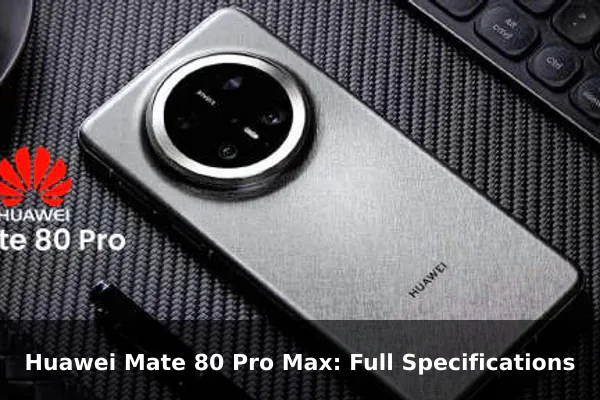
The camera hardware is the most distinctive part of the Mate 80 Pro Max. The rear system includes a 50MP variable-aperture wide camera with OIS, a 50MP periscope telephoto camera with 4x optical zoom, a second 50MP periscope telephoto camera with 6.2x optical zoom, and a 40MP ultrawide camera with autofocus. This gives the phone a wide focal range without relying only on digital zoom.
The dual-periscope approach is especially useful for people who shoot portraits, travel scenes, architecture, concerts, distant subjects, or compressed-perspective street photos. Laser autofocus, a color spectrum sensor, HDR, panorama, and LED flash round out the still-photo tools. Video support includes 4K recording, 1080p at up to 960fps, HDR, gyro-EIS, OIS, and HDR Vivid, so the camera package is aimed at users who want both still-image flexibility and capable video capture.
Selfie And Biometrics
On the front, the Mate 80 Pro Max uses a 13MP ultrawide selfie camera with autofocus and a TOF 3D depth and biometrics sensor. The ultrawide field of view should help with group selfies, video calls, and handheld vlogging, while autofocus is a welcome detail for keeping faces sharper at different distances. Front video reaches 4K and 1080p with HDR and gyro-EIS.
The biometric setup includes Face ID and a side-mounted fingerprint sensor. That dual approach is practical because face unlock can be convenient when the phone is on a desk, while the fingerprint sensor remains useful in situations where face recognition is less convenient.
Battery And Charging
The 6000 mAh battery is generous for a flagship phone and should appeal to heavy users. Large batteries are especially helpful in phones with big high-refresh displays, complex camera systems, 5G connectivity, and bright outdoor operation. Actual endurance will depend on network conditions, brightness, camera use, and HarmonyOS power tuning, but the capacity gives the Mate 80 Pro Max a strong foundation.
Charging is also a major strength. The phone supports 100W wired charging, 80W wireless charging, 20W reverse wireless charging, and 18W reverse wired charging. That means it can be used not only as a fast-charging daily driver but also as a backup power source for accessories or another device in a pinch.
Connectivity And Ecosystem
The connectivity list is broad: GSM, CDMA, HSPA, CDMA2000, LTE, and 5G with SA/NSA support are listed, alongside Wi-Fi 7, Bluetooth 6.0, NFC, infrared, USB Type-C 3.1, OTG, and DisplayPort 1.2. The positioning system support is also extensive, covering GPS, GLONASS, BDS, GALILEO, QZSS, and NavIC bands. For a premium phone, that kind of connectivity depth is important because it affects travel, navigation, accessory support, and external-display use.
One notable regional feature is BDS Satellite Calling and Messaging, listed for China only. That limitation matters: international buyers should not assume satellite features will work globally. The same caution applies to software services, carrier support, and retail warranty terms, which may vary by market and seller.
Who Should Buy It
The Huawei Mate 80 Pro Max is best for users who want a large flagship with serious camera reach, a bright premium display, long battery capacity, and fast wired and wireless charging. It makes the most sense for photographers, frequent travelers, Huawei ecosystem users, and buyers who prioritize hardware richness over compact size.
It is less ideal for users who want a lightweight phone, microSD expansion, a 3.5mm headphone jack, or a compact Android experience. It is also a phone that international buyers should research carefully before importing, especially around app availability, warranty, network bands, and China-only satellite functions.
Conclusion
The Huawei Mate 80 Pro Max is a premium, camera-first flagship with a huge LTPO OLED screen, dual periscope zoom cameras, strong durability ratings, a 6000 mAh battery, and very fast charging. Choose it if you want Huawei’s most ambitious large phone experience and are comfortable with its size and ecosystem considerations.
References
- HUAWEI Mate 80 Pro Max Specifications – Huawei China – Primary source for the phone's official dimensions, display, chipset, memory, cameras, battery, charging, connectivity, durability, and footnotes.
- HUAWEI Mate 80 Pro Max Product Page – Huawei China – Official product page for feature claims, design details, colors, and Huawei marketing descriptions that complement the specs table.
- HUAWEI Mate 80 Pro Max Support – Huawei China – Official support page useful for verifying model support, service context, manuals, and post-launch product information.
- HUAWEI Mate 80 Pro Max – Huawei Mall / VMALL – Official Huawei retail listing for available configurations, colors, pricing, and purchase-related notes in China.
- Huawei Mate 80 Pro Max – GSMArena – Established phone-spec reference useful as an English-language cross-check for launch status and consolidated specifications.
