
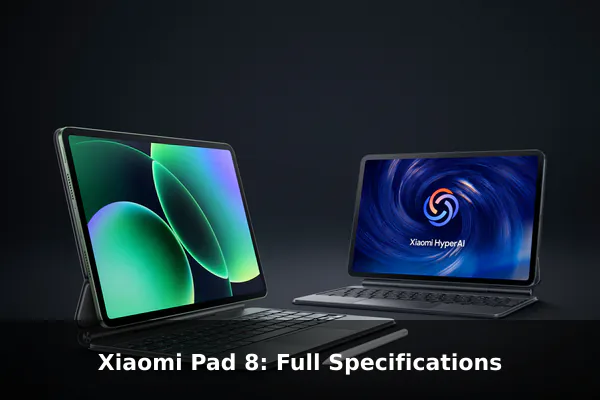
The Xiaomi Pad 8 arrives as a Wi-Fi-only Android tablet aimed at buyers who want a large, high-refresh screen and flagship-class silicon without paying flagship money. Announced on 25 September 2025 and listed as available from the same day, it pairs an 11.2-inch IPS LCD panel with the Qualcomm Snapdragon 8s Gen 4 platform, a roomy 9200 mAh battery, and quad stereo speakers tuned with Dolby Atmos. With an indicative price of about 260 EUR, it positions itself squarely as a value-focused media and productivity slate.
This article breaks down what the Xiaomi Pad 8 offers across design, display, performance, cameras, battery, connectivity, and software, and explains who it suits best. Specifications here are based on the listed source data; for the latest confirmed details and regional availability, always cross-check Xiaomi’s official channels before buying.
Full Specifications
Network
| Technology | No cellular connectivity |
| 2G bands | N/A |
| 3G bands | N/A |
| GPRS | N/A |
| EDGE | N/A |
Launch
| Announced | 2025, September 25 |
| Status | Available. Released 2025, September 25 |
Body
| Dimensions | 251.2 x 173.4 x 5.8 mm (9.89 x 6.83 x 0.23 in) |
| Weight | 485 g or 494 g (1.07 lb) |
| Build | Glass front, aluminum frame, aluminum back |
| SIM | No |
| Stylus support (magnetic) |
Display
| Type | IPS LCD, 68B colors, 144Hz, HDR10, Dolby Vision, HDR Vivid, 800 nits (peak) |
| Size | 11.2 inches, 373.7 cm2 (~85.8% screen-to-body ratio) |
| Resolution | 2136 x 3200 pixels, 3:2 ratio (~344 ppi density) |
Platform
| OS | Android 16, HyperOS 3 |
| Chipset | Qualcomm SM8735 Snapdragon 8s Gen 4 (4 nm) |
| CPU | Octa-core (1×3.21 GHz Cortex-X4 & 3×3.0 GHz Cortex-A720 & 2×2.8 GHz Cortex-A720 & 2×2.0 GHz Cortex-A720) |
| GPU | Adreno 825 |
Memory
| Card slot | No |
| Internal | 128GB 8GB RAM, 256GB 8GB RAM, 256GB 12GB RAM |
| UFS 3.1 – 128GB only UFS 4.1 |
Main Camera
| Single | 13 MP, f/2.2, (wide), 1/3.06", 1.12µm, PDAF |
| Features | LED flash, HDR |
| Video | 4K@30fps, 1080p@30/60fps |
Selfie camera
| Single | 8 MP, f/2.3, (wide), 1/4.0", 1.12µm |
| Features | HDR |
| Video | 1080p@30fps |
Sound
| Loudspeaker | Yes, with stereo speakers, Dolby Atmos (4 speakers) |
| 3.5mm jack | No |
| 24-bit/192kHz Hi-Res & Hi-Res Wireless audio |
Comms
| WLAN | Wi-Fi 802.11 a/b/g/n/ac/6/7, dual-band, Wi-Fi Direct |
| Bluetooth | 5.4, LHDC 5 |
| Positioning | No |
| NFC | No |
| Infrared port | Yes |
| Radio | No |
| USB | USB Type-C 3.2, accessory connector |
Features
| Sensors | Accelerometer, gyro, proximity, compass |
Battery
| Type | 9200 mAh |
| Charging | 45W wired, PD3.0, QC3+ 22.5 reverse wireless charging |
Misc
| Colors | Black, Blue, Green |
| Models | 25091RP04G |
| SAR EU | 0.99 W/kg (body) |
| Price | About 260 EUR |
Price and Availability
The Xiaomi Pad 8 offers a compelling combination of features and performance. While the base price is around €260, the actual cost may vary depending on your location and retailer. Below, you’ll find the approximate price of the Xiaomi Pad 8 converted into various currencies. Please note that these are estimates based on recent exchange rates as of June 9, 2026 and may not reflect the exact price you’ll find at a retailer.
- United States: $300
- Japan: ¥48,026
- United Kingdom: £225
- Australia: A$425
- Canada: C$418
- Taiwan: NT$9,469
- Denmark: kr1.940
- Saudi Arabia: ﷼1,124
- South Korea: ₩458,226
- Germany: €260
- Brazil: R$1.549
- Vietnam: ₫7.864.697
- Kenya: KSh 38,810
- India: ₹28,692
- Indonesia: Rp 5.441.019
- Nigeria: ₦405,200
- Pakistan: ₨83,410
- Philippines: ₱18,493
- Bangladesh: ৳৩৬,৮১০
Is the Xiaomi Pad 8 Good Value?
At roughly 260 EUR, the Xiaomi Pad 8 undercuts many flagship tablets while still delivering a recent chipset, a 144Hz display, and a large battery. The trade-offs are deliberate and sensible for the price: it skips cellular connectivity, has no microSD card slot, and uses an IPS LCD panel rather than OLED. For buyers who mainly stream video, browse, take notes, and run everyday apps, that bundle of compromises is easy to accept in exchange for the strong core hardware.
Design and Build Quality
Measuring 251.2 x 173.4 x 5.8 mm and weighing 485 g or 494 g depending on configuration, the Pad 8 keeps a slim 5.8 mm profile that helps it feel manageable despite its size. The build combines a glass front with an aluminum frame and aluminum back, giving it a more premium feel than plastic rivals. It also supports a magnetic stylus, which makes it a candidate for note-taking and light sketching, though accessories are typically sold separately. There is no SIM tray, underscoring its Wi-Fi-only nature.
Display: Big, Bright, and Smooth
The 11.2-inch IPS LCD has a sharp 2136 x 3200 resolution in a productivity-friendly 3:2 aspect ratio, with about 344 ppi density and an 85.8% screen-to-body ratio. A 144Hz refresh rate keeps scrolling and animations fluid, while HDR10, Dolby Vision, and HDR Vivid support broaden compatibility with streaming content. Peak brightness is listed at 800 nits, which is comfortable indoors and usable outdoors in shade. The 3:2 ratio is well suited to documents, web pages, and split-screen multitasking, even if it is less cinematic than a 16:10 panel.
Performance and Software
Powering the tablet is the Qualcomm SM8735 Snapdragon 8s Gen 4 built on a 4 nm process, paired with an Adreno 825 GPU. Its octa-core CPU tops out at 3.21 GHz on a Cortex-X4 prime core, backed by multiple Cortex-A720 cores. Memory options run from 128GB with 8GB RAM up to 256GB with 12GB RAM, with the base model using UFS 3.1 storage and higher tiers moving to faster UFS 4.1. It ships with Android 16 under HyperOS 3, Xiaomi’s latest interface layer, which adds multitasking and productivity features suited to a larger screen.
Cameras for Everyday Use
Cameras are not the headline feature here, and that fits the device class. The rear setup is a single 13 MP f/2.2 wide sensor with PDAF and an LED flash, capable of 4K at 30fps and 1080p at 30 or 60fps. On the front, an 8 MP f/2.3 wide camera handles video calls and selfies, recording 1080p at 30fps. Both support HDR. For document scanning, occasional snapshots, and conferencing, the hardware is adequate, though it is not a substitute for a dedicated phone camera.
Battery and Charging
A large 9200 mAh battery anchors the Pad 8 and should comfortably handle long streaming sessions and a full day of mixed use. Charging is rated at 45W wired with PD3.0 and QC3+ support, and the tablet can also act as a power bank through 22.5W reverse wireless charging. While 45W is modest next to the fastest phone chargers, it is reasonable for a battery this size in a tablet.
Connectivity and Audio
Wireless connectivity is well covered with Wi-Fi 7 (alongside legacy 802.11 a/b/g/n/ac/6), dual-band support, and Wi-Fi Direct, plus Bluetooth 5.4 with LHDC 5 for higher-quality wireless audio. There is also an infrared port and a USB Type-C 3.2 connection with an accessory connector for keyboards and docks. Notably, the Pad 8 has no GPS positioning, no NFC, and no FM radio, which are common omissions on Wi-Fi tablets. Audio is a strong point: four stereo speakers with Dolby Atmos, plus 24-bit/192kHz Hi-Res and Hi-Res Wireless certification, though there is no 3.5mm headphone jack.
Who Should Buy the Xiaomi Pad 8?
The Pad 8 is a natural fit for students, home users, and media fans who want a big, fast screen and long battery life at a mid-range price. The stylus support and 3:2 display make it appealing for note-taking and reading, while the quad speakers suit movie and music playback. Buyers who need mobile data on the go, satellite navigation, NFC payments, or expandable storage should weigh those missing features carefully before committing.
Conclusion
The Xiaomi Pad 8 delivers a compelling value package: a sharp 11.2-inch 144Hz display, the capable Snapdragon 8s Gen 4, a generous 9200 mAh battery, and standout quad-speaker audio, all for around 260 EUR. Its main limitations are the lack of cellular, GPS, NFC, and a card slot, plus an LCD rather than OLED panel. If you want an affordable, well-built Wi-Fi tablet for streaming, browsing, study, and light creative work, the Pad 8 is an easy recommendation; if you need on-the-go data or navigation, look to a cellular alternative. As always, confirm final specifications and pricing on Xiaomi’s official website before purchasing.
Official references
- Xiaomi Official Global Website (mi.com) – Primary manufacturer source for confirmed Xiaomi Pad 8 launch status, specifications, product images, software features, and regional availability.
- China Ministry of Industry and Information Technology / TENAA (tenaa.com.cn) – Chinese regulatory filings can verify device model numbers, network capabilities, dimensions, battery rating, and certification status.
- China Compulsory Certification / CQC (cqc.com.cn) – Official certification records can help verify charger, battery, and electrical safety certification details for China-market Xiaomi devices.
- Bluetooth SIG Launch Studio (bluetooth.com) – Bluetooth qualification listings can verify Bluetooth version, product identifiers, and certified wireless profiles.
- Wi-Fi Alliance Product Finder (wi-fi.org) – Wi-Fi certifications can confirm supported Wi-Fi standards and certified product names or model numbers.
