
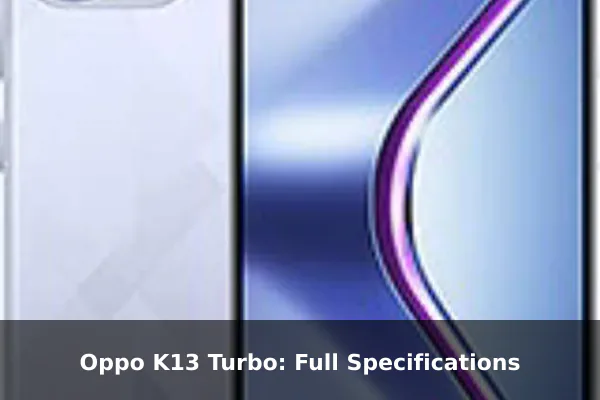
The Oppo K13 Turbo is a performance-focused 5G smartphone built around a large 6.8-inch AMOLED display, a MediaTek Dimensity 8450 chipset, and a notably large 7000 mAh battery. It sits in an interesting position for buyers who want gaming-friendly hardware and long endurance without moving into a flagship price band.
This article focuses on the Oppo K13 Turbo as the non-Pro model, using the supplied PLM110 source data and official OPPO and MediaTek reference anchors for context. The full specifications table will be added separately, so the sections below explain what the hardware means in daily use and who this phone is best suited for.
Full Specifications
Network
| Technology: | GSM / CDMA / HSPA / LTE / 5G |
| 2G bands: | GSM 850 / 900 / 1800 / 1900 |
| CDMA 800 | |
| 3G bands: | HSDPA 850 / 1700 / 2100 |
| 4G bands: | 1, 3, 5, 6, 8, 19, 28, 34, 38, 39, 40, 41, 42, 48 |
| 5G bands: | 1, 3, 5, 8, 28, 38, 40, 41, 48, 77, 78 SA/NSA |
| Speed: | HSPA, LTE, 5G |
Launch
| Announced: | 2025, July 21 |
| Status: | Available. Released 2025, July 25 |
Body
| Dimensions: | 162.8 x 77.2 x 7.3 mm (6.41 x 3.04 x 0.29 in) |
| Weight: | 207 g (7.30 oz) |
| SIM: | Nano-SIM + Nano-SIM |
| Built-in cooling fan IP68/IP69 dust tight and water resistant (high pressure water jets; immersible up to 2m for 30 min) |
Display
| Type: | AMOLED, 1B colors, 120Hz, 1600 nits (peak) |
| Size: | 6.8 inches, 112.8 cm2 (~89.8% screen-to-body ratio) |
| Resolution: | 1280 x 2800 pixels, 19.5:9 ratio (~453 ppi density) |
Platform
| OS: | Android 15, ColorOS 15 |
| Chipset: | Mediatek Dimensity 8450 (4 nm) |
| CPU: | Octa-core (1×3.25 GHz Cortex-A725 & 3×3.0 GHz Cortex-A725 & 4×2.1 GHz Cortex-A725) |
| GPU: | Mali-G720 MC7 |
Memory
| Card slot: | No |
| Internal: | 256GB 12GB RAM, 256GB 16GB RAM, 512GB 12GB RAM |
| UFS 3.1 |
Main Camera
| Dual: | 50 MP, f/1.8, 27mm (wide), PDAF 2 MP |
| Features: | LED flash, HDR, panorama |
| Video: | 4K@30/60fps, 1080p@30fps |
Selfie camera
| Single: | 16 MP, f/2.4, 22mm (wide) |
| Features: | 1080p@30fps |
| Video: | Yes |
Sound
| Loudspeaker: | Yes, with stereo speakers |
| 3.5mm jack: | No |
Comms
| WLAN: | Wi-Fi 802.11 a/b/g/n/ac/6, dual-band |
| Bluetooth: | 5.4, A2DP, LE, aptX HD, LHDC 5 |
| Positioning: | GPS, GLONASS, GALILEO, BDS, QZSS |
| NFC: | Yes |
| Infrared port: | Yes |
| Radio: | No |
| USB: | USB Type-C 2.0, OTG |
Features
| Sensors: | Fingerprint (under display, optical), accelerometer, gyro, proximity, compass |
Battery
| Type: | 7000 mAh |
| Charging: | 80W wired, 13.5W PD, 44W UFCS, 33W PPS Reverse wired |
Misc
| Colors: | Purple Phantom, Midnight Maverick, White Knight |
| Models: | PLM110 |
| Price: | About 220 EUR |
Price and Availability
The Oppo K13 Turbo offers a compelling combination of features and performance. While the base price is around €220, the actual cost may vary depending on your location and retailer. Below, you’ll find the approximate price of the Oppo K13 Turbo converted into various currencies. Please note that these are estimates based on recent exchange rates as of August 11, 2026 and may not reflect the exact price you’ll find at a retailer.
- United States: $254
- Japan: ¥40,440
- United Kingdom: £188
- Australia: A$360
- Canada: C$354
- Taiwan: NT$8,186
- Denmark: kr1.642
- Saudi Arabia: ﷼952
- South Korea: ₩359,011
- Germany: €220
- Brazil: R$1.300
- Vietnam: ₫6.597.850
- Kenya: KSh 32,846
- India: ₹24,231
- Indonesia: Rp 4.529.628
- Nigeria: ₦345,350
- Pakistan: ₨70,530
- Philippines: ₱15,544
- Bangladesh: ৳৩১,৩৬৯
Value Positioning
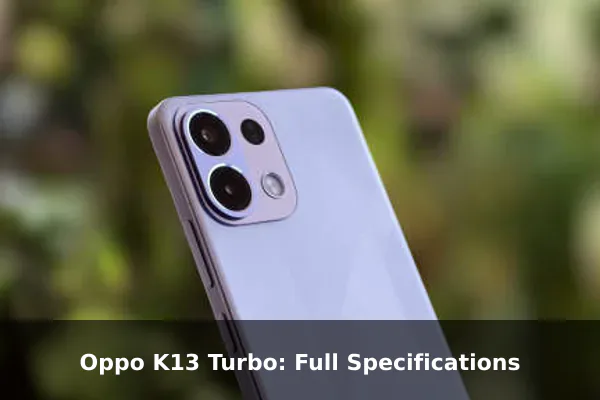
The Oppo K13 Turbo is shaped around a simple value promise: give buyers a fast display, modern 5G silicon, a very large battery, and a built-in cooling fan at a price level that is listed from about 220 EUR in the source data. That makes it more interesting as a performance-per-price phone than as a camera-first or ultra-slim lifestyle model.
Its main appeal is the balance between the MediaTek Dimensity 8450 platform, UFS 3.1 storage, high RAM options, and 80W wired charging. Buyers comparing it with regular mid-range phones should pay attention to those practical strengths rather than expecting every flagship convenience.
Design and Durability
At 162.8 x 77.2 x 7.3 mm, the Oppo K13 Turbo is slim for a phone with a 7000 mAh battery, although the 207 g weight makes it feel more substantial in the hand. The large display and wide body suggest it is better suited to two-handed use, gaming, video playback, and reading than compact one-handed operation.
The standout design detail is the built-in cooling fan, which is unusual in this class and directly supports the phone’s performance identity. The listed IP68/IP69 rating is also notable, with dust-tight protection, resistance to high-pressure water jets, and immersion up to 2 meters for 30 minutes. As always, water resistance should be treated as protection against accidents rather than an invitation for routine water exposure.
Display Experience
The 6.8-inch AMOLED panel is one of the strongest parts of the Oppo K13 Turbo package. It supports 1 billion colors, a 120Hz refresh rate, and a 1280 x 2800 resolution, giving it a sharp density of about 453 ppi. For gaming, scrolling, streaming, and social apps, those numbers point to a screen that should feel crisp and fluid.
The listed 1600 nits peak brightness is helpful for outdoor visibility, though peak brightness figures usually apply only in specific conditions. The nearly 89.8 percent screen-to-body ratio also helps the phone feel immersive, especially for media and landscape gaming.
Performance and Cooling
The Dimensity 8450 is a 4 nm chipset with an all-Cortex-A725 octa-core CPU layout, led by one core at 3.25 GHz, three cores at 3.0 GHz, and four cores at 2.1 GHz. Combined with the Mali-G720 MC7 GPU, the hardware is clearly aimed at sustained mid-to-upper-range Android performance.
The cooling fan is the feature that gives the K13 Turbo its own identity. In phones, raw benchmark power is only part of the story; heat control matters when gaming, recording video, or using 5G data for long periods. The fan does not automatically make it a flagship gaming phone, but it should help the device hold performance more consistently than many passive-cooled mid-range models.
Memory and Storage
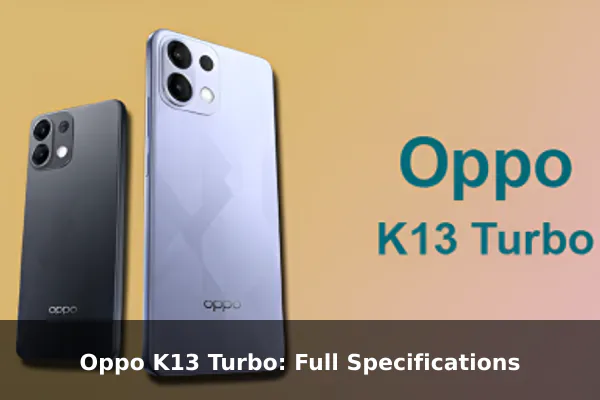
The source data lists three configurations: 256GB with 12GB RAM, 256GB with 16GB RAM, and 512GB with 12GB RAM. All use UFS 3.1 storage, which is a welcome detail because faster storage improves app loading, large file handling, and general responsiveness.
There is no memory card slot, so the storage choice matters at purchase. Users who record lots of 4K video, install large games, or keep offline media should consider the 512GB version if available in their market.
Camera Setup
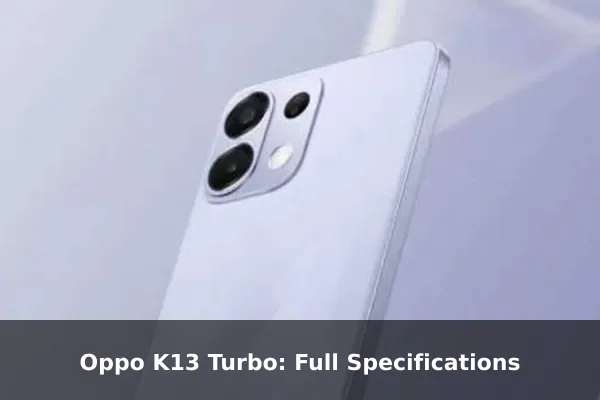
The rear camera system is functional rather than elaborate. It combines a 50 MP wide camera with PDAF and a secondary 2 MP camera, with LED flash, HDR, panorama, and video recording up to 4K at 30 or 60 fps. The main 50 MP sensor is the camera that matters most here; the 2 MP unit should be viewed as supporting hardware rather than a major creative tool.
For selfies, the phone uses a 16 MP front camera with 1080p video support. This should be adequate for video calls, social clips, and everyday portraits, but camera enthusiasts may want a phone with stronger ultrawide, telephoto, or advanced selfie hardware.
Battery and Charging
The 7000 mAh battery is one of the biggest reasons to consider the Oppo K13 Turbo. It gives the phone a clear endurance advantage on paper, especially for users who stream, game, navigate, or use mobile data heavily during the day.
Charging support is also broad: 80W wired charging, 13.5W PD, 44W UFCS, 33W PPS, and reverse wired charging are listed in the source data. The combination of a huge battery and fast wired charging makes the phone well suited to users who dislike battery anxiety but still want quick top-ups.
Software and Everyday Features
The phone ships with Android 15 and ColorOS 15, giving it a current software base for 2025. ColorOS typically emphasizes customization, multitasking tools, and OPPO ecosystem features, though long-term update availability can vary by region and model.
Everyday hardware features include an under-display optical fingerprint sensor, accelerometer, gyroscope, proximity sensor, and compass. Stereo speakers are included, but there is no 3.5 mm headphone jack, so wired audio users will need USB-C audio or wireless headphones.
Connectivity
The Oppo K13 Turbo supports GSM, CDMA, HSPA, LTE, and 5G, with SA and NSA 5G bands listed. Its band support includes common sub-6GHz 5G bands such as n1, n3, n5, n8, n28, n41, n77, and n78, although buyers should still confirm local carrier compatibility before importing the PLM110 model.
Wireless features are strong for the class, with Wi-Fi 6, Bluetooth 5.4, NFC, infrared, multi-system positioning, and USB Type-C with OTG. The USB port is listed as USB 2.0, so wired transfer speeds are not a premium feature.
Who Should Buy the Oppo K13 Turbo?
The Oppo K13 Turbo is best for buyers who want a big-screen Android phone with long battery life, 5G, fast charging, and stronger sustained performance than a typical budget mid-ranger. It makes particular sense for mobile gamers, heavy video watchers, commuters, and users who care more about endurance than pocketable size.
It is less ideal for users who want a compact phone, expandable storage, a headphone jack, or a versatile multi-camera system with ultrawide and telephoto options. Compared with the existing K13 Turbo Pro coverage, this model deserves attention as the more value-focused Turbo option rather than a duplicate of the Pro story.
Conclusion
The Oppo K13 Turbo stands out through its 120Hz AMOLED display, Dimensity 8450 chipset, built-in cooling fan, IP68/IP69 protection, and 7000 mAh battery. Its camera setup is modest, and storage is not expandable, but the core package is strong for users who prioritize performance, endurance, and 5G value. Recommended for buyers who want a durable, battery-heavy Android phone with gaming-friendly cooling at a sensible price.
References
- OPPO India – OPPO K13 Turbo Specifications – Primary English manufacturer spec sheet for the OPPO K13 Turbo 5G, including model number CPH2761, dimensions, display, cameras, chipset, battery, charging, bands, SAR, OS, and in-box contents.
- OPPO India – OPPO K13 Turbo Product Page – Official product page for feature claims such as built-in cooling fan, IP ratings, display highlights, battery claims, and OPPO disclaimers.
- OPPO China – OPPO K13 Turbo Specifications – Primary manufacturer spec sheet for the China variant, useful for checking PLM110 configuration differences such as RAM/storage options, network bands, NFC, and regional naming.
- OPPO India Newsroom – K13 Turbo Series Press Release – Official launch/context source for the K13 Turbo series, especially cooling system details and positioning for gaming performance.
- MediaTek – Dimensity 8450 – Official chipset reference for verifying Dimensity 8450 CPU, GPU, connectivity, camera/video support, memory, and wireless capabilities mentioned in the phone specs.
