
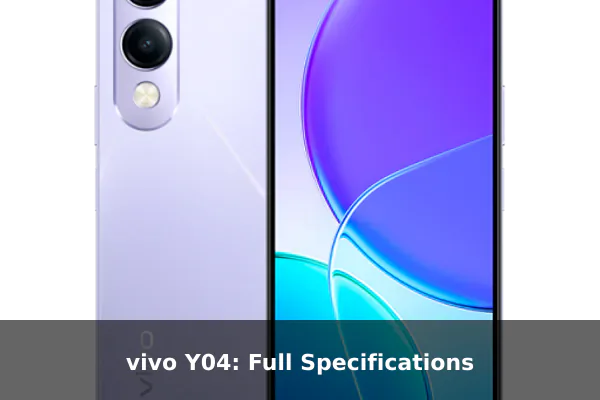
The vivo Y04 is an entry-level 4G smartphone built around a large display, a big battery, expandable storage, and practical everyday features. It is positioned for buyers who want a simple Android phone without paying for 5G, high-end cameras, or premium materials.
Based on the supplied source data and official reference anchors, the Y04 stands out most for its 5500 mAh battery, 90Hz IPS LCD, stereo speakers, IP64 rating, and dedicated microSD slot. This article focuses on how those specifications translate into real buying value.
Full Specifications
Network
| Technology: | GSM / HSPA / LTE |
| 2G bands: | GSM 850 / 900 / 1800 / 1900 |
| 3G bands: | HSDPA 850 / 900 / 2100 |
| 4G bands: | 1, 3, 5, 7, 8, 20, 28, 38, 40, 41 – International |
| 1, 3, 5, 8, 38, 40, 41 – India | |
| Speed: | HSPA, LTE |
Launch
| Announced: | 2025, February 26 |
| Status: | Available. Released 2025, March 11 |
Body
| Dimensions: | 167.3 x 77 x 8.2 mm (6.59 x 3.03 x 0.32 in) |
| Weight: | 199 g (7.02 oz) |
| Build: | Glass front, plastic frame, plastic back |
| SIM: | Nano-SIM + Nano-SIM |
| IP64 dust tight and water resistant (water splashes) MIL-STD-810H compliant* * does not guarantee ruggedness or use in extreme conditions |
Display
| Type: | IPS LCD, 90Hz, 570 nits (HBM) |
| Size: | 6.74 inches, 109.7 cm2 (~85.1% screen-to-body ratio) |
| Resolution: | 720 x 1600 pixels, 20:9 ratio (~260 ppi density) |
| Protection: | Mohs level 5 |
Platform
| OS: | Android 14, Funtouch 14 |
| Chipset: | Unisoc T7225 (12 nm) |
| CPU: | Octa-core (2×2.0 GHz Cortex-A75 & 6×1.8 GHz Cortex-A55) |
| GPU: | Mali-G52 MP1 |
Memory
| Card slot: | microSDXC (dedicated slot) |
| Internal: | 64GB 4GB RAM, 128GB 4GB RAM, 128GB 6GB RAM, 256GB 4GB RAM |
| eMMC 5.1 |
Main Camera
| Single: | 13 MP, f/2.2, (wide), PDAF 0.08 MP, f/3.0 (auxiliary lens) |
| Features: | LED flash, panorama |
| Video: | 1080p@30fps |
Selfie camera
| Single: | 5 MP, f/2.2, (wide) |
| Video: | Yes |
Sound
| Loudspeaker: | Yes, with stereo speakers |
| 3.5mm jack: | Yes |
Comms
| WLAN: | Wi-Fi 802.11 a/b/g/n/ac, dual-band |
| Bluetooth: | 5.2, A2DP, LE |
| Positioning: | GPS, GALILEO, GLONASS, BDS, QZSS |
| NFC: | No |
| Radio: | FM radio |
| USB: | USB Type-C 2.0, OTG |
Features
| Sensors: | Fingerprint (side-mounted), accelerometer, proximity, compass |
Battery
| Type: | Li-Ion 5500 mAh |
| Charging: | 15W wired |
Misc
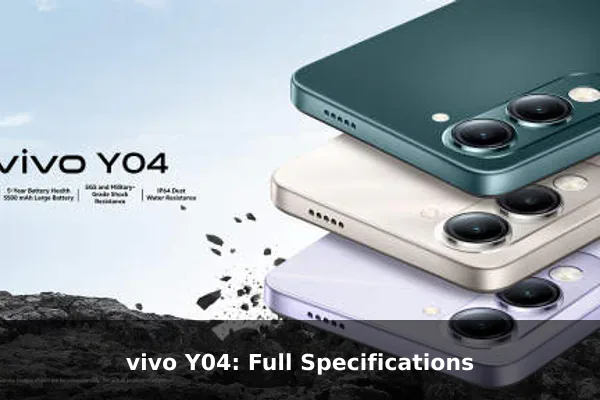
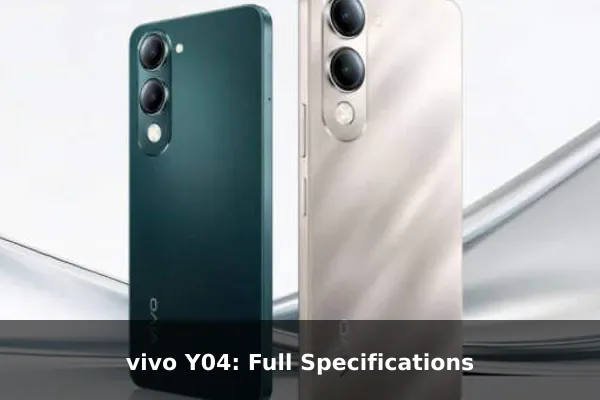
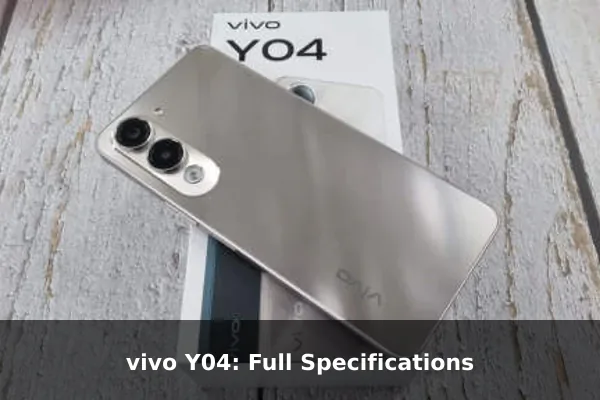
| Colors: | Titanium Gold (Titanium Silver), Dark Green (Majestic Green), Violet |
| Models: | V2430 |
| SAR: | 0.97 W/kg (head) 0.93 W/kg (body) |
| Price: | About 110 EUR |
EU LABEL
| Energy: | Class A |
| Battery: | 52:40h endurance, 1000 cycles |
| Free fall: | Class A (300 falls) |
| Repairability: | Class B |
Price and Availability
The vivo Y04 offers a compelling combination of features and performance. While the base price is around €110, the actual cost may vary depending on your location and retailer. Below, you’ll find the approximate price of the vivo Y04 converted into various currencies. Please note that these are estimates based on recent exchange rates as of July 21, 2026 and may not reflect the exact price you’ll find at a retailer.
- United States: $126
- Japan: ¥20,407
- United Kingdom: £93
- Australia: A$179
- Canada: C$177
- Taiwan: NT$4,058
- Denmark: kr821
- Saudi Arabia: ﷼471
- South Korea: ₩185,982
- Germany: €110
- Brazil: R$641
- Vietnam: ₫3.295.639
- Kenya: KSh 16,257
- India: ₹12,117
- Indonesia: Rp 2.256.770
- Nigeria: ₦172,131
- Pakistan: ₨34,907
- Philippines: ₱7,749
- Bangladesh: ৳১৫,৪৯৭
Value Positioning
The vivo Y04 is best understood as a budget durability-and-battery phone rather than a performance-focused model. Its reported price level of about 110 EUR places it in a very competitive entry segment, where buyers usually care more about battery life, storage flexibility, serviceability, and basic reliability than benchmark scores. In that context, vivo has made several sensible choices: a large 5500 mAh battery, dual SIM support, expandable storage, a 3.5mm headphone jack, FM radio, and a USB-C port with OTG.
The trade-off is equally clear. This is a 4G-only phone with an HD+ screen, eMMC 5.1 storage, modest cameras, and a Unisoc T7225 chipset. Those choices help keep cost down, but they also define the Y04 as a phone for calls, messaging, light apps, video streaming, navigation, and casual photography rather than gaming, heavy multitasking, or content creation.
Design and Durability
The vivo Y04 has a large body measuring 167.3 x 77 x 8.2 mm and weighing 199 g. That makes it a substantial device, especially for users coming from smaller phones, but the size also supports the large display and battery. The construction uses a glass front with a plastic frame and plastic back, which is typical for this category and should help reduce cost and weight compared with metal or glass-heavy designs.
Its IP64 rating is one of the more useful details in the specification sheet. The phone is listed as dust tight and resistant to water splashes, which is helpful for daily use around light rain, dusty environments, or accidental splashes. The MIL-STD-810H compliance note should be read carefully, however, because it does not guarantee ruggedness or safe use in extreme conditions. Buyers should treat the Y04 as a more resilient budget phone, not as a fully rugged outdoor device.
Display Experience
The 6.74-inch IPS LCD is clearly designed for people who want a big screen for reading, browsing, social media, and video. The 90Hz refresh rate is a welcome addition at this level, because it can make scrolling and interface movement feel smoother than a basic 60Hz panel. The listed 570 nits high-brightness mode should be adequate for many indoor and shaded outdoor situations, though it should not be expected to match brighter mid-range or flagship OLED displays.
The main compromise is resolution. At 720 x 1600 pixels and roughly 260 ppi, the screen is not as sharp as Full HD panels. Text, icons, and video will still be usable, but users who read a lot of small text or watch high-resolution video may notice the lower pixel density. Mohs level 5 protection adds another practical note, suggesting some resistance against scratches, although a screen protector is still sensible for long-term use.
Performance and Storage
The Unisoc T7225 is a 12 nm chipset with two Cortex-A75 performance cores and six Cortex-A55 efficiency cores. This setup is suitable for everyday Android tasks such as messaging, calling, browsing, maps, banking apps, and light social media. The Mali-G52 MP1 GPU is modest, so graphics-heavy games should be kept to low settings where they run acceptably.
Storage choices are more interesting than the processor. The Y04 is listed in 64GB and 128GB configurations with 4GB RAM, plus 128GB with 6GB RAM and 256GB with 4GB RAM. The dedicated microSDXC slot is important because it lets users expand media storage without sacrificing a second SIM. The internal storage standard is eMMC 5.1, so app installation, large file transfers, and heavy multitasking will not feel as fast as phones using UFS storage.
Camera Expectations
The rear camera system is simple: a 13 MP wide camera with PDAF and a 0.08 MP auxiliary lens. The main camera should be treated as a basic daylight shooter for documents, casual snapshots, and social sharing. LED flash and panorama support cover common needs, and 1080p video at 30fps is enough for simple clips.
The 5 MP front camera is similarly modest. It should handle video calls and basic selfies, but buyers should not expect strong low-light detail, advanced portrait processing, or high-resolution front video performance. If camera quality is a top priority, this is not the strongest reason to choose the Y04; the phone is more convincing as a long-lasting practical handset.
Battery and Charging
The 5500 mAh battery is one of the vivo Y04’s strongest specifications. Combined with a 4G modem, HD+ display resolution, and an efficiency-oriented chipset, it should deliver dependable endurance for users who spend the day on messaging, calls, browsing, streaming, and navigation. The EU label information also lists 52 hours and 40 minutes of endurance and 1000 battery cycles, which supports the phone’s positioning as a longevity-minded budget device.
Charging is limited to 15W wired. That is acceptable for overnight charging or topping up during downtime, but it is not fast by current standards. Buyers who are used to rapid charging should factor this in. The large battery is the bigger advantage here; the charging system is functional rather than a headline feature.
Software and Everyday Features
The vivo Y04 runs Android 14 with Funtouch 14. That gives the phone a modern Android base and vivo’s familiar interface layer, including standard customization and device management features. Because software update policies can vary by market and retailer, buyers should check local vivo information if long-term update support is a major concern.
Everyday hardware features are well covered. The side-mounted fingerprint sensor is convenient, especially on a phone with an LCD panel where in-display fingerprint scanning is not expected. The sensor list also includes accelerometer, proximity, and compass support, which covers basic app and navigation needs.
Connectivity and Audio
The vivo Y04 supports GSM, HSPA, and LTE networks, with separate international and India 4G band listings in the source data. It is not a 5G phone, so it is best suited for buyers in areas where 4G coverage is still strong and affordable data plans matter more than next-generation network speed.
Connectivity is otherwise practical. Wi-Fi 802.11 a/b/g/n/ac with dual-band support is included, along with Bluetooth 5.2, major satellite positioning systems, FM radio, USB Type-C 2.0, and OTG. NFC is not included, which may matter for users who rely on tap-to-pay services. Stereo speakers and a 3.5mm headphone jack are positive additions for media playback and wired audio accessories.
Who Should Buy the vivo Y04?
The vivo Y04 makes the most sense for students, first-time smartphone buyers, backup-phone users, or anyone who wants a low-cost Android device with strong battery life and practical basics. It is also a sensible option for users who need dual SIM plus microSD expansion, since that combination remains very useful in budget markets.
It is less suitable for buyers who want 5G, sharper display quality, fast charging, premium materials, or strong camera performance. The best reason to choose it is not any single flagship-style feature, but the overall balance of battery capacity, storage flexibility, splash resistance, and familiar Android usability at an accessible price point.
Conclusion
The vivo Y04 is a straightforward budget 4G phone with a large 90Hz display, 5500 mAh battery, expandable storage, stereo speakers, and useful durability touches. Its cameras, charging speed, and performance are basic, but the overall package is practical. Choose it if you want an affordable everyday phone focused on battery life and essential features.
References
- vivo Global – vivo Y04 Specifications – Primary manufacturer specification page for the vivo Y04, covering display, processor, memory, battery, cameras, dimensions, connectivity, sensors, IP rating, and in-box contents.
- vivo Indonesia Official Store – Y04 – Official vivo Indonesia store listing for the Y04, useful for confirming local SKU, color, RAM/storage variant, price, and availability context.
- vivo Taiwan – vivo Y04 Specifications – Official regional vivo Y04 specification page that can help cross-check variant-specific details such as storage, network bands, display, battery, cameras, and box contents.
- GSMchoice – Vivo Y04 4G Technical Specifications – Established independent phone specification database useful as a secondary cross-check for dimensions, display, battery, memory variants, network support, and announcement timing.
