
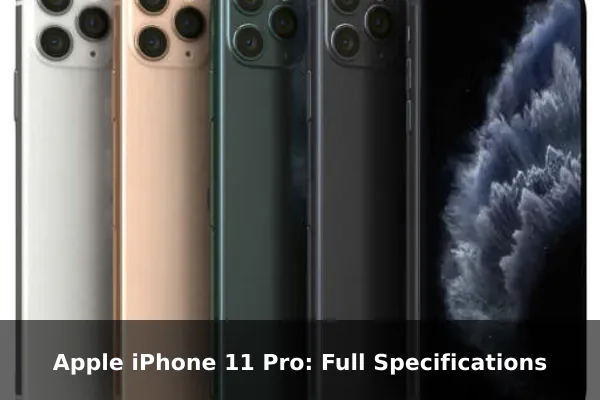
The Apple iPhone 11 Pro arrived in September 2019 as Apple’s compact flagship, pairing a 5.8-inch Super Retina XDR OLED display with the then-new A13 Bionic chip and a triple 12 MP rear camera system. Years later, it remains a reference point for buyers weighing a used or refurbished iPhone that still runs current iOS releases.
This guide walks through what the iPhone 11 Pro brings to the table today, from build quality and imaging to battery endurance and long-term software support, so you can decide whether it still fits your needs in a market now dominated by larger and heavier devices.
Full Specifications
Network
| Technology: | GSM / CDMA / HSPA / EVDO / LTE |
| 2G bands: | GSM 850 / 900 / 1800 / 1900 |
| CDMA 800 / 1900 | |
| 3G bands: | HSDPA 850 / 900 / 1700(AWS) / 1900 / 2100 |
| CDMA2000 1xEV-DO | |
| 4G bands: | 1, 2, 3, 4, 5, 7, 8, 11, 12, 13, 17, 18, 19, 20, 21, 25, 26, 28, 29, 30, 32, 34, 38, 39, 40, 41, 42, 46, 48, 66 – A2215 |
| 1, 2, 3, 4, 5, 7, 8, 12, 13, 14, 17, 18, 19, 20, 25, 26, 29, 30, 34, 38, 39, 40, 41, 42, 46, 48, 66, 71 – A2160, A2217 | |
| Speed: | HSPA, LTE 1.6 Gbps DL, EV-DO Rev.A 3.1 Mbps |
Launch
| Announced: | 2019, September 10 |
| Status: | Available. Released 2019, September 20 |
Body
| Dimensions: | 144 x 71.4 x 8.1 mm (5.67 x 2.81 x 0.32 in) |
| Weight: | 188 g (6.63 oz) |
| Build: | Glass front (Corning-made glass), glass back (Corning-made glass), stainless steel frame |
| SIM: | Nano-SIM + eSIMNano-SIM + Nano-SIM (China) |
| IP68 dust tight and water resistant (immersible up to 4m for 30 min) Apple Pay (Visa, MasterCard, AMEX certified) |
Display
| Type: | Super Retina XDR OLED, HDR10, Dolby Vision, 800 nits (HBM), 1200 nits (peak) |
| Size: | 5.8 inches, 84.4 cm2 (~82.1% screen-to-body ratio) |
| Resolution: | 1125 x 2436 pixels, 19.5:9 ratio (~458 ppi density) |
| Protection: | Scratch-resistant glass |
Platform
| OS: | iOS 13, upgradable to iOS 18.6 |
| Chipset: | Apple A13 Bionic (7 nm+) |
| CPU: | Hexa-core (2×2.65 GHz Lightning + 4×1.8 GHz Thunder) |
| GPU: | Apple GPU (4-core graphics) |
Memory
| Card slot: | No |
| Internal: | 64GB 4GB RAM, 256GB 4GB RAM, 512GB 4GB RAM |
| NVMe |
Main Camera
| Triple: | 12 MP, f/1.8, 26mm (wide), 1/2.55″, 1.4µm, dual pixel PDAF, OIS 12 MP, f/2.0, 52mm (telephoto), 1/3.4″, 1.0µm, PDAF, OIS, 2x optical zoom 12 MP, f/2.4, 120˚, 13mm (ultrawide), 1/3.6″ |
| Features: | Dual-LED dual-tone flash, HDR (photo/panorama) |
| Video: | 4K@24/25/30/60fps, 1080p@25/30/60/120/240fps, HDR, stereo sound rec. |
Selfie camera
| Single: | 12 MP, f/2.2, 23mm (wide), 1/3.6″, 1.0µm SL 3D, (depth/biometrics sensor) |
| Features: | HDR |
| Video: | 4K@24/25/30/60fps, 1080p@25/30/60/120fps, gyro-EIS |
Sound
| Loudspeaker: | Yes, with stereo speakers |
| 3.5mm jack: | No |
Comms
| WLAN: | Wi-Fi 802.11 a/b/g/n/ac/6, dual-band, hotspot |
| Bluetooth: | 5.0, A2DP, LE |
| Positioning: | GPS, GLONASS, GALILEO, QZSS |
| NFC: | Yes |
| Radio: | No |
| USB: | Lightning, USB 2.0 |
Features
| Sensors: | Face ID, accelerometer, gyro, proximity, compass, barometer |
| Ultra Wideband (UWB) support |
Battery
| Type: | Li-Ion 3046 mAh, non-removable (11.67 Wh) |
| Charging: | Wired, PD2.0, 50% in 30 min Wireless (Qi) |
Misc
| Colors: | Matte Space Gray, Matte Silver, Matte Gold, Matte Midnight Green |
| Models: | A2215, A2160, A2217, iPhone12,3 |
| SAR: | 1.18 W/kg (head) 1.16 W/kg (body) |
| SAR EU: | 0.99 W/kg (head) 0.99 W/kg (body) |
| Price: | About 240 EUR |
Our Tests
| Performance: | AnTuTu: 460784 (v7) GeekBench: 13829 (v4.4) GFXBench: 57fps (ES 3.1 onscreen) |
| Display: | 805 nits max brightness (measured) |
| Camera: | Photo / Video |
| Loudspeaker: | -24.3 LUFS (Very good) |
| Audio quality: | Noise -94.2dB / Crosstalk -81.0dB |
| Battery (old): | Endurance rating 86h |
Price and Availability
The Apple iPhone 11 Pro offers a compelling combination of features and performance. While the base price is around €240, the actual cost may vary depending on your location and retailer. Below, you’ll find the approximate price of the Apple iPhone 11 Pro converted into various currencies. Please note that these are estimates based on recent exchange rates as of May 24, 2026 and may not reflect the exact price you’ll find at a retailer.
- United States: $278
- Japan: ¥44,317
- United Kingdom: £207
- Australia: A$391
- Canada: C$384
- Taiwan: NT$8,768
- Denmark: kr1.791
- Saudi Arabia: ﷼1,044
- South Korea: ₩421,757
- Germany: €240
- Brazil: R$1.395
- Vietnam: ₫7.281.273
- Kenya: KSh 36,158
- India: ₹26,680
- Indonesia: Rp 4.928.345
- Nigeria: ₦378,407
- Pakistan: ₨77,687
- Philippines: ₱17,165
- Bangladesh: ৳৩৪,২৩৭
Value in 2026: Is the iPhone 11 Pro Still Worth It?
At an indicative second-hand price near 240 EUR, the iPhone 11 Pro sits in a competitive bracket against entry-level new Androids and older mid-range iPhones. Its appeal lies in flagship-grade hardware at a budget price, though buyers should weigh battery health, warranty status, and the eventual end of iOS updates. Actual market pricing varies by region, storage tier, and condition, so treat the listed figure as a rough reference rather than a fixed quote.
Design and Build Quality
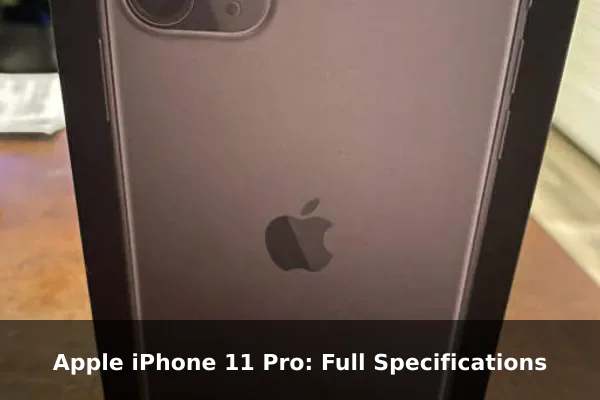
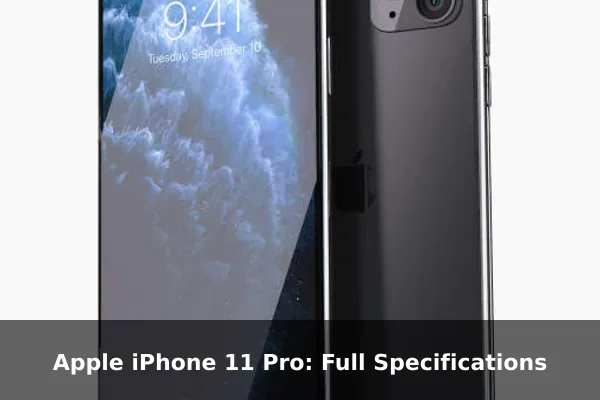
The iPhone 11 Pro measures 144 x 71.4 x 8.1 mm and weighs 188 g, making it one of the last truly pocketable flagship iPhones. Apple pairs a Corning-made glass front and back with a stainless steel frame and an IP68 rating that allows immersion up to 4 meters for 30 minutes, according to Apple’s published specifications. The matte finish on Space Gray, Silver, Gold, and Midnight Green resists fingerprints noticeably better than the glossier finishes on older Pro models.
Super Retina XDR Display
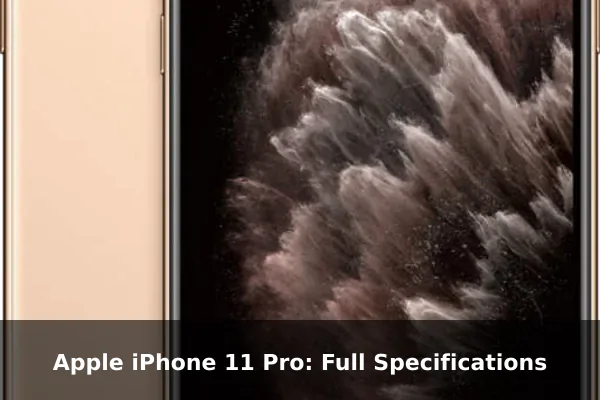
The 5.8-inch Super Retina XDR OLED panel runs at 1125 x 2436 pixels for roughly 458 ppi. It supports HDR10 and Dolby Vision, with Apple quoting 800 nits typical brightness and 1200 nits peak for HDR content; independent measurements landed around 805 nits in standard use. For a compact phone, the contrast, color accuracy, and HDR playback still hold up well against many current mid-range OLED screens.
Performance with the A13 Bionic
Apple’s A13 Bionic, built on a 7 nm+ process, features a hexa-core CPU (2×2.65 GHz Lightning + 4×1.8 GHz Thunder) and a 4-core Apple GPU, backed by 4 GB of RAM. Benchmark results from the launch era include AnTuTu around 460k (v7) and GeekBench 4 around 13.8k, and the chip continues to handle modern apps, light gaming, and multitasking comfortably. Sustained performance under load is reasonable thanks to the steel-and-glass chassis acting as a heat spreader.
Triple Camera System
The rear camera array combines a 12 MP wide (f/1.8, OIS), a 12 MP 2x telephoto (f/2.0, OIS), and a 12 MP ultrawide (f/2.4, 120 degrees). Video tops out at 4K 60fps with stereo sound, and the front 12 MP TrueDepth camera also records 4K 60fps. Night Mode on the main and telephoto lenses remains usable, though newer iPhones extend low-light capture to the ultrawide and selfie sensors.
Battery and Charging
The 3046 mAh battery (11.67 Wh) supports USB Power Delivery 2.0 fast charging, reaching about 50% in 30 minutes with a compatible adapter, plus Qi wireless charging. Endurance was rated at 86 hours in mixed use at launch, but real-world results on an aging unit depend heavily on battery health, which Apple lets you check in iOS Settings. Replacing a worn battery is often the single biggest upgrade for a used iPhone 11 Pro.
Software and Long-Term Support
The iPhone 11 Pro shipped with iOS 13 and has received updates through iOS 18.6, giving it an unusually long support window compared with most Android peers from 2019. Apple has not publicly committed to a final supported version, so future major iOS upgrades are not guaranteed, but security updates for older iOS branches have typically continued for some time after a model is dropped from the main release line.
Connectivity and Sensors
Connectivity covers Wi-Fi 6, Bluetooth 5.0, NFC for Apple Pay, GPS with GLONASS, Galileo, and QZSS, plus Apple’s first-generation Ultra Wideband (U1) chip for spatial awareness features. The phone uses a Lightning port with USB 2.0 speeds rather than USB-C, and there is no 3.5 mm headphone jack or microSD slot, so storage tier (64, 256, or 512 GB) is fixed at purchase.
Who Should Buy the iPhone 11 Pro
This phone suits buyers who want a compact iOS device, prefer a stainless steel build, and are comfortable with a used or refurbished purchase. It is less suitable for anyone who needs 5G, USB-C, an always-on display, or guaranteed multi-year iOS updates from this point forward. Pair any purchase with a battery health check and, ideally, a seller that offers a short return window.
Conclusion
The Apple iPhone 11 Pro remains a compelling compact flagship on the secondhand market, blending durable design, a high-quality OLED, capable triple cameras, and long iOS support. If you can verify good battery health and accept the lack of 5G and USB-C, it is a sensible budget-friendly entry into the iPhone ecosystem; otherwise, a newer iPhone with a longer guaranteed update runway may be the safer pick.
Official references
- Apple Support – iPhone 11 Pro Technical Specifications – Primary source for dimensions, display, chip, cameras, wireless bands, battery, sensors, SIM, software, and other official specifications.
- Apple Support – Identify your iPhone model – Official Apple reference for iPhone 11 Pro model numbers, capacities, colors, physical identifiers, and year introduced.
- Apple Newsroom – iPhone 11 Pro and iPhone 11 Pro Max announcement – Official launch announcement with context on release timing, display, A13 Bionic, camera system, durability, connectivity, and feature positioning.
- Apple Product Environmental Report – iPhone 11 Pro – Official Apple PDF for environmental, material, energy, packaging, and lifecycle details that can support specification and sustainability sections.
- Apple Regulatory Information – iPhone12,3 RF Exposure – Official Apple regulatory reference for RF exposure information tied to the iPhone 11 Pro hardware identifier.
