
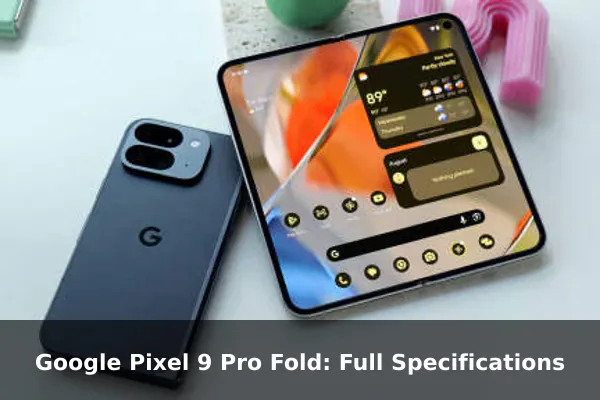
The Google Pixel 9 Pro Fold is Google’s second-generation book-style foldable, built around a larger 8.0-inch inner display, a more conventional 6.3-inch cover screen, and the Tensor G4 platform. It sits in the premium foldable category, but its appeal is less about raw gaming power and more about a compact tablet experience with Pixel camera processing and long software support.
This article focuses on what the specifications mean in daily use, from the thinner unfolded body and dual-screen setup to the camera system, battery score, wireless features, and Android update promise. A separate full specifications table will provide the complete technical listing.
Full Specifications
Network
| Technology: | GSM / HSPA / LTE / 5G |
| 2G bands: | GSM 850 / 900 / 1800 / 1900 |
| 3G bands: | HSDPA 800 / 850 / 900 / 1700(AWS) / 1900 / 2100 |
| 4G bands: | 1, 2, 3, 4, 5, 7, 8, 12, 13, 14, 17, 18, 19, 20, 21, 25, 26, 28, 29, 30, 32, 38, 39, 40, 41, 42, 46, 48, 66, 71 |
| 5G bands: | 1, 2, 3, 5, 7, 8, 12, 14, 20, 25, 26, 28, 29, 30, 38, 40, 41, 48, 66, 70, 71, 75, 76, 77, 78, 79, 257, 258, 260, 261 SA/NSA/Sub6/mmWave |
| Speed: | HSPA, LTE (CA), 5G |
Launch
| Announced: | 2024, August 13 |
| Status: | Available. Released 2024, September 04 |
Body
| Dimensions: | Unfolded: 155.2 x 150.2 x 5.1 mmFolded: 155.2 x 77.1 x 10.5 mm |
| Weight: | 257 g (9.07 oz) |
| Build: | Glass front (Gorilla Glass Victus 2) (folded), plastic front (unfolded), glass back (Gorilla Glass Victus 2), aluminum frame |
| SIM: | Nano-SIM + eSIM |
| IPX8 water resistant |
Display
| Type: | Foldable LTPO OLED, 120Hz, HDR10+, 1600 nits (HBM), 2700 nits (peak) |
| Size: | 8.0 inches, 207.4 cm2 (~89.0% screen-to-body ratio) |
| Resolution: | 2076 x 2152 pixels, 1:1 ratio (~373 ppi density) |
| Cover display: OLED, 120Hz, HDR, Corning Gorilla Glass Victus 2 6.3 inches, 1080 x 2424 pixels, 20:9 ratio, 422 ppi 1800 nits (HBM), 2700 nits (peak) |
Platform
| OS: | Android 14, upgradable to Android 15, up to 7 major Android upgrades |
| Chipset: | Google Tensor G4 (4 nm) |
| CPU: | Octa-core (1×3.1 GHz Cortex-X4 & 3×2.6 GHz Cortex-A720 & 4×1.92 GHz Cortex-A520) |
| GPU: | Mali-G715 MC7 |
Memory
| Card slot: | No |
| Internal: | 256GB 16GB RAM, 512GB 16GB RAM |
| UFS 3.1 |
Main Camera
| Triple: | 48 MP, f/1.7, 25mm (wide), 1/2.0″, 0.8µm, dual pixel PDAF, OIS 10.8 MP, f/3.1, 112mm (telephoto), 1/3.2″, dual pixel PDAF, OIS, 5x optical zoom 10.5 MP, f/2.2, 127˚ (ultrawide), 1/3.4″, PDAF |
| Features: | Multi-zone Laser AF, LED flash, Pixel Shift, Ultra-HDR, panorama, Best Take, Zoom Enhance |
| Video: | 4K@24/30/60fps, 1080p@24/30/60/120/240fps, 10-bit HDR, gyro-EIS, OIS |
Selfie camera
| Single: | 10 MP, f/2.2, 23mm (wide), 1/3.94″, PDAF Cover camera: 10 MP, f/2.2, 23mm (wide), 1/3.94″, PDAF |
| Features: | HDR, panorama |
| Video: | 4K@30/60fps, 1080p@30/60fps |
Sound
| Loudspeaker: | Yes, with stereo speakers |
| 3.5mm jack: | No |
Comms
| WLAN: | Wi-Fi 802.11 a/b/g/n/ac/6e/7, tri-band |
| Bluetooth: | 5.3, A2DP, LE, aptX HD |
| Positioning: | GPS (L1+L5), GLONASS, GALILEO, BDS, QZSS, NavIC |
| NFC: | Yes |
| Radio: | No |
| USB: | USB Type-C 3.2 |
Features
| Sensors: | Fingerprint (side-mounted), accelerometer, gyro, proximity, compass, barometer |
| Ultra Wideband (UWB) support Satellite SOS service Circle to Search |
Battery
| Type: | 4650 mAh |
| Charging: | 21W wired 7.5W wireless Bypass charging |
Misc
| Colors: | Obsidian, Porcelain |
| Models: | GGH2X, GC15S |
| SAR EU: | 0.98 W/kg (head) 1.39 W/kg (body) |
| Price: | € 1,235.23 / $ 984.99 / £ 864.99 / ₹ 134,999 |
Our Tests
| Performance: | AnTuTu: 1222228 (v10) GeekBench: 4783 (v6) 3DMark: 2620 (Wild Life Extreme) |
| Display: | 2199 nits max brightness (measured) |
| Loudspeaker: | -24.1 LUFS (Very good) |
| Battery: | Active use score 11:54h |
Price and Availability
The Google Pixel 9 Pro Fold offers a compelling combination of features and performance. While the base price is around €1.235, the actual cost may vary depending on your location and retailer. Below, you’ll find the approximate price of the Google Pixel 9 Pro Fold converted into various currencies. Please note that these are estimates based on recent exchange rates as of July 22, 2026 and may not reflect the exact price you’ll find at a retailer.
- United States: $1,409
- Japan: ¥229,685
- United Kingdom: £1,052
- Australia: A$2,012
- Canada: C$1,986
- Taiwan: NT$45,568
- Denmark: kr9.220
- Saudi Arabia: ﷼5,284
- South Korea: ₩2,085,525
- Germany: €1.235
- Brazil: R$7.158
- Vietnam: ₫36.984.664
- Kenya: KSh 182,446
- India: ₹1,35,658
- Indonesia: Rp 25.194.176
- Nigeria: ₦1,930,936
- Pakistan: ₨391,691
- Philippines: ₱87,040
- Bangladesh: ৳১,৭৩,৮১৪
Value and Market Position
The Pixel 9 Pro Fold is not a mainstream value phone; it is a premium foldable aimed at buyers who want a phone, small tablet, and Pixel software experience in one device. The raw price data places it firmly in flagship territory, so the buying decision should be based on whether the foldable format will genuinely change how you read, multitask, navigate, edit photos, or use productivity apps. Compared with a standard flagship slab phone, the extra cost mainly buys the larger inner OLED screen, hinge engineering, dual-display flexibility, and a more specialized body design.
Its value case is strongest for users who already like Pixel features and want a large-screen device without carrying a separate tablet. The 16GB RAM configuration across both storage options also helps the phone feel properly specified for multitasking. However, the lack of expandable storage means buyers should choose between 256GB and 512GB carefully from the start.
Design and Build Quality
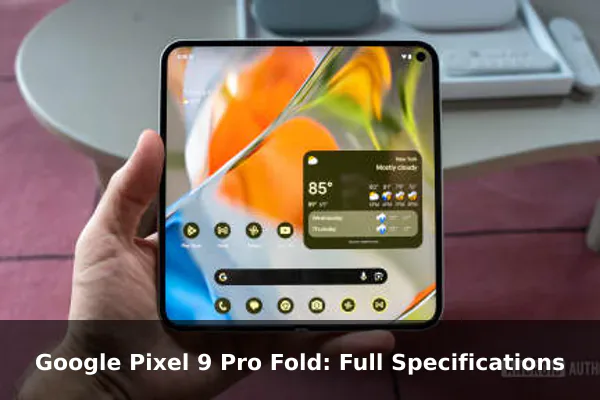
The Pixel 9 Pro Fold has a clear design priority: make the folded phone feel closer to a normal handset while still opening into a spacious tablet-style panel. Folded, it measures 10.5 mm thick, while unfolded it is only 5.1 mm thick, which is notably slim for a book-style foldable. At 257 g, it is still heavier than regular flagships, but that weight is expected in this class because of the hinge, dual displays, reinforced frame, and larger surface area.
The material mix is appropriately premium: Gorilla Glass Victus 2 on the folded front and back, an aluminum frame, and a plastic front layer on the inner foldable display. IPX8 water resistance adds useful protection against accidental water exposure, though the rating does not imply dust resistance. The Nano-SIM plus eSIM setup is modern and practical, especially for travelers or users managing personal and work lines.
Display Experience
The display package is the main reason to consider this phone. The inner 8.0-inch Foldable LTPO OLED panel supports 120Hz refresh, HDR10+, and very high rated brightness. The nearly square 1:1 aspect ratio is well suited to reading documents, viewing maps, browsing desktop-style pages, comparing photos, and running supported apps side by side. Its measured 2199 nits maximum brightness also suggests strong outdoor usability.
The 6.3-inch cover display matters just as much because it is the screen used for quick replies, calls, authentication, camera controls, and one-handed tasks. With 1080 x 2424 resolution, 120Hz refresh, HDR support, Gorilla Glass Victus 2, and a 20:9 ratio, it avoids feeling like a compromised secondary panel. That balance is important: a foldable becomes much easier to live with when the outside screen works well for normal phone use.
Performance and Hardware
The Tensor G4 chipset is built on a 4 nm process and uses an octa-core CPU led by a Cortex-X4 performance core. The Mali-G715 MC7 GPU and 16GB RAM give the Pixel 9 Pro Fold enough headroom for Android multitasking, AI-assisted features, photo processing, and split-screen workflows. The benchmark figures from the source data, including AnTuTu v10 at 1,222,228 and GeekBench v6 at 4,783, indicate flagship-class performance, though gaming-focused phones may still lead in sustained graphics output.
UFS 3.1 storage is fast enough for app loading, camera capture, and general file handling, but it is not the newest storage standard. In practical terms, the phone should feel responsive for productivity and photography, while users focused on maximum benchmark performance may find stronger options in non-folding performance flagships.
Camera System
The triple rear camera system is versatile rather than extreme. It combines a 48MP wide camera with OIS, a 10.8MP telephoto camera with 5x optical zoom and OIS, and a 10.5MP ultrawide camera with autofocus. This gives the phone a useful range for everyday scenes, portraits, travel, documents, and distant subjects. Google’s computational features, including Pixel Shift, Ultra-HDR, Best Take, and Zoom Enhance, are central to the camera experience.
Video recording reaches 4K at up to 60fps, with 10-bit HDR, gyro-EIS, and OIS support. The selfie setup includes a 10MP inner camera and a 10MP cover camera, both with PDAF, which is helpful for video calls and social capture. Because this is a foldable, users can also benefit from flexible shooting angles and using the cover display as a preview in supported camera modes.
Battery and Charging
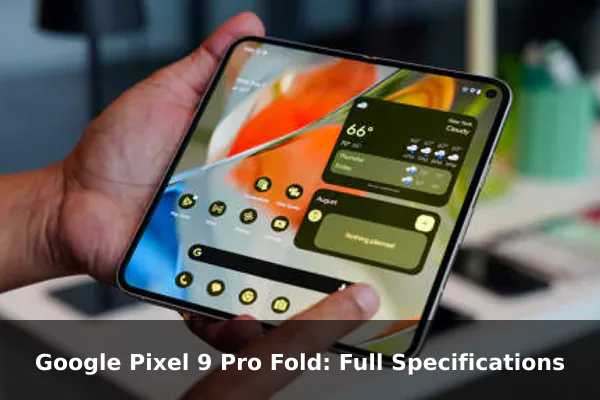
The 4650 mAh battery is reasonable for a foldable with two high-brightness OLED displays. The active use score of 11 hours and 54 minutes points to solid endurance, though heavy inner-screen use, 5G, navigation, camera recording, and high brightness can drain any foldable faster than lighter mixed use on the cover screen. Buyers should think of the battery as dependable rather than oversized.
Charging is more conservative. The phone supports 21W wired charging, 7.5W wireless charging, and bypass charging. That is useful for overnight charging and desk charging, but it is not aimed at users who expect very fast top-ups. Bypass charging is a practical addition because it can reduce battery stress during plugged-in use, such as navigation, streaming, or long video calls.
Software and AI Features
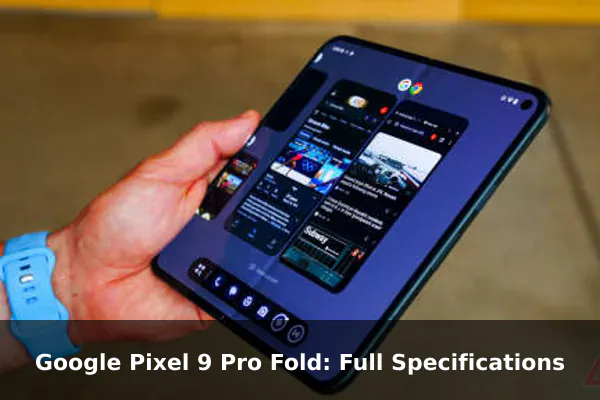
The Pixel 9 Pro Fold ships with Android 14, is upgradable to Android 15, and is listed with up to seven major Android upgrades. That long support window is one of the phone’s strongest ownership advantages, especially for a premium device that buyers may want to keep for several years. Pixel Drop updates also make the software experience feel more active over time than a basic version-number promise.
Google’s AI-focused features are part of the identity of this device. Circle to Search, Pixel camera processing, Best Take, and other software-assisted tools make the phone feel more like a Google services flagship than a pure hardware showcase. For users who rely on Google Photos, Assistant-style workflows, translation, search, and cloud services, that integration can matter more than small benchmark differences.
Connectivity and Everyday Features
Connectivity is comprehensive. The Pixel 9 Pro Fold supports GSM, HSPA, LTE, and 5G, including Sub-6 and mmWave bands in the listed configuration. Wi-Fi support extends through Wi-Fi 7 with tri-band operation, while Bluetooth 5.3 includes aptX HD. Positioning support is broad as well, with GPS L1+L5, GLONASS, GALILEO, BDS, QZSS, and NavIC.
The phone also includes NFC, Ultra Wideband support, USB Type-C 3.2, stereo speakers, and Satellite SOS service. There is no 3.5mm headphone jack or FM radio, which is typical for premium flagships. The side-mounted fingerprint reader is a sensible choice for a foldable because it can work whether the phone is open or closed.
Who Should Buy It?
The Pixel 9 Pro Fold makes the most sense for buyers who want a large inner display but still need a practical outer phone screen. It is especially compelling for readers, frequent travelers, multitaskers, Pixel camera fans, and users who want long software support in a foldable form factor. The dual-screen design is also useful for people who review documents, compare information, manage email, or use maps and messaging heavily.
It is less ideal for buyers who mainly want the lightest phone, the fastest charging, the lowest price, or the highest sustained gaming performance. A standard Pixel or another premium slab phone will be easier to carry and cheaper to replace. The Pixel 9 Pro Fold is best treated as a productivity-first flagship with strong cameras and long support, not simply as a larger version of a regular phone.
Conclusion
The Google Pixel 9 Pro Fold is a polished premium foldable with a strong cover display, bright inner OLED panel, capable triple camera system, Tensor G4 hardware, broad connectivity, and long Android update support. Its charging speeds and weight are the main tradeoffs, but for users who will benefit from the foldable screen every day, it is an easy recommendation among Pixel devices.
References
- Google Pixel Phone Help – Pixel phone hardware tech specs – Primary Google specification source for Pixel 9 Pro Fold display, dimensions, weight, battery, memory, storage, processor, cameras, sensors, ports, SIM, connectivity, network bands, materials, warranty, and box contents.
- Google Blog – Introducing Pixel 9 Pro Fold – Official launch article confirming announcement details, availability date, colors, Tensor G4, foldable design claims, camera features, AI features, and water-resistance notes.
- Google Pixel Phone Help – Safety & regulatory guide for Pixel 9 Pro Fold – Official safety and regulatory source for Pixel 9 Pro Fold model numbers, FCC compliance, battery certification, SAR/regulatory notices, EU declaration, radio-frequency bands, and environmental compliance.
- Google Pixel Phone Help – Pixel software update support – Official source for Pixel update policy, including Pixel 9 Pro Fold eligibility for 7 years of OS, security, and Pixel Drop updates.
- Google Blog – How Google redesigned the Pixel 9 Pro Fold – Official engineering/design background useful for explaining the thinner chassis, redesigned hinge, thermal architecture, display changes, and hardware tradeoffs behind the specifications.
