
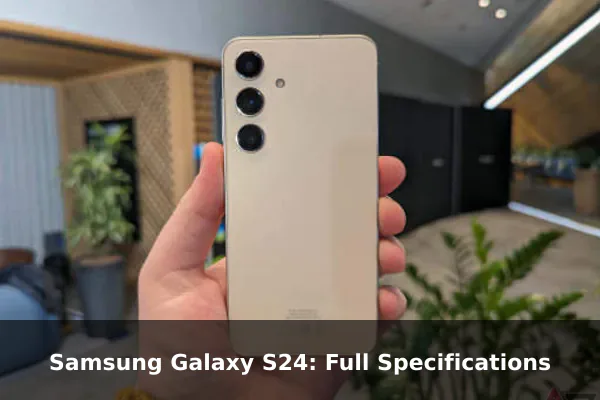
The Samsung Galaxy S24 is the compact entry in Samsung’s 2024 flagship Galaxy S line, built for buyers who want premium hardware without moving to a large-screen Ultra model. It combines a 6.2-inch LTPO AMOLED display, a triple rear camera system, Galaxy AI features, and long software support in a pocket-friendly body.
This article focuses on what the Galaxy S24 specification sheet means in daily use: portability, regional chipset differences, display quality, camera flexibility, battery expectations, and whether the phone still makes sense as a value-focused flagship option.
Full Specifications
Network
| Technology: | GSM / CDMA / HSPA / EVDO / LTE / 5G |
| 2G bands: | GSM 850 / 900 / 1800 / 1900 |
| CDMA 800 / 1900 & TD-SCDMA | |
| 3G bands: | HSDPA 850 / 900 / 1700(AWS) / 1900 / 2100 |
| CDMA2000 1xEV-DO | |
| 4G bands: | 1, 2, 3, 4, 5, 7, 8, 12, 13, 17, 18, 19, 20, 25, 26, 28, 32, 38, 39, 40, 41, 66 – International |
| 1, 2, 3, 4, 5, 7, 8, 12, 13, 14, 18, 19, 20, 25, 26, 28, 29, 30, 38, 39, 40, 41, 48, 66, 71 – USA | |
| 5G bands: | 1, 2, 3, 5, 7, 8, 12, 20, 25, 26, 28, 38, 40, 41, 66, 75, 77, 78 SA/NSA/Sub6 – International |
| 1, 7, 25, 28, 41, 66, 71, 78, 257, 258, 260, 261 SA/NSA/Sub6/mmWave – USA | |
| Speed: | HSPA, LTE (up to 7CA), 5G |
Launch
| Announced: | 2024, January 17 |
| Status: | Available. Released 2024, January 24 |
Body
| Dimensions: | 147 x 70.6 x 7.6 mm (5.79 x 2.78 x 0.30 in) |
| Weight: | 167 g or 168 g (5.89 oz) |
| Build: | Glass front (Gorilla Glass Victus 2), glass back (Gorilla Glass Victus 2), aluminum frame |
| SIM: | Nano-SIM + Nano-SIM + eSIM + eSIM (max 2 at a time) – INT Nano-SIM + eSIM + eSIM (max 2 at a time) – USA Nano-SIM + Nano-SIM – CN |
| IP68 dust tight and water resistant (immersible up to 1.5m for 30 min) Armor aluminum 2 frame |
Display
| Type: | Dynamic LTPO AMOLED 2X, 120Hz, 480Hz PWM, HDR10+, 2600 nits (peak) |
| Size: | 6.2 inches, 94.4 cm2 (~90.9% screen-to-body ratio) |
| Resolution: | 1080 x 2340 pixels, 19.5:9 ratio (~416 ppi density) |
| Protection: | Corning Gorilla Glass Victus 2 |
Platform
| OS: | Android 14, up to 7 major Android upgrades, One UI 6.1.1 |
| Chipset: | Qualcomm SM8650-AC Snapdragon 8 Gen 3 (4 nm) – USA/Canada/ChinaExynos 2400 (4 nm) – International |
| CPU: | 8-core (1×3.39GHz Cortex-X4 & 3×3.1GHz Cortex-A720 & 2×2.9GHz Cortex-A720 & 2×2.2GHz Cortex-A520)10-core (1×3.2GHz Cortex-X4 & 2×2.9GHz Cortex-A720 & 3×2.6GHz Cortex-A720 & 4×1.95GHz Cortex-A520) |
| GPU: | Adreno 750 (1 GHz) – USA/Canada/ChinaXclipse 940 – International |
Memory
| Card slot: | No |
| Internal: | 128GB 8GB RAM, 256GB 8GB RAM, 256GB 12GB RAM, 512GB 8GB RAM |
| UFS 3.1 – 128GB only UFS 4.0 |
Main Camera
| Triple: | 50 MP, f/1.8, 24mm (wide), 1/1.56″, 1.0µm, dual pixel PDAF, OIS 10 MP, f/2.4, 67mm (telephoto), 1/3.94″, 1.0µm, PDAF, OIS, 3x optical zoom 12 MP, f/2.2, 13mm, 120˚ (ultrawide), 1/2.55″ 1.4µm, Super Steady video |
| Features: | LED flash, auto-HDR, panorama |
| Video: | 8K@24/30fps, 4K@30/60fps, 1080p@30/60/120/240fps, HDR10+, stereo sound rec., gyro-EIS |
Selfie camera
| Single: | 12 MP, f/2.2, 26mm (wide), 1/3.2″, 1.12µm, dual pixel PDAF |
| Features: | HDR, HDR10+ |
| Video: | 4K@30/60fps, 1080p@30fps |
Sound
| Loudspeaker: | Yes, with stereo speakers |
| 3.5mm jack: | No |
| 32-bit/384kHz audio Tuned by AKG |
Comms
| WLAN: | Wi-Fi 802.11 a/b/g/n/ac/6e, tri-band, Wi-Fi Direct |
| Bluetooth: | 5.3, A2DP, LE |
| Positioning: | GPS, GLONASS, BDS, GALILEO, QZSS |
| NFC: | Yes |
| Radio: | No |
| USB: | USB Type-C 3.2, DisplayPort 1.2, OTG |
Features
| Sensors: | Fingerprint (under display, ultrasonic), accelerometer, gyro, proximity, compass, barometer |
| Samsung DeX, Samsung Wireless DeX (desktop experience support) Circle to Search |
Battery
| Type: | Li-Ion 4000 mAh |
| Charging: | 25W wired, PD3.0, 50% in 30 min 15W wireless (Qi) 4.5W reverse wireless |
Misc
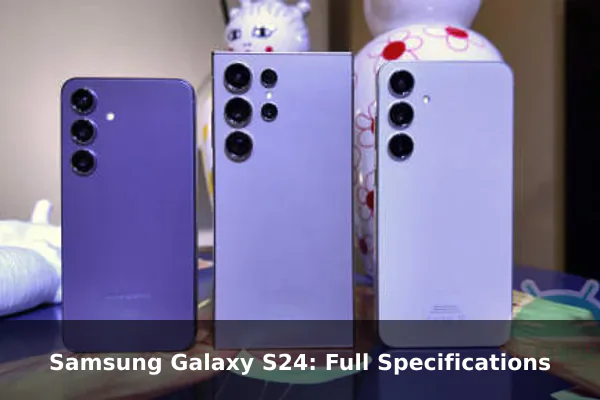
| Colors: | Onyx Black, Marble Grey, Cobalt Violet, Amber Yellow, Jade Green, Sandstone Orange, Sapphire Blue |
| Models: | SM-S921B, SM-S921B/DS, SM-S921U, SM-S921U1, SM-S921W, SM-S921N, SM-S9210, SM-S921E, SM-S921E/DS |
| SAR: | 1.23 W/kg (head) 1.10 W/kg (body) |
| SAR EU: | 0.87 W/kg (head) 1.35 W/kg (body) |
| Price: | € 458.00 / $ 328.70 / £ 348.99 / ₹ 42,761 |
Our Tests
| Performance: | AnTuTu: 1218977 (v9), 1696727 (v10) GeekBench: 5833 (v5), 6747 (v6) 3DMark: 4183 (Wild Life Extreme) |
| Display: | 1401 nits max brightness (measured) |
| Camera: | Photo / Video |
| Loudspeaker: | -25.2 LUFS (Very good) |
| Battery: | Active use score 12:06h |
Price and Availability
The Samsung Galaxy S24 offers a compelling combination of features and performance. While the base price is around €458, the actual cost may vary depending on your location and retailer. Below, you’ll find the approximate price of the Samsung Galaxy S24 converted into various currencies. Please note that these are estimates based on recent exchange rates as of September 15, 2026 and may not reflect the exact price you’ll find at a retailer.
- United States: $529
- Japan: ¥81,678
- United Kingdom: £392
- Australia: A$741
- Canada: C$735
- Taiwan: NT$16,790
- Denmark: kr3.424
- Saudi Arabia: ﷼1,985
- South Korea: ₩712,388
- Germany: €458
- Brazil: R$2.725
- Vietnam: ₫13.720.917
- Kenya: KSh 68,531
- India: ₹50,523
- Indonesia: Rp 9.327.039
- Nigeria: ₦713,274
- Pakistan: ₨146,934
- Philippines: ₱33,250
- Bangladesh: ৳৬৫,১১৭
Compact Flagship Value
The strongest angle for the Samsung Galaxy S24 is not that it has the largest battery or the most extreme camera hardware. Its value is in bringing Samsung’s flagship experience into a smaller, lighter phone. At 147 x 70.6 x 7.6 mm and around 167 to 168 g, it is far easier to handle than many premium Android phones, while still offering 5G, a high-end display, wireless charging, Samsung DeX, and a durable glass-and-metal build.
The listed launch date of January 17, 2024, with release from January 24, 2024, places it in the same generation as the wider Galaxy S24 family. That matters because buyers get many of the same core software and ecosystem features as the larger models, but with a lower entry point and a more manageable size.
Design and Durability
The Galaxy S24 uses Gorilla Glass Victus 2 on the front and back, paired with Samsung’s Armor Aluminum 2 frame. This gives the phone a flagship feel without pushing weight too high. The IP68 rating adds practical protection against dust and water immersion up to 1.5 meters for 30 minutes, which is useful for everyday accidents, rain, and travel.
Samsung also offers a broad color range: Onyx Black, Marble Grey, Cobalt Violet, Amber Yellow, Jade Green, Sandstone Orange, and Sapphire Blue. Some colors may depend on region or sales channel, so buyers should confirm local availability before choosing.
Display Quality
The 6.2-inch Dynamic LTPO AMOLED 2X panel is one of the phone’s key strengths. It supports a 120Hz refresh rate, HDR10+, and a listed peak brightness of 2600 nits. The source test result also reports 1401 nits measured maximum brightness, which suggests strong outdoor readability even if real-world brightness depends on mode, content, and ambient light.
The 1080 x 2340 resolution works out to about 416 ppi, which is sharp for this screen size. The 19.5:9 aspect ratio keeps the device slim in hand, while the approximate 90.9 percent screen-to-body ratio helps the small chassis feel modern rather than cramped.
Performance and Regional Chipsets
Performance is more complicated than a single line on the spec sheet because the Galaxy S24 uses different chipsets by market. USA, Canada, and China variants are listed with the Snapdragon 8 Gen 3 for Galaxy, while international models use the Exynos 2400. Both are 4 nm flagship-class platforms, but performance, thermals, modem behavior, and efficiency can vary depending on region and workload.
The benchmark figures are strong for a compact phone: AnTuTu scores are listed at 1218977 on v9 and 1696727 on v10, with GeekBench scores of 5833 on v5 and 6747 on v6. The 3DMark Wild Life Extreme score of 4183 points to capable gaming performance, though a small body can still limit sustained performance during long, heavy sessions.
Memory and Storage
The Galaxy S24 does not include a microSD card slot, so storage choice matters at purchase. Listed configurations include 128GB with 8GB RAM, 256GB with 8GB RAM, 256GB with 12GB RAM, and 512GB with 8GB RAM. The 128GB version uses UFS 3.1 storage, while higher storage options use UFS 4.0 according to the source data.
For casual users, 128GB may be workable, but the 256GB model is the safer recommendation for buyers who record 4K or 8K video, install large games, or keep years of photos locally. The lack of expandable storage is one of the few practical compromises in an otherwise premium package.
Camera System
The rear camera setup is versatile rather than experimental. It combines a 50MP main camera with optical image stabilization, a 10MP telephoto camera with 3x optical zoom, and a 12MP ultrawide camera with a 120-degree field of view. That gives the S24 a useful focal range for everyday photography, portraits, architecture, landscapes, and travel.
Video support is also flagship-grade, with 8K recording at 24 or 30fps, 4K at 30 or 60fps, and high-frame-rate 1080p options. HDR10+, stereo sound recording, and gyro-EIS help make the phone more capable for mobile creators. On the front, the 12MP selfie camera includes dual pixel PDAF and can record 4K video at up to 60fps.
Battery and Charging
The 4000 mAh battery is modest compared with larger Android flagships, but it fits the phone’s compact positioning. The listed active use score of 12:06h is respectable for a smaller flagship, especially with a bright LTPO AMOLED display and premium chipset inside.
Charging is practical rather than class-leading. The phone supports 25W wired charging with PD3.0, advertised as 50 percent in 30 minutes, plus 15W wireless charging and 4.5W reverse wireless charging. Buyers who want very fast wired charging may find rival brands more aggressive, but Samsung’s setup is balanced and widely compatible.
Software and Galaxy Features
The Galaxy S24 launched with Android 14 and One UI 6.1.1, with support for up to seven major Android upgrades. That long update commitment is one of its biggest ownership advantages, especially for buyers who keep phones for several years.
Samsung DeX and Wireless DeX are also important differentiators. They allow the phone to work in a desktop-style environment when connected to compatible displays or accessories. Circle to Search adds a modern AI-assisted search workflow, making the S24 feel more current than a basic hardware refresh.
Connectivity and Everyday Use
Connectivity is extensive, with GSM, CDMA, HSPA, EVDO, LTE, and 5G support listed. International and USA models differ in supported LTE and 5G bands, with USA variants adding mmWave 5G bands. This makes it especially important to buy the correct regional model for your carrier.
Other premium conveniences include Wi-Fi 6e, Bluetooth 5.3, NFC, GPS with multiple satellite systems, USB Type-C 3.2, DisplayPort 1.2, and OTG. The phone also has stereo speakers, 32-bit/384kHz audio, AKG tuning, and an ultrasonic under-display fingerprint sensor. There is no 3.5mm headphone jack or FM radio.
Who Should Buy It
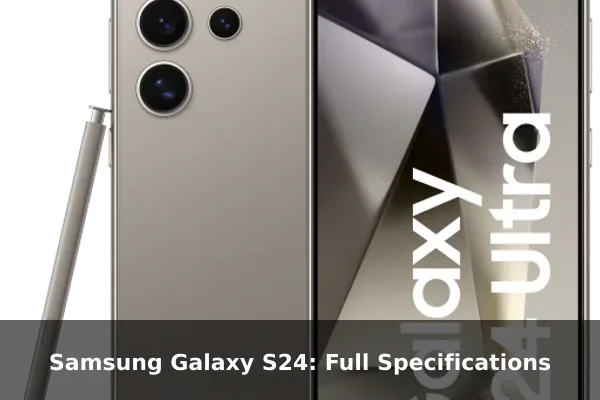
The Galaxy S24 is best for users who want a compact Android flagship with a high-quality screen, strong cameras, long software support, and Samsung ecosystem features. It is especially appealing if you dislike oversized phones but still want premium materials, IP68 protection, wireless charging, and desktop-style DeX support.
It is less ideal for buyers who need expandable storage, the longest possible battery life, the fastest charging speeds, or the most advanced zoom camera Samsung offers. Those users may be better served by larger Galaxy models or competing performance phones.
Conclusion
The Samsung Galaxy S24 is a polished compact flagship with a bright LTPO AMOLED display, durable build, flexible triple camera system, strong regional chipset options, and excellent long-term software support. Choose it if you want a premium Samsung phone that stays comfortable in one hand; skip it only if battery size, expandable storage, or ultra-fast charging is your top priority.
References
- Samsung Galaxy S24 and S24+ Official Specifications – Official Samsung English specs page for Galaxy S24/S24+, useful for display, dimensions, cameras, battery, connectivity, colors, and model comparisons.
- Samsung Newsroom US Galaxy S24 Series Launch – Official launch announcement with a detailed specifications table, launch context, Galaxy AI features, chipset, OS, charging, and availability notes.
- Samsung India Galaxy S24 Business Product Page – Official Samsung product page for the SM-S921B variant, useful for regional Exynos specs, launch date, connectivity, sensors, battery, and physical specifications.
- Samsung Mobile Galaxy S24 Software Update History – Official Samsung update documentation for Galaxy S24 SM-S921B, useful for current Android version, security patch level, and software update claims.
- Qualcomm Snapdragon 8 Gen 3 Mobile Platform – Official Qualcomm reference for Snapdragon 8 Gen 3 specs used in some Galaxy S24 regional variants, including CPU, GPU, modem, Wi-Fi, and AI platform details.
