
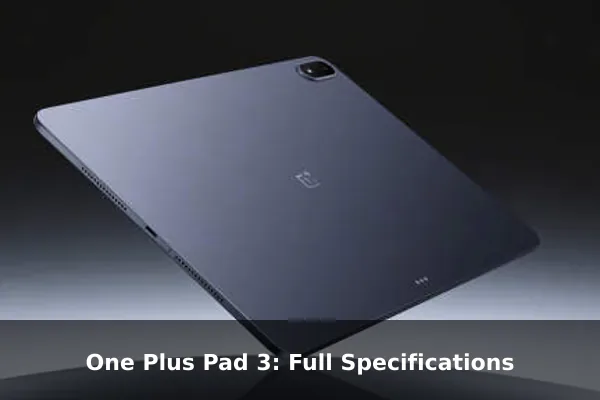
The One Plus Pad 3 is a large-screen Android tablet built around flagship-class hardware, a 13.2-inch high-refresh display, and a very large battery. It is not a cellular device, so its value depends heavily on whether Wi-Fi use, stylus support, and media performance fit your daily workflow.
At about 600 EUR, it sits in a competitive space where buyers expect more than casual browsing. The headline story here is a productivity-focused tablet with Snapdragon 8 Elite power, 8-speaker audio, 80W charging, and a slim aluminum body rather than a phone-style all-rounder.
Full Specifications
Network
| Technology: | No cellular connectivity |
| 2G bands: | N/A |
| 3G bands: | N/A |
| 4G bands: | N/A |
| GPRS: | No |
| EDGE: | No |
Launch
| Announced: | 2025, June 05 |
| Status: | Available. Released 2025, June 19 |
Body
| Dimensions: | 289.6 x 209.7 x 6 mm (11.40 x 8.26 x 0.24 in) |
| Weight: | 675 g (1.49 lb) |
| Build: | Glass front, aluminum frame, aluminum back |
| SIM: | No |
| Stylus support |
Display
| Type: | IPS LCD, 68B colors, Dolby Vision, 144Hz, 900 nits (HBM) |
| Size: | 13.2 inches, 530.0 cm2 (~87.3% screen-to-body ratio) |
| Resolution: | 2400 x 3392 pixels (~315 ppi density) |
Platform
| OS: | Android 15, ColorOS 15 |
| Chipset: | Qualcomm SM8750-AB Snapdragon 8 Elite (3 nm) |
| CPU: | Octa-core (2×4.32 GHz Oryon V2 Phoenix L + 6×3.53 GHz Oryon V2 Phoenix M) |
| GPU: | Adreno 830 |
Memory
| Card slot: | No |
| Internal: | 256GB 12GB RAM, 512GB 16GB RAM |
| UFS 4.0 |
Main Camera
| Single: | 13 MP |
| Features: | Color spectrum sensor, LED flash |
| Video: | 4K@30fps, 1080p@30ps, gyro-EIS |
Selfie camera
| Single: | 8 MP |
| Video: | 1080p@30fps |
Sound
| Loudspeaker: | Yes, with stereo speakers (8 speakers) |
| 3.5mm jack: | No |
| 24-bit/192kHz audio |
Comms
| WLAN: | Wi-Fi 802.11 a/b/g/n/ac/6/7, dual-band |
| Bluetooth: | 5.4, A2DP, LE, aptX HD |
| Positioning: | No |
| NFC: | No |
| Radio: | No |
| USB: | USB Type-C 3.2, OTG, accessory connector |
Features
| Sensors: | Accelerometer, proximity (accessories only), gyro, compass |
Battery
| Type: | 12140 mAh |
| Charging: | 80W wired |
Misc
| Colors: | Storm Blue |
| Models: | OPD2415 |
| Price: | About 600 EUR |
Our Tests
| Loudspeaker: | -23.6 LUFS (Very good) |
| Battery: | Active use score 10:49h |
Price and Availability
The One Plus Pad 3 offers a compelling combination of features and performance. While the base price is around €600, the actual cost may vary depending on your location and retailer. Below, you’ll find the approximate price of the One Plus Pad 3 converted into various currencies. Please note that these are estimates based on recent exchange rates as of September 19, 2026 and may not reflect the exact price you’ll find at a retailer.
- United States: $689
- Japan: ¥108,163
- United Kingdom: £515
- Australia: A$967
- Canada: C$963
- Taiwan: NT$21,908
- Denmark: kr4.485
- Saudi Arabia: ﷼2,583
- South Korea: ₩954,954
- Germany: €600
- Brazil: R$3.535
- Vietnam: ₫17.924.687
- Kenya: KSh 89,128
- India: ₹66,007
- Indonesia: Rp 12.217.815
- Nigeria: ₦936,281
- Pakistan: ₨191,163
- Philippines: ₱43,200
- Bangladesh: ৳৮৪,৫৯৩
Value and Positioning
The One Plus Pad 3 is best understood as a premium Android tablet, not a stretched smartphone. Its source specifications point to a device designed for media, note-taking, multitasking, and performance-heavy Android apps, with no cellular connectivity and no SIM support. That immediately defines its buyer: someone comfortable relying on Wi-Fi at home, work, school, or through a mobile hotspot.
The approximate 600 EUR price places it above entry-level tablets and closer to productivity-focused models. What helps its case is the combination of Snapdragon 8 Elite, UFS 4.0 storage, 12GB or 16GB RAM options, a large 13.2-inch display, and 80W wired charging. Those are not budget-tablet ingredients. The trade-off is that buyers looking for GPS, NFC, radio, a headphone jack, or mobile network access will need to look elsewhere.
Design and Build Quality
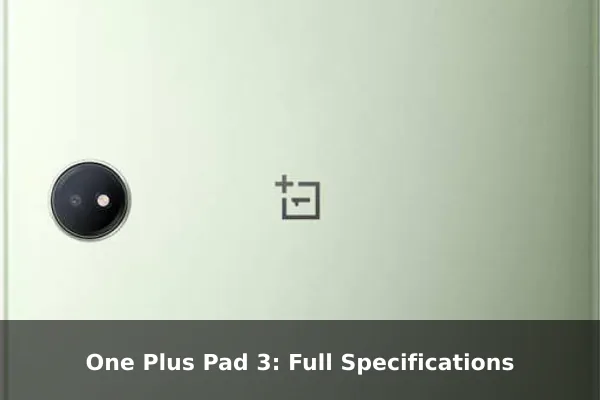
The tablet measures 289.6 x 209.7 x 6 mm and weighs 675 g, making it very slim but still substantial in the hand. A 13.2-inch tablet is naturally better suited to desk, lap, stand, or keyboard use than one-handed reading. The glass front, aluminum frame, and aluminum back give it the material profile expected from a higher-end tablet.
Stylus support is one of the most important design details because it changes how the device can be used. For students, designers, annotators, and meeting-heavy professionals, stylus compatibility can make the Pad 3 more than a media screen. However, the source data does not list a stylus in the box, so buyers should verify accessory availability and bundle details in their region before purchasing.
Display Experience
The display is one of the strongest parts of the One Plus Pad 3. It uses a 13.2-inch IPS LCD panel with 68 billion colors, Dolby Vision, a 144Hz refresh rate, and up to 900 nits in high brightness mode. The 2400 x 3392 resolution works out to roughly 315 ppi, which is sharp for a tablet this size.
For watching video, reading documents, editing photos casually, and using split-screen apps, the large canvas is the main attraction. The 144Hz refresh rate should make scrolling and stylus movement feel smoother than standard 60Hz tablets, while Dolby Vision support is useful for compatible streaming content. The main caveat is panel technology: this is IPS LCD, not OLED, so buyers who prioritize perfect black levels may still prefer an OLED-based tablet.
Performance Hardware
The Snapdragon 8 Elite is the specification that most clearly separates the Pad 3 from midrange tablets. It uses a 3 nm Qualcomm SM8750-AB platform with an octa-core CPU made up of two 4.32 GHz Oryon V2 Phoenix L cores and six 3.53 GHz Oryon V2 Phoenix M cores, paired with the Adreno 830 GPU.
In practical terms, this hardware profile should be well suited to demanding Android games, heavy multitasking, creative apps, large browser sessions, and long-term performance expectations. The memory options also reinforce that direction: 256GB with 12GB RAM or 512GB with 16GB RAM. There is no card slot, so storage choice matters at purchase. Users who store lots of offline video, large project files, or games should consider the 512GB model if available.
Camera Expectations
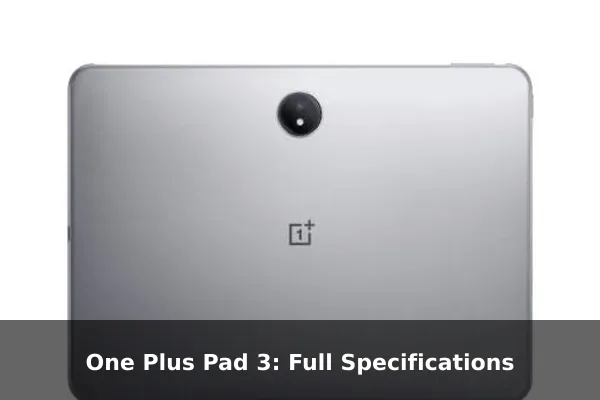
The camera setup is functional rather than photography-led. The rear camera is a single 13 MP unit with a color spectrum sensor, LED flash, 4K video at 30fps, 1080p video at 30fps, and gyro-EIS. The selfie camera is an 8 MP unit with 1080p video at 30fps.
That is sensible for a tablet. The rear camera should be enough for scanning documents, capturing reference shots, or occasional video, but this device is not trying to replace a flagship phone camera. The front camera is likely more important for video calls, online classes, and meetings. Buyers should judge it as a communication tool first and a camera second.
Battery Life and Charging
The 12140 mAh battery is one of the key reasons the Pad 3 makes sense as a work and entertainment tablet. The provided test result lists an active use score of 10:49h, which suggests it can handle a full day of mixed use for many users, depending on brightness, refresh rate, app load, and speaker use.
Charging is rated at 80W wired, which is notably fast for a tablet with this much capacity. That matters because large tablets often take a long time to refill. Fast wired charging makes the Pad 3 more convenient for users who switch between desk work, travel, streaming, and note-taking sessions.
Software and Everyday Use
The One Plus Pad 3 runs Android 15 with ColorOS 15. For a large tablet, software optimization matters as much as raw speed. The hardware can support demanding workflows, but the daily experience will depend on how well apps scale, how smoothly multitasking works, and how useful One Plus accessory features are in practice.
The sensor list includes accelerometer, gyro, compass, and proximity for accessories only. This again points toward a tablet built around landscape productivity and accessory use. It should be most comfortable as a media screen, writing board, gaming display, and portable work companion rather than as a navigation or cellular communication device.
Connectivity and Audio
Connectivity is modern but clearly Wi-Fi-first. The Pad 3 supports Wi-Fi 802.11 a/b/g/n/ac/6/7, dual-band, plus Bluetooth 5.4 with A2DP, LE, and aptX HD. USB Type-C 3.2, OTG, and an accessory connector are also included. There is no positioning, NFC, radio, GPRS, EDGE, or cellular network support.
Audio is a standout area. The tablet has stereo speakers with an 8-speaker setup, 24-bit/192kHz audio support, and a loudspeaker test result of -23.6 LUFS, rated very good. There is no 3.5mm headphone jack, so wired audio users will need USB-C audio gear or an adapter, while wireless users get strong Bluetooth codec support.
Who Should Buy It?
The One Plus Pad 3 makes the most sense for buyers who want a large Android tablet for streaming, reading, note-taking, gaming, multitasking, and desk-based productivity. It is especially appealing if you care about display smoothness, loud speakers, strong performance, and fast charging more than mobile network access.
It is less suitable for users who need a compact tablet, cellular connectivity, built-in GPS-style positioning, expandable storage, or a headphone jack. The Pad 3 is a powerful Wi-Fi tablet with a clear personality: big screen, premium chipset, big battery, and accessory-friendly design. If those priorities match your usage, it is a compelling option in its class.
Conclusion
The One Plus Pad 3 is a performance-focused Android tablet with a sharp 13.2-inch 144Hz display, Snapdragon 8 Elite power, strong speaker hardware, and a large 12140 mAh battery with 80W charging. Its lack of cellular connectivity and expandable storage should be considered carefully, but for Wi-Fi-first productivity and entertainment, it is easy to recommend.
References
- OnePlus Pad 3 Official Specifications – Official specs page with dimensions, display, chipset, memory, battery, charging, cameras, connectivity, OS, audio, and in-box contents.
- OnePlus Pad 3 Official Product Page – Official product page confirming headline features, display claims, battery capacity, charging notes, accessories, and feature disclaimers.
- OnePlus Pad 3 Official Launch Press Release – Official launch announcement with availability, pricing, RAM/storage configuration, software update promise, and regional details for the US and Canada.
- Qualcomm Snapdragon 8 Elite Official Information – Primary chipset source referenced by OnePlus for Snapdragon 8 Elite performance claims and platform context.
- OnePlus Support User Manuals – Official OnePlus support portal for user manuals and device documentation, useful for verifying safety, warranty, and setup-related details.
