
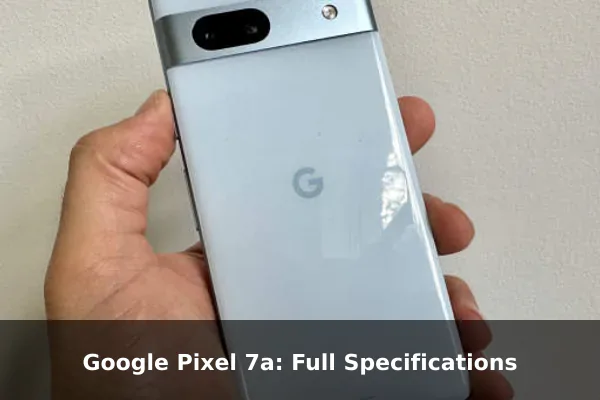
The Google Pixel 7a is a compact Android phone built around Google’s Tensor G2 chipset, a 90Hz OLED display, and a dual rear camera system led by a 64 MP main sensor. It sits in the A-series line, but its feature mix brings it closer to Google’s regular Pixel models than older budget Pixels.
This article focuses on what the Pixel 7a means as a value-focused 5G phone: its design trade-offs, display quality, real-world performance, camera flexibility, battery behavior, software support, and model-specific connectivity differences.
Full Specifications
Network
| Technology: | GSM / HSPA / LTE / 5G |
| 2G bands: | GSM 850 / 900 / 1800 / 1900 |
| 3G bands: | HSDPA 800 / 850 / 900 / 1700(AWS) / 1900 / 2100 |
| 4G bands: | 1, 2, 3, 4, 5, 7, 8, 12, 13, 14, 17, 20, 25, 26, 28, 29, 30, 38, 40, 41, 48, 66, 71 – GWKK3, G0DZQ |
| 1, 2, 3, 4, 5, 7, 8, 12, 17, 18, 19, 20, 21, 25, 28, 32, 38, 39, 40, 41, 42, 66 – GHL1X, G82U8 | |
| 5G bands: | 1, 2, 3, 5, 7, 8, 12, 14, 20, 25, 28, 30, 38, 41, 48, 66, 71, 77, 78 SA/NSA/Sub6 – GWKK3 |
| 1, 2, 3, 5, 7, 8, 12, 14, 20, 25, 28, 30, 38, 41, 48, 66, 71, 77, 78, 260, 261 SA/NSA/Sub6/mmWave – G0DZQ | |
| 1, 2, 3, 5, 7, 8, 12, 20, 25, 28, 38, 40, 41, 66, 75, 76, 77, 78, 79 SA/NSA/Sub6 – GHL1X, G82U8 | |
| Speed: | HSPA, LTE (CA), 5G |
Launch
| Announced: | 2023, May 10 |
| Status: | Available. Released 2023, May 10 |
Body
| Dimensions: | 152 x 72.9 x 9 mm (5.98 x 2.87 x 0.35 in) |
| Weight: | 193.5 g (6.84 oz) |
| Build: | Glass front (Gorilla Glass 3), aluminum frame, plastic back |
| SIM: | Nano-SIM + eSIM |
| IP67 dust/water resistant (up to 1m for 30 min) |
Display
| Type: | OLED, HDR, 90Hz |
| Size: | 6.1 inches, 90.7 cm2 (~81.8% screen-to-body ratio) |
| Resolution: | 1080 x 2400 pixels, 20:9 ratio (~429 ppi density) |
| Protection: | Corning Gorilla Glass 3 |
Platform
| OS: | Android 13, upgradable to Android 15, up to 5 major Android upgrades |
| Chipset: | Google Tensor G2 (5 nm) |
| CPU: | Octa-core (2×2.85 GHz Cortex-X1 & 2×2.35 GHz Cortex-A78 & 4×1.80 GHz Cortex-A55) |
| GPU: | Mali-G710 MP7 |
Memory
| Card slot: | No |
| Internal: | 128GB 8GB RAM |
| UFS 3.1 |
Main Camera
| Dual: | 64 MP, f/1.9, 26mm (wide), 1/1.73″, 0.8µm, dual pixel PDAF, OIS 13 MP, f/2.2, 120˚ (ultrawide), 1.12µm |
| Features: | Dual-LED flash, Pixel Shift, Auto-HDR, panorama |
| Video: | 4K@30/60fps, 1080p@30/60/120/240fps, OIS |
Selfie camera
| Single: | 13 MP, f/2.2, 20mm (ultrawide), 1.12µm |
| Features: | HDR, panorama |
| Video: | 4K@30fps, 1080p@30fps |
Sound
| Loudspeaker: | Yes, with stereo speakers |
| 3.5mm jack: | No |
Comms
| WLAN: | Wi-Fi 802.11 a/b/g/n/ac/6e, tri-band |
| Bluetooth: | 5.3, A2DP, LE |
| Positioning: | GPS, GLONASS, GALILEO, BDS, QZSS, NavIC |
| NFC: | Yes |
| Radio: | No |
| USB: | USB Type-C 3.2 |
Features
| Sensors: | Fingerprint (under display, optical), accelerometer, gyro, proximity, compass, barometer |
| Circle to Search |
Battery
| Type: | Li-Po 4385 mAh |
| Charging: | 18W wired, PD3.0 7.5W wireless |
Misc
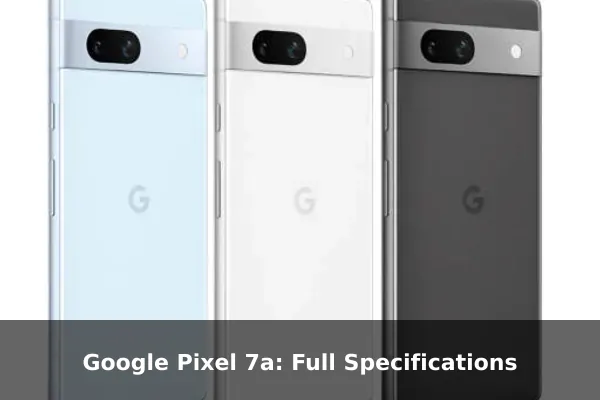
| Colors: | Charcoal, Snow, Sea, Coral |
| Models: | GWKK3, GHL1X, G0DZQ, G82U8 |
| Price: | € 195.00 / $ 161.45 / £ 175.20 / ₹ 27,999 |
Our Tests
| Performance: | AnTuTu: 765281 (v9) GeekBench: 3191 (v5.1), 3631 (v6) GFXBench: 62fps (ES 3.1 onscreen) |
| Display: | 1070 nits max brightness (measured) |
| Camera: | Photo / Video |
| Loudspeaker: | -26.5 LUFS (Good) |
| Battery (old): | Endurance rating 76h |
Price and Availability
The Google Pixel 7a offers a compelling combination of features and performance. While the base price is around €195, the actual cost may vary depending on your location and retailer. Below, you’ll find the approximate price of the Google Pixel 7a converted into various currencies. Please note that these are estimates based on recent exchange rates as of September 7, 2026 and may not reflect the exact price you’ll find at a retailer.
- United States: $226
- Japan: ¥35,371
- United Kingdom: £168
- Australia: A$314
- Canada: C$313
- Taiwan: NT$7,169
- Denmark: kr1.458
- Saudi Arabia: ﷼849
- South Korea: ₩305,364
- Germany: €195
- Brazil: R$1.160
- Vietnam: ₫5.889.304
- Kenya: KSh 29,336
- India: ₹21,408
- Indonesia: Rp 3.994.965
- Nigeria: ₦300,688
- Pakistan: ₨62,884
- Philippines: ₱14,187
- Bangladesh: ৳২৭,৮৪৪
Value Position
The Pixel 7a is most interesting because it brings several premium Pixel traits into a smaller and more affordable body. Tensor G2, 8 GB of RAM, wireless charging, a 90Hz OLED panel, IP67 protection, and Google’s computational camera processing give it a stronger feature base than many mid-range phones that rely mainly on large batteries or high megapixel counts.
Its value depends heavily on market price. The source price data places it well below its original launch level, but pricing and stock can vary by region, condition, seller, and model code. At a reduced price, the Pixel 7a becomes especially appealing for buyers who prioritize software experience, camera consistency, and compact handling over fast charging or expandable storage.
Design and Build
The Pixel 7a measures 152 x 72.9 x 9 mm and weighs 193.5 g, making it smaller than many current Android phones but not especially light. The aluminum frame gives it a more solid feel than a fully plastic budget device, while the plastic back helps control cost and durability concerns. Gorilla Glass 3 protects the front, which is usable but less advanced than newer Gorilla Glass generations.
The IP67 rating is a meaningful advantage for daily use, covering dust resistance and water resistance up to 1 meter for 30 minutes under rated conditions. As with any phone, that resistance can degrade with wear, repairs, or impact, so it should be treated as protection against accidents rather than permission for underwater use.
Display Experience
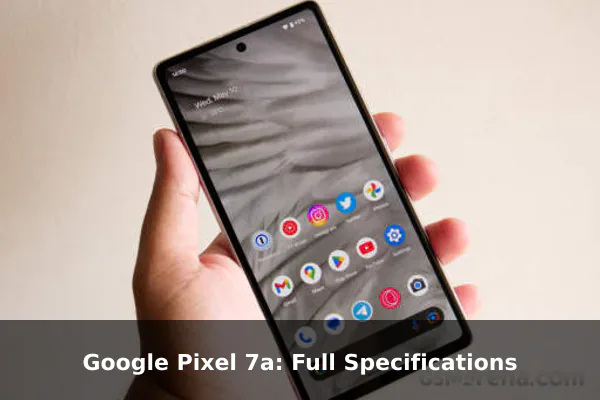
The 6.1-inch OLED display is one of the Pixel 7a’s strongest everyday features. Its 1080 x 2400 resolution, 20:9 aspect ratio, and roughly 429 ppi density make text and photos sharp, while HDR support and the 90Hz refresh rate give it a smoother feel than older 60Hz A-series Pixels.
The measured peak brightness figure of 1070 nits is strong enough for comfortable outdoor readability in many conditions. It is not a flagship LTPO panel, so buyers should not expect the most advanced adaptive refresh behavior, but the balance of size, sharpness, contrast, and refresh rate is very good for a compact mid-range Pixel.
Tensor G2 Performance
Google Tensor G2 is not only about benchmark speed. Its value is also tied to Pixel camera processing, speech features, on-device intelligence, security hardware, and the overall Pixel software stack. The listed test results, including AnTuTu 765281 on v9 and GeekBench scores of 3191 on v5.1 and 3631 on v6, point to performance that is comfortably above basic mid-range needs.
For daily use, the Pixel 7a should handle messaging, navigation, streaming, photo editing, banking apps, social media, and multitasking smoothly. The Mali-G710 MP7 GPU and GFXBench result of 62fps in ES 3.1 onscreen suggest respectable graphics capability, although heavy gaming remains one of the areas where larger gaming-focused phones with stronger cooling and bigger batteries may be better choices.
Camera System
The rear camera setup combines a 64 MP wide camera with OIS and dual pixel PDAF alongside a 13 MP ultrawide camera with a 120-degree field of view. This is a practical two-camera layout: the main sensor covers general photography, low-light scenes, portraits, and video, while the ultrawide camera is useful for travel, interiors, group shots, and landscapes.
Pixel phones are typically strongest in processing consistency rather than manual hardware variety. The Pixel 7a lacks a telephoto camera, so zoom quality will rely on digital processing instead of optical reach. Video support is strong for the class, with up to 4K at 60fps from the rear camera, 1080p slow-motion options, and OIS helping stabilize footage from the main camera.
Battery and Charging
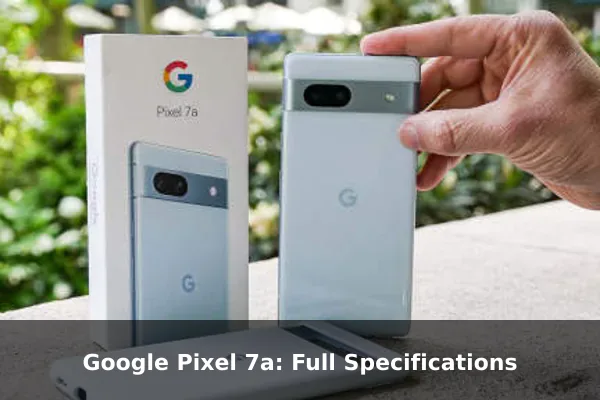
The 4385 mAh battery is sized for a compact phone rather than maximum endurance. The listed old endurance rating of 76 hours suggests dependable but not class-leading battery life. Users who mainly browse, message, stream music, use maps occasionally, and take photos should find it workable for normal daily use, while extended gaming, hotspot use, or heavy 5G activity will drain it faster.
Charging is one of the clearer compromises. The Pixel 7a supports 18W wired charging with PD3.0 and 7.5W wireless charging. Wireless charging is welcome in this segment, but both wired and wireless speeds are modest compared with many Android rivals. Buyers who need very fast top-ups should factor this in.
Software and Pixel Features
The Pixel 7a launched with Android 13 and is listed as upgradable to Android 15 with up to 5 major Android upgrades. That gives it a long software runway for an A-series phone, especially for users who keep devices for several years. Pixel phones also tend to receive Google features quickly, though availability can depend on region, language, account settings, and app support.
Circle to Search is included in the source data and adds a modern search layer for identifying objects, text, or products from supported screen content. The under-display optical fingerprint sensor, stereo speakers, NFC, and broad location system support round out the experience in a way that feels more complete than entry-level Android phones.
Connectivity and Model Differences
The Pixel 7a supports GSM, HSPA, LTE, and 5G, with carrier aggregation on LTE and both SA and NSA 5G modes listed. Wi-Fi 6E, Bluetooth 5.3, NFC, USB Type-C 3.2, and support for GPS, GLONASS, GALILEO, BDS, QZSS, and NavIC make the connectivity package strong for the price class.
Model codes matter. The G0DZQ variant includes listed mmWave bands 260 and 261, while other versions focus on Sub-6 5G. Buyers in markets where mmWave support is relevant should check the exact model before purchase, especially when buying imported, refurbished, or marketplace units.
Who Should Buy It
The Pixel 7a is best for buyers who want a smaller Android phone with clean software, reliable cameras, good display quality, water resistance, NFC, stereo speakers, and long update potential. It is also a sensible choice for users who prefer Google’s camera style and Android interface over heavily customized manufacturer skins.
It is less ideal for people who need expandable storage, a headphone jack, ultra-fast charging, a telephoto lens, or a very large display. The single 128 GB storage option is enough for many users, but people who record lots of 4K video or keep large offline media libraries may find it restrictive over time.
References
Reference sources used for cross-checking include Google Pixel Phone Help hardware specifications, Google’s Pixel 7a launch announcement, and the provided source catalog from tampungspekhp.berkasdrive.com.
Conclusion
The Google Pixel 7a remains a strong compact Android choice when priced competitively. Its biggest strengths are the Tensor G2 platform, OLED 90Hz display, dependable Pixel camera processing, IP67 protection, wireless charging, and long software outlook. Its main compromises are slow charging, no microSD slot, no 3.5mm jack, and no optical zoom camera. Recommended for buyers who want Pixel software and camera quality in a smaller value-focused phone.
