
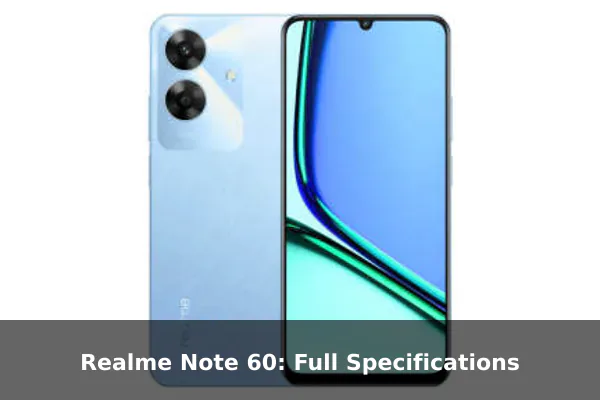
The Realme Note 60 is a budget-focused Android phone built around practical basics: a large 90Hz display, a 5000 mAh battery, dual SIM support, expandable storage, and a 32 MP rear camera. It is not designed to compete with mid-range 5G models, but it does aim to make everyday smartphone use feel dependable at a low entry price.
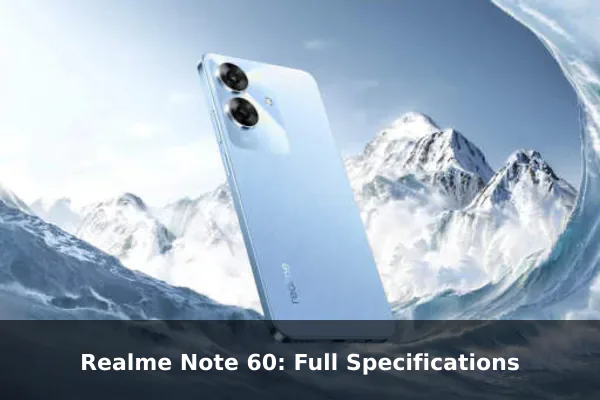
Its most distinctive angle is durability for the category. Realme highlights an IP64 rating, reinforced glass, a slim 7.8 mm body, and a die-cast aluminum chassis structure, giving the Note 60 a tougher identity than many simple 4G phones aimed at calls, messaging, streaming, and light app use.
Full Specifications
Network
| Technology: | GSM / HSPA / LTE |
| 2G bands: | GSM 850 / 900 / 1800 / 1900 |
| 3G bands: | HSDPA 900 / 2100 |
| 4G bands: | 1, 3, 5, 8, 40 |
| Speed: | HSPA, LTE |
Launch
| Announced: | 2024, August 30 |
| Status: | Available. Released 2024, August 30 |
Body
| Dimensions: | 167.3 x 76.7 x 7.8 mm (6.59 x 3.02 x 0.31 in) |
| Weight: | 187 g (6.60 oz) |
| Build: | Glass front, plastic frame, plastic back |
| SIM: | Nano-SIM + Nano-SIM |
| IP64 dust tight and water resistant (water splashes) Die-cast aluminum chassis |
Display
| Type: | IPS LCD, 90Hz, 450 nits (typ), 560 nits (HBM) |
| Size: | 6.74 inches, 109.7 cm2 (~85.5% screen-to-body ratio) |
| Resolution: | 720 x 1600 pixels, 20:9 ratio (~260 ppi density) |
| Protection: | Reinforced glass |
Platform
| OS: | Android 14, Realme UI |
| Chipset: | Unisoc Tiger T612 (12 nm) |
| CPU: | Octa-core (2×1.8 GHz Cortex-A75 & 6×1.8 GHz Cortex-A55) |
| GPU: | Mali-G57 |
Memory
| Card slot: | microSDXC (dedicated slot) |
| Internal: | 64GB 3GB RAM, 64GB 4GB RAM, 128GB 4GB RAM, 128GB 6GB RAM, 128GB 8GB RAM, 256GB 4GB RAM, 256GB 8GB RAM |
Main Camera
| Single: | 32 MP, f/1.8, (wide), PDAF Auxiliary lens |
| Features: | LED flash, panorama |
| Video: | 1080p@30fps |
Selfie camera
| Single: | 5 MP, (wide) |
| Video: | 720p@30fps |
Sound
| Loudspeaker: | Yes |
| 3.5mm jack: | Yes |
Comms
| WLAN: | Wi-Fi 802.11 a/b/g/n/ac, dual-band |
| Bluetooth: | 5.0, A2DP, LE |
| Positioning: | GPS, GALILEO, GLONASS, BDS |
| NFC: | No |
| Radio: | Unspecified |
| USB: | USB Type-C 2.0 |
Features
| Sensors: | Fingerprint (side-mounted), accelerometer, proximity, compass |
Battery
| Type: | 5000 mAh |
| Charging: | 10W wired |
Misc
| Colors: | Voyage Blue, Marble Black |
| Models: | RMX3933 |
| Price: | € 86.00 / $ 165.00 / £ 77.00 |
Price and Availability
The Realme Note 60 offers a compelling combination of features and performance. While the base price is around €86, the actual cost may vary depending on your location and retailer. Below, you’ll find the approximate price of the Realme Note 60 converted into various currencies. Please note that these are estimates based on recent exchange rates as of August 7, 2026 and may not reflect the exact price you’ll find at a retailer.
- United States: $99
- Japan: ¥15,689
- United Kingdom: £74
- Australia: A$141
- Canada: C$139
- Taiwan: NT$3,197
- Denmark: kr642
- Saudi Arabia: ﷼372
- South Korea: ₩141,286
- Germany: €86
- Brazil: R$508
- Vietnam: ₫2.585.718
- Kenya: KSh 12,849
- India: ₹9,442
- Indonesia: Rp 1.777.872
- Nigeria: ₦135,154
- Pakistan: ₨27,543
- Philippines: ₱6,027
- Bangladesh: ৳১২,২৭৪
Value Positioning
The Realme Note 60 sits in the practical end of the smartphone market, where buyers usually care more about battery life, screen size, storage flexibility, and repair-conscious build choices than benchmark numbers. Its raw price data places it in budget territory, although final pricing can vary by market, retailer, configuration, and taxes. That matters because the Note 60 is offered in several memory and storage versions, starting from modest 64 GB variants and reaching up to 256 GB storage with higher RAM options.
The key value argument is simple: this is a 4G Android phone for users who want the core experience without paying for features they may not use. There is no 5G, no ultrawide camera, no OLED panel, and no fast charging beyond 10W. In exchange, the phone keeps useful everyday details such as a 3.5 mm headphone jack, a dedicated microSDXC slot, USB Type-C, dual-band Wi-Fi, and a side-mounted fingerprint reader.
Design And Durability
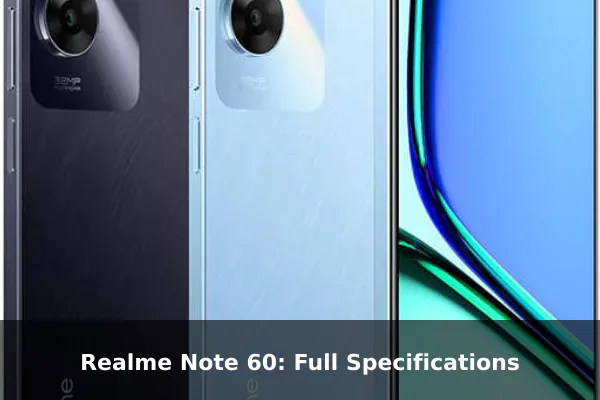
At 167.3 x 76.7 x 7.8 mm and 187 g, the Realme Note 60 is a large but fairly slim phone. The plastic frame and plastic back are expected at this level, while the glass front and reinforced glass protection help the front surface feel more reassuring for daily use. Realme also lists IP64 dust tight and water resistant protection against splashes, which is a useful advantage for a phone likely to be carried without much ceremony.
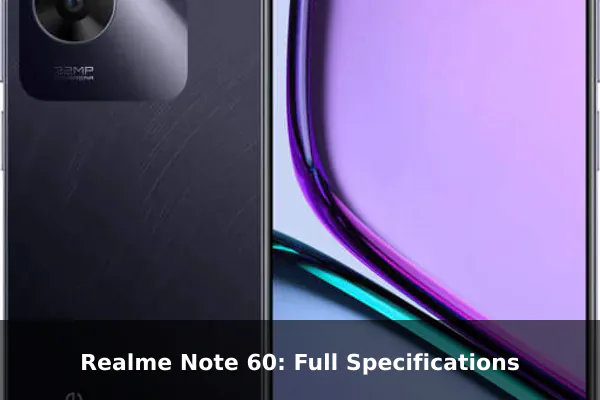
The die-cast aluminum chassis claim gives the Note 60 a more durability-led identity than a typical entry phone. It should not be treated like a rugged device, and IP64 does not mean waterproof, but it does suggest better resistance to dust and light water exposure than phones with no stated rating. The color options, Voyage Blue and Marble Black, keep the styling straightforward, with the blue finish adding the more expressive look.
Display Experience
The 6.74-inch IPS LCD is one of the strongest reasons to consider the Realme Note 60. Its 90Hz refresh rate can make scrolling feel smoother than older 60Hz budget phones, and the large panel suits messaging, video, web browsing, navigation, and reading. The 720 x 1600 resolution is modest for the screen size, so fine text and dense web pages will not look as crisp as on Full HD panels, but the tradeoff can help reduce power demand.
Brightness is listed at 450 nits typical and 560 nits in high brightness mode. That is usable for indoor and shaded outdoor use, though direct midday sunlight may still challenge visibility. This is an IPS LCD rather than AMOLED, so buyers should not expect deep black levels or always-on display behavior. The display is best understood as large, smooth, and functional rather than premium.
Performance And Storage
The Unisoc Tiger T612 chipset uses an octa-core CPU with two Cortex-A75 cores and six Cortex-A55 cores, paired with a Mali-G57 GPU. This hardware is suitable for communication apps, browsing, social media, video playback, banking apps, and simple games. It is not the right match for heavy multitasking, demanding 3D games, or long-term users who keep many background apps open at once.
Configuration choice matters more than usual here. The 3 GB RAM version should be treated as the basic option for light users, while 4 GB or 6 GB RAM models are more sensible for a smoother daily experience. The 8 GB RAM variants are the most comfortable on paper, especially with 128 GB or 256 GB storage. The dedicated microSDXC slot is a major plus because it lets users expand media storage without giving up a second SIM card.
Camera Expectations
The rear camera setup is simple: a 32 MP wide camera with PDAF, supported by an auxiliary lens. Realme includes LED flash, panorama support, and 1080p video recording at 30 fps. For this class, the main camera should be approached as a daylight and casual-documentation tool. It is suitable for receipts, notes, social posts, and family snapshots when lighting is good.
The 5 MP front camera records 720p video at 30 fps. That is enough for basic selfies and video calls, but it is not aimed at creators or users who expect sharp front-camera video. The lack of additional rear focal lengths also means there is no true ultrawide or telephoto flexibility. Buyers should choose the Note 60 for simple camera reliability, not for camera versatility.
Battery And Charging
The 5000 mAh battery is one of the Note 60’s most important specifications. Combined with an HD+ display, a 4G chipset, and modest performance demands, it should be well suited to a full day of typical use. Users focused on messaging, calls, browsing, maps, music, and occasional video playback are the best match for this battery profile.
The limitation is charging speed. The 10W wired charging support is slow compared with many modern phones, even some budget competitors. This makes overnight charging or planned top-ups more realistic than quick charging before leaving home. For buyers who value endurance more than charging speed, the compromise is acceptable. For users who frequently need fast midday charging, it is a clear weakness.
Software And Everyday Features
The Realme Note 60 ships with Android 14 and Realme UI. That gives it a current software base for its launch period, with Realme’s interface layered on top for features such as customization, system tools, and brand-specific interaction options. As always with budget Android phones, long-term update policy can vary by region, so buyers should check the local Realme support page or retailer listing before purchase.
The side-mounted fingerprint sensor is a practical choice because it keeps unlocking fast and familiar. The sensor list also includes accelerometer, proximity, and compass support, covering the basics for rotation, calls, and navigation behavior. The phone keeps the 3.5 mm jack, which remains useful for wired earphones, school use, work calls, and low-cost accessories.
Connectivity And Network Fit
The Realme Note 60 is a 4G LTE phone with GSM and HSPA fallback. Its listed 4G bands include 1, 3, 5, 8, and 40 in the provided source data, while official regional pages may list broader market-specific band support. Because band availability can differ by market variant and carrier, buyers should confirm compatibility with their local operator before importing the RMX3933 model.
Wireless basics are solid for the price: Wi-Fi 802.11 a/b/g/n/ac with dual-band support, Bluetooth 5.0, GPS, GALILEO, GLONASS, and BDS positioning. NFC is not included, so contactless payments and NFC pairing are not part of the package. USB Type-C 2.0 is present, which is welcome for charging and basic data transfer even though it is not a high-speed port.
Who Should Buy The Realme Note 60?
The Realme Note 60 makes the most sense for first-time smartphone buyers, students, secondary-phone users, delivery and field workers, and anyone who wants a simple Android handset with a big screen and strong battery capacity. It also suits users who still rely on wired headphones, microSD cards, or dual SIM setups.
It is less suitable for buyers who want 5G, sharper display resolution, fast charging, advanced gaming performance, or a flexible camera system. In comparison-friendly terms, the Note 60 is not trying to be the most powerful phone for the money. Its better pitch is that it combines budget pricing, everyday Android usability, a large 90Hz display, expandable storage, and a more resilient body than expected in this segment.
Conclusion
The Realme Note 60 is a sensible budget 4G phone with a large 90Hz screen, 5000 mAh battery, expandable storage, headphone jack, Android 14, and useful splash and dust resistance. Its weak points are predictable: slow 10W charging, basic cameras, HD+ resolution, and no NFC or 5G. Buy it if durability, battery life, and low-cost everyday use matter more than speed or camera range.
References
- realme Note 60 Specifications – realme Global – Primary manufacturer specification page for display, chipset, memory, cameras, battery, dimensions, wireless bands, ports, sensors, and Android version.
- realme Note 60 Product Page – realme Middle East & Africa – Official English product page with feature claims such as ArmorShell build, IP64 resistance, 32MP camera, 90Hz display, slim body, and configuration highlights.
- FCC Equipment Authorization System (fcc.gov) – Official regulator database for confirming the RMX3933 device authorization under FCC ID 2AUYFRMX3933, including wireless compliance, operating frequencies, and SAR/RF exposure filings.
- FoneArena realme Note 60 Launch Coverage – Reputable mobile technology publication useful for cross-checking launch date, Indonesia pricing, configurations, and summarized specifications against official sources.
