
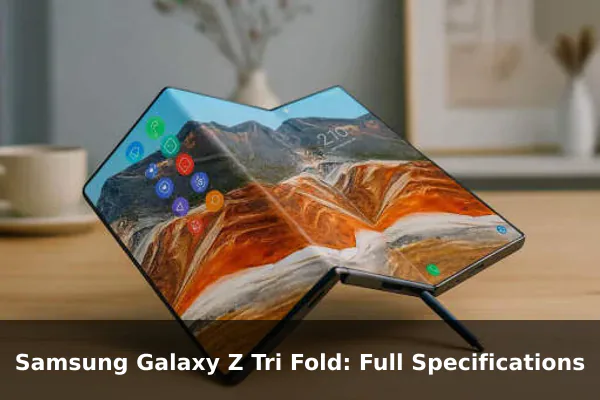
Samsung pushes foldable design into new territory with the Galaxy Z Tri Fold, a triple-folding flagship that unfolds into a tablet-sized 10.0-inch canvas while still slipping into a pocket when closed. Announced on December 2, 2025 and released ten days later, it pairs Samsung’s most ambitious hinge engineering yet with the Snapdragon 8 Elite chipset, a 200 MP main camera, and One UI 8 on Android 16.
This article focuses on what the Tri Fold means in real-world use rather than just listing numbers: how the dual-hinge body holds up, where the multi-panel display shines, and whether the roughly 2,100 EUR positioning makes sense for the buyer it targets. Use it alongside the full specifications table for a complete picture.
Full Specifications
Network
| Technology: | GSM / CDMA / HSPA / EVDO / LTE / 5G |
| 2G bands: | GSM 850 / 900 / 1800 / 1900 |
| CDMA 800 / 1900 | |
| 3G bands: | HSDPA 850 / 900 / 1700(AWS) / 1900 / 2100 |
| CDMA2000 1xEV-DO | |
| 4G bands: | LTE |
| 5G bands: | SA/NSA/Sub6 |
| Speed: | HSPA, LTE, 5G |
Launch
| Announced: | 2025, December 02 |
| Status: | Available. Released 2025, December 12 |
Body
| Dimensions: | Unfolded: 159.2 x 214.1 x 3.9-4.2 mmFolded: 159.2 x 75 x 12.9 mm |
| Weight: | 309 g (10.90 oz) |
| Build: | Glass front (Gorilla Glass Victus Ceramic 2) (folded), plastic front (unfolded), ceramic-glass fiber-reinforced polymer back, aluminum frame, titanium hinge housing |
| SIM: | · Nano-SIM + Nano-SIM + eSIM + eSIM (max 2 at a time)· Nano-SIM + Nano-SIM + multiple eSIM (max 2 at a time)· Nano-SIM + Nano-SIM |
| IP48 dust and water resistant (dust > 1mm; immersible up to 1.5m for 30 min) Advanced Armor aluminum frame |
Display
| Type: | Tri-foldable Dynamic LTPO AMOLED 2X, 120Hz, HDR, 1600 nits (peak) |
| Size: | 10.0 inches, 305.4 cm2 (~89.6% screen-to-body ratio) |
| Resolution: | 1584 x 2160 pixels, 4:3 ratio (~269 ppi density) |
| Dynamic LTPO AMOLED 2X, 120Hz, HDR, 2600 nits (peak), Corning Gorilla Glass Ceramic 2 6.5 inches, 1080 x 2520 pixels, 422 ppi |
Platform
| OS: | Android 16, One UI 8 |
| Chipset: | Qualcomm SM8750-AC Snapdragon 8 Elite (3 nm) |
| CPU: | Octa-core (2×4.47 GHz Oryon V2 Phoenix L + 6×3.53 GHz Oryon V2 Phoenix M) |
| GPU: | Adreno 830 (1200 MHz) |
Memory
| Card slot: | No |
| Internal: | 512GB 16GB RAM, 1TB 16GB RAM |
| UFS |
Main Camera
| Triple: | 200 MP, f/1.7, 24mm (wide), 1/1.3″, 0.6µm, multi-directional PDAF, OIS 10 MP, f/2.4, 67mm (telephoto), 1/3.94″, 1.0µm, PDAF, OIS, 3x optical zoom 12 MP, f/2.2, 13mm, 120˚ (ultrawide), 1/2.55″, 1.4µm, dual pixel PDAF |
| Features: | LED flash, HDR, panorama |
| Video: | 8K@30fps, 4K@60fps, 1080p@60/120/240fps (gyro-EIS), 10-bit HDR, HDR10+ |
Selfie camera
| Single: | 10 MP, f/2.2, 18mm (ultrawide), 1/3.0″, 1.12µm Cover camera: 10 MP, f/2.2, 24mm (wide), 1/3.0″, 1.12µm |
| Features: | HDR |
| Video: | 4K@30/60fps, 1080p@30/60fps, gyro-EIS |
Sound
| Loudspeaker: | Yes, with stereo speakers |
| 3.5mm jack: | No |
Comms
| WLAN: | Wi-Fi 802.11 a/b/g/n/ac/6e/7, tri-band, Wi-Fi Direct |
| Bluetooth: | 5.4, A2DP, LE, aptX HD |
| Positioning: | GPS, GALILEO, GLONASS, BDS, QZSS |
| NFC: | Yes |
| Radio: | No |
| USB: | USB Type-C |
Features
| Sensors: | Fingerprint (side-mounted), accelerometer, gyro, proximity, compass, barometer |
| Samsung DeX wireless (desktop experience support) |
Battery
| Type: | Li-Ion 5600 mAh |
| Charging: | 45W wired, QC2.0, 50% in 30 min 15W wireless 4.5W reverse wireless |
Misc
| Colors: | Crafted Black |
| Models: | SM-D639B, SM-D639B/DS, SM-D639U, SM-D639U1, SM-D639N, SM-D6390 |
| Price: | About 2100 EUR (price in S. Korea) |
Price and Availability
The Samsung Galaxy Z Tri Fold offers a compelling combination of features and performance. While the base price is around €2.100, the actual cost may vary depending on your location and retailer. Below, you’ll find the approximate price of the Samsung Galaxy Z Tri Fold converted into various currencies. Please note that these are estimates based on recent exchange rates as of June 25, 2026 and may not reflect the exact price you’ll find at a retailer.
- United States: $2,384
- Japan: ¥385,617
- United Kingdom: £1,811
- Australia: A$3,456
- Canada: C$3,392
- Taiwan: NT$75,646
- Denmark: kr15.674
- Saudi Arabia: ﷼8,941
- South Korea: ₩3,679,279
- Germany: €2.100
- Brazil: R$12.383
- Vietnam: ₫62.598.447
- Kenya: KSh 308,751
- India: ₹2,25,578
- Indonesia: Rp 42.818.253
- Nigeria: ₦3,242,305
- Pakistan: ₨663,129
- Philippines: ₱146,032
- Bangladesh: ৳২,৯৩,২০২
Why the Galaxy Z Tri Fold Stands Apart
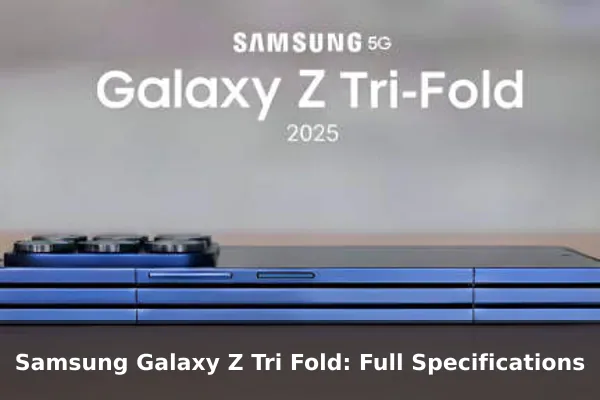
Most foldables fold once; the Z Tri Fold folds twice, using two titanium-housed hinges to wrap a single flexible panel into a three-section slab. That places it in a tiny niche occupied by very few rivals, and it is Samsung’s clearest answer to the multi-fold concept. The payoff is a genuine tablet experience that collapses to roughly phone width, making it a true two-devices-in-one proposition for people who currently carry both a handset and a small tablet.
Design and Build Quality
Unfolded, the Tri Fold measures just 3.9-4.2 mm thick, expanding to a chunkier 12.9 mm when closed, with a 309 g weight that reflects its tablet-class footprint. Samsung leans on premium materials: a Gorilla Glass Victus Ceramic 2 cover, a ceramic-glass fiber-reinforced polymer back, an Advanced Armor aluminum frame, and titanium hinge housings. IP48 dust and water resistance is notable for a multi-hinge device, offering immersion protection up to 1.5 m for 30 minutes, though the sub-1 mm dust rating is a reminder that folding mechanisms remain harder to fully seal than a slab phone.
The Tri-Foldable Display Experience
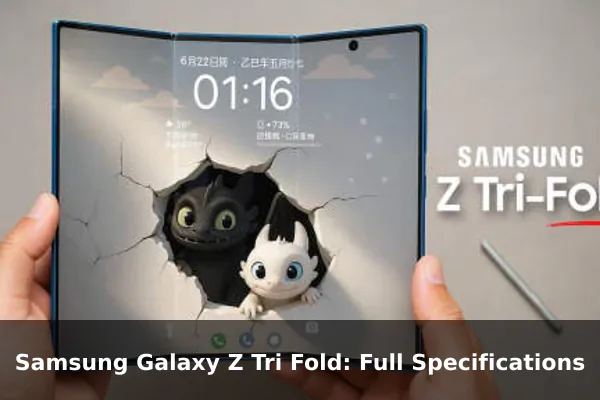
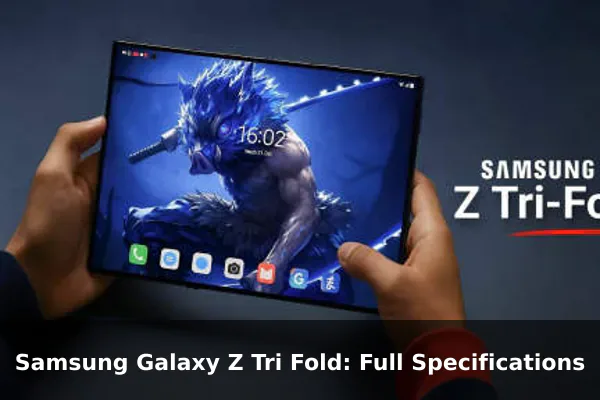
The headline is a 10.0-inch Dynamic LTPO AMOLED 2X main panel running at 120Hz with HDR and a 1600-nit peak, at 1584 x 2160 in a 4:3 ratio that suits documents, reading, and split-screen multitasking. When folded, a 6.5-inch 1080 x 2520 cover display (also LTPO AMOLED 2X, 120Hz, up to 2600 nits peak, protected by Gorilla Glass Ceramic 2) handles everyday one-handed tasks. The result is a device you can use like a normal phone, then open fully for video, gaming, or productivity without compromise.
Performance and Hardware
Power comes from the Qualcomm Snapdragon 8 Elite (SM8750-AC) built on a 3 nm process, with an octa-core Oryon V2 layout topping out at 4.47 GHz and an Adreno 830 GPU. Samsung pairs it with a generous 16GB of RAM across both the 512GB and 1TB UFS storage tiers, so memory is never the bottleneck even with several apps tiled across the large screen. There is no microSD slot, so buyers should size their storage choice carefully up front.
Camera System
The rear array is led by a 200 MP f/1.7 wide sensor with multi-directional PDAF and OIS, joined by a 10 MP f/2.4 telephoto offering 3x optical zoom with OIS and a 12 MP f/2.2 ultrawide with a 120-degree field of view. Video tops out at 8K@30fps and 4K@60fps with 10-bit HDR and HDR10+. Selfies are handled by a 10 MP ultrawide on the inner display plus a 10 MP cover camera, and the foldable form factor doubles as a built-in tripod for hands-free shooting and high-quality video calls.
Battery and Charging
A 5600 mAh Li-Ion battery powers the larger canvas, with 45W wired charging rated to reach roughly 50% in 30 minutes, plus 15W wireless and 4.5W reverse wireless charging. The capacity is sensible for the screen real estate, though the 45W wired ceiling is conservative next to some flagship rivals that push higher figures; in practice the efficient 3 nm chip helps stretch each charge across mixed phone-and-tablet use.
Software, DeX and Connectivity
The Tri Fold ships with Android 16 and One UI 8, and Samsung’s long software-support track record makes it a strong pick for buyers who keep premium devices for years. Samsung DeX wireless turns the device into a desktop-style workspace, complementing the multi-window strengths of the big screen. Connectivity is comprehensive: Wi-Fi 7 with tri-band support, Bluetooth 5.4 with aptX HD, NFC, USB Type-C, broad 5G SA/NSA Sub6 bands, and a side-mounted fingerprint sensor. Flexible SIM options include dual Nano-SIM plus eSIM combinations.
Who Should Buy the Galaxy Z Tri Fold
This is a device for early adopters, mobile professionals, and content creators who genuinely want a pocketable tablet and can absorb a flagship-plus price. If you mostly use a single screen, a conventional foldable or slab flagship delivers more value. But for multitaskers who read, sketch, present, and watch on the move, the tri-fold format is uniquely capable, offered at launch in a single Crafted Black finish.
Conclusion
The Samsung Galaxy Z Tri Fold is a statement device that delivers a real tablet-to-phone transformation with top-tier silicon, a versatile 200 MP camera system, and the polish of One UI 8 on Android 16. Its trade-offs are familiar to cutting-edge foldables: significant weight, a high price, no expandable storage, and conservative wired charging. For buyers who want the most flexible large-screen Samsung experience and value innovation over outright affordability, it is a compelling, future-leaning choice; everyone else will likely be better served by a standard foldable or flagship slab. Always confirm final pricing, availability, and exact specifications with official Samsung sources for your region.
References
- Samsung Galaxy Z TriFold Official Product Page – Official Samsung product page for current device details including display sizes, camera, processor, battery, color, durability, DeX, and availability status.
- Samsung Global Newsroom – Introducing Galaxy Z TriFold – Primary launch article with Samsung's official specifications table, dimensions, weight, cameras, chipset, battery, charging, display, and launch markets.
- Samsung Mobile Press – Galaxy Z TriFold Tech Specs – Official Samsung press resource intended for media use, useful for confirming technical specs and official product assets.
- GSMArena – Samsung Galaxy Z TriFold 5G – Established smartphone specifications database useful as a secondary cross-check for network bands, model details, camera configuration, battery, dimensions, and feature listings.
