
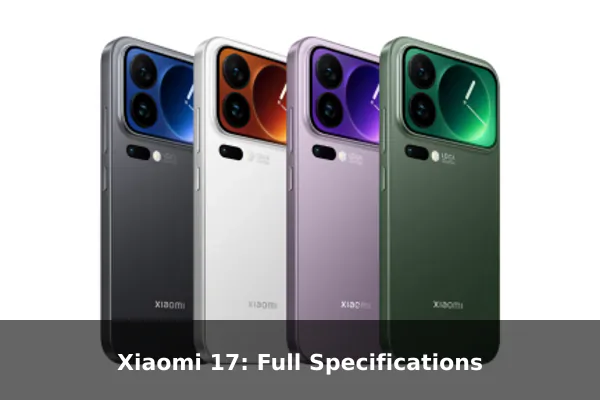
The Xiaomi 17 is a compact flagship built around high-end silicon, a bright LTPO AMOLED display, Leica-branded cameras, and an unusually large silicon-carbon battery. It targets buyers who want premium Android hardware without moving into oversized ultra-phone territory.
Announced on September 25, 2025 and released on September 27, 2025, the phone combines Snapdragon 8 Elite Gen 5 performance, HyperOS 3, 5G connectivity, fast wired and wireless charging, and a dual-SIM body with IP68 protection.
Full Specifications
Network
| Technology: | GSM / HSPA / LTE / 5G |
| 2G bands: | GSM 850 / 900 / 1800 / 1900 |
| 3G bands: | HSDPA 800 / 850 / 900 / 1700(AWS) / 1900 / 2100 |
| 4G bands: | 1, 2, 3, 4, 5, 7, 8, 12, 17, 18, 19, 20, 25, 26, 28, 34, 38, 39, 40, 41, 42, 48, 66 |
| 5G bands: | 1, 2, 3, 5, 7, 8, 12, 18, 20, 25, 26, 28, 38, 40, 41, 48, 66, 77, 78, 80, 81, 83, 84, 89 SA/NSA |
| Speed: | HSPA, LTE, 5G |
Launch
| Announced: | 2025, September 25 |
| Status: | Available. Released 2025, September 27 |
Body
| Dimensions: | 151.1 x 71.8 x 8.1 mm (5.95 x 2.83 x 0.32 in) |
| Weight: | 191 g (6.74 oz) |
| Build: | Glass front (Dragon Crystal Glass), aluminum frame |
| SIM: | Nano-SIM + Nano-SIM |
| IP68 dust tight and water resistant (immersible up to 1.5m for 30 min) |
Display
| Type: | LTPO AMOLED, 68B colors, 2160Hz PWM, 120Hz, Dolby Vision, HDR Vivid, HDR10+, 3500 nits (peak) |
| Size: | 6.3 inches, 97.1 cm2 (~89.5% screen-to-body ratio) |
| Resolution: | 1220 x 2656 pixels, 19.5:9 ratio (~464 ppi density) |
| Protection: | Xiaomi Dragon Crystal Glass |
Platform
| OS: | Android 16, HyperOS 3 |
| Chipset: | Qualcomm SM8850-AC Snapdragon 8 Elite Gen 5 (3 nm) |
| CPU: | Octa-core (2×4.6 GHz Oryon V3 Phoenix L + 6×3.62 GHz Oryon V3 Phoenix M) |
| GPU: | Adreno 840 |
Memory
| Card slot: | No |
| Internal: | 256GB 12GB RAM, 512GB 12GB RAM, 512GB 16GB RAM, 1TB 16GB RAM |
| UFS 4.1 |
Main Camera
| Triple: | 50 MP, f/1.7, 23mm (wide), 1/1.31″, 1.2µm, dual pixel PDAF, OIS 50 MP, f/2.0, 60mm (telephoto), 1/2.76″, 0.64µm, PDAF (10cm – ∞), OIS, 2.6x optical zoom 50 MP, f/2.4, 17mm, 102˚ (ultrawide), 1/2.76″, 0.64µm |
| Features: | Laser AF, color spectrum sensor, Leica lens, Dual-LED dual-tone flash, HDR, panorama |
| Video: | 8K@30fps (HDR), 4K@30/60fps (HDR10+, 10-bit Dolby Vision HDR, 10-bit LOG), 1080p@30/60/120/240/960fps, 720p@1920fps, gyro-EIS |
Selfie camera
| Single: | 50 MP, f/2.2, 21mm (wide), PDAF |
| Features: | HDR, panorama |
| Video: | 4K@30/60fps, 1080p@30/60fps, HDR10+, gyro-EIS |
Sound
| Loudspeaker: | Yes, with stereo speakers (with Dolby Atmos) |
| 3.5mm jack: | No |
| 24-bit/192kHz Hi-Res & Hi-Res wireless audio Snapdragon sound |
Comms
| WLAN: | Wi-Fi 802.11 a/b/g/n/ac/6/7, dual-band, Wi-Fi Direct |
| Bluetooth: | 5.4, A2DP, LE, aptX HD, aptX Adaptive, LHDC 5 |
| Positioning: | GPS (L1+L5), BDS (B1I+B1c+B2a), GALILEO (E1+E5a), QZSS (L1+L5), NavIC (L5), GLONASS |
| NFC: | Yes |
| Infrared port: | Yes |
| Radio: | No |
| USB: | USB Type-C 3.2, Display Port, OTG |
Features
| Sensors: | Fingerprint (under display, ultrasonic), accelerometer, proximity, gyro, compass, barometer |
Battery
| Type: | Si/C Li-Ion 7000 mAh |
| Charging: | 100W wired, PD3.0, QC3+, 100W PPS 50W wireless 22.5W reverse wireless |
Misc
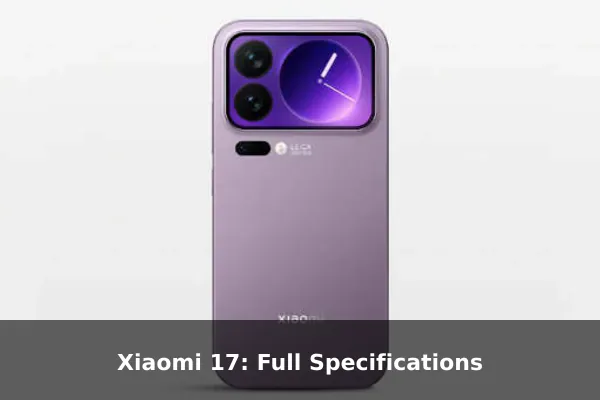
| Colors: | Black, Blue, Pink, White |
| Price: | About 540 EUR |
Price and Availability
The Xiaomi 17 offers a compelling combination of features and performance. While the base price is around €540, the actual cost may vary depending on your location and retailer. Below, you’ll find the approximate price of the Xiaomi 17 converted into various currencies. Please note that these are estimates based on recent exchange rates as of July 20, 2026 and may not reflect the exact price you’ll find at a retailer.
- United States: $617
- Japan: ¥100,281
- United Kingdom: £459
- Australia: A$885
- Canada: C$865
- Taiwan: NT$19,968
- Denmark: kr4.029
- Saudi Arabia: ﷼2,314
- South Korea: ₩917,881
- Germany: €540
- Brazil: R$3.156
- Vietnam: ₫16.181.438
- Kenya: KSh 79,848
- India: ₹59,425
- Indonesia: Rp 11.051.134
- Nigeria: ₦850,126
- Pakistan: ₨171,681
- Philippines: ₱38,013
- Bangladesh: ৳৭৬,১৫১
Value Position
The Xiaomi 17 is most interesting as a compact flagship with very few obvious compromises on paper. Its source price marker of about 540 EUR places it in a value-focused premium zone, though actual retail pricing can vary by market, taxes, importer channels, storage option, and promotions. What matters for comparison is that Xiaomi is pairing flagship processing, UFS 4.1 storage, a high-resolution LTPO AMOLED panel, Leica camera hardware, and 100W charging in one package.
That combination makes it a stronger value argument than many compact phones that trim battery size, charging speed, zoom hardware, or storage performance. The absence of a microSD slot is expected in this class, so buyers should choose the storage tier carefully. The 256GB base option with 12GB RAM should suit most users, while the 512GB and 1TB versions are better for heavy video recording, offline media, and long-term app storage.
Design And Durability
The Xiaomi 17 keeps the footprint relatively manageable with a 151.1 x 71.8 x 8.1 mm body and a 191 g weight. Those numbers make it smaller than many large-screen flagships, yet it still has enough physical presence to hold a large battery and triple rear camera system. The glass front, aluminum frame, and Dragon Crystal Glass protection suggest a premium build direction rather than a lightweight mid-range approach.
IP68 dust and water resistance is a practical advantage for daily use. The listed rating covers immersion up to 1.5 meters for 30 minutes under controlled conditions, so it should be treated as protection against accidents rather than an invitation to use the phone underwater. The Black, Blue, Pink, and White color options also give it a wider style range than phones that focus only on neutral finishes.
Display Experience
The 6.3-inch LTPO AMOLED display is one of the phone’s central strengths. Its 1220 x 2656 resolution gives it a sharp pixel density of about 464 ppi, while the 120Hz refresh rate should keep scrolling, animation, and supported games feeling smooth. LTPO technology is also important because it can vary refresh behavior more efficiently than a fixed high-refresh panel.
For media, the panel supports Dolby Vision, HDR Vivid, and HDR10+, with a listed 3500-nit peak brightness. Peak brightness figures usually apply only in specific conditions, but the spec still points to strong outdoor visibility and punchy HDR playback. The 2160Hz PWM detail will matter to readers sensitive to display flicker, although comfort can still depend on brightness level, environment, and individual sensitivity.
Performance And Storage
The Snapdragon 8 Elite Gen 5 is the performance anchor. Its octa-core CPU layout, with two high-clock Oryon V3 Phoenix L cores and six Oryon V3 Phoenix M cores, is aimed at demanding gaming, camera processing, multitasking, and on-device AI workloads. The Adreno 840 GPU should also give the Xiaomi 17 enough headroom for high-end Android games and graphics-heavy apps.
UFS 4.1 storage is another meaningful specification because it affects app loading, file transfers, camera burst handling, and large video recording. RAM choices run from 12GB to 16GB, depending on storage tier. There is no card slot, so the best long-term pick for creators is likely 512GB or 1TB, especially if 4K Dolby Vision, 8K clips, or RAW photography are part of the workflow.
Leica Triple Camera System
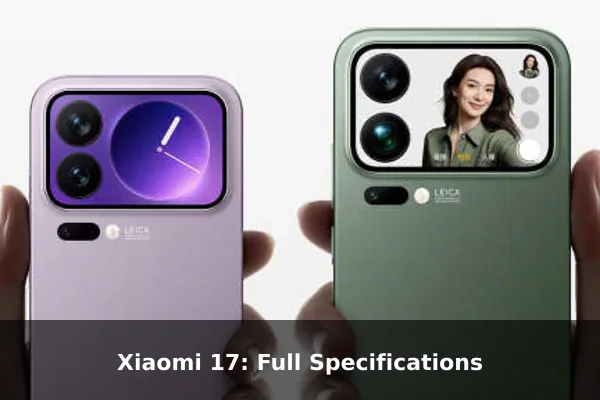
The rear camera setup is built around three 50MP sensors: a 23mm wide camera with OIS, a 60mm telephoto camera with OIS and 2.6x optical zoom, and a 17mm ultrawide camera with a 102-degree field of view. This is a more balanced setup than phones that use a strong main camera but downgrade the ultrawide or skip optical zoom entirely.
The 60mm telephoto lens is especially useful for portraits, street photos, food shots, and tighter framing without relying only on digital crop. The 10 cm to infinity focus range also gives it more flexibility for close subjects. Leica lens branding, laser autofocus, a color spectrum sensor, HDR, panorama, and dual-tone flash round out the still-photo package.
Video And Selfie Camera
Video specifications are ambitious. The Xiaomi 17 supports 8K at 30fps with HDR, 4K at 30 or 60fps with HDR10+, 10-bit Dolby Vision HDR, and 10-bit LOG, plus high-frame-rate 1080p and 720p slow motion modes. Gyro-EIS is listed, which is important for handheld recording, although stabilization quality still depends on mode, lens, lighting, and processing.
The front camera is also unusually strong on paper. A 50MP selfie camera with PDAF, HDR, panorama, 4K recording at up to 60fps, HDR10+, and gyro-EIS makes the phone more credible for vloggers, video calls, and social media creators. Autofocus on the front camera is a real usability gain because it helps keep faces sharper across different framing distances.
Battery And Charging
The listed 7000 mAh silicon-carbon Li-Ion battery is a major differentiator, especially in a phone with a 6.3-inch display. Silicon-carbon battery technology helps manufacturers push capacity higher without making the device as bulky as older battery designs might require. For heavy users, this is arguably as important as the chipset because endurance determines how comfortably the phone handles travel, gaming, navigation, and camera use.
Charging is equally aggressive. The phone lists 100W wired charging with PD3.0, QC3+, and 100W PPS support, plus 50W wireless charging and 22.5W reverse wireless charging. Charger availability and peak speeds can vary by region and accessory, but the overall setup is clearly aimed at users who do not want battery anxiety.
Software And Everyday Features
The Xiaomi 17 runs Android 16 with HyperOS 3. That gives it a modern software base, although long-term update policy and regional feature availability should always be checked against the local Xiaomi site or retailer listing. HyperOS is typically feature-rich, so buyers who like deep customization, built-in tools, and Xiaomi ecosystem integration will get more from it than users who prefer a very minimal Android skin.
The sensor list is broad: ultrasonic under-display fingerprint recognition, accelerometer, proximity sensor, gyroscope, compass, and barometer. The ultrasonic fingerprint sensor is worth highlighting because it is generally positioned as a premium authentication feature, especially compared with basic optical sensors.
Connectivity And Audio
Connectivity is flagship-grade. The Xiaomi 17 supports GSM, HSPA, LTE, and 5G, with a wide band list for both LTE and sub-6 5G SA and NSA networks. Band support is strong on paper, but buyers importing the phone should still confirm carrier compatibility, VoLTE support, and regional firmware behavior before purchasing.
Wi-Fi 7, Bluetooth 5.4, NFC, infrared, multi-system positioning, and USB Type-C 3.2 with DisplayPort and OTG make the phone well equipped for modern accessories and productivity use. Audio is handled by stereo speakers with Dolby Atmos, Hi-Res and Hi-Res wireless audio, Snapdragon Sound, aptX HD, aptX Adaptive, and LHDC 5. There is no 3.5mm headphone jack, so wired audio users will need USB-C audio gear or an adapter.
Who Should Buy It
The Xiaomi 17 is best suited to buyers who want a compact flagship with strong battery life, fast charging, a serious camera setup, and top-tier Android performance. It should appeal to users comparing premium Xiaomi, OnePlus, vivo, Samsung, and Google models but who want more charging speed and a larger battery than many mainstream compact flagships provide.
It is less ideal for buyers who need expandable storage, a headphone jack, or guaranteed local carrier support from an imported unit. It is also not the obvious pick for someone who simply wants the largest possible display. Its strongest identity is balance: high-end power, high-end imaging, and high-capacity endurance in a body that remains easier to handle than many ultra-sized phones.
Conclusion
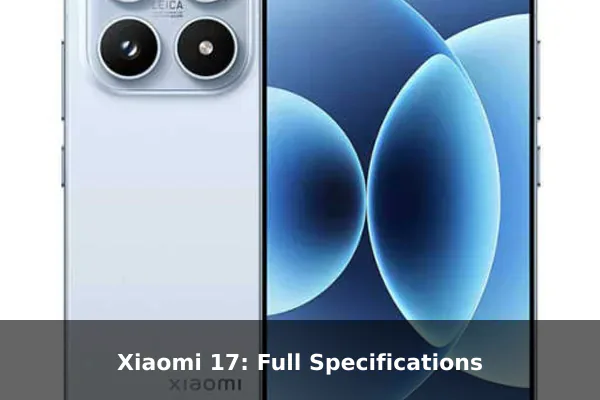
The Xiaomi 17 stands out as a compact premium Android phone with Snapdragon 8 Elite Gen 5 performance, a sharp LTPO AMOLED display, Leica triple 50MP cameras, fast charging, and a very large listed battery. Choose it if you want flagship hardware in a more manageable size and can buy a storage variant that fits your long-term needs.
References
- Xiaomi 17 Specs | Xiaomi Global – Primary source for Xiaomi 17 hardware specifications, including processor, RAM/storage, dimensions, display, cameras, battery, connectivity, sensors, OS, and package contents.
- Xiaomi 17 Product Page | Xiaomi Global – Official product overview for key feature claims, design details, camera system, battery and charging claims, display features, and Xiaomi footnotes/disclaimers.
- Xiaomi 17 FAQ | Xiaomi Global Support – Official support FAQ with launch date, colors, dimensions, weight, screen details, package information, and region-related notes.
- Snapdragon 8 Elite Gen 5 | Qualcomm – Primary chipset reference for the Snapdragon 8 Elite Gen 5 platform used by the Xiaomi 17, useful for verifying SoC, CPU, GPU, modem, Wi-Fi, and AI platform claims.
- Xiaomi 17 Full Specifications | PhoneArena – Established mobile-device reference site useful for cross-checking specs, release information, bands, dimensions, battery, camera details, and independent test data.
