
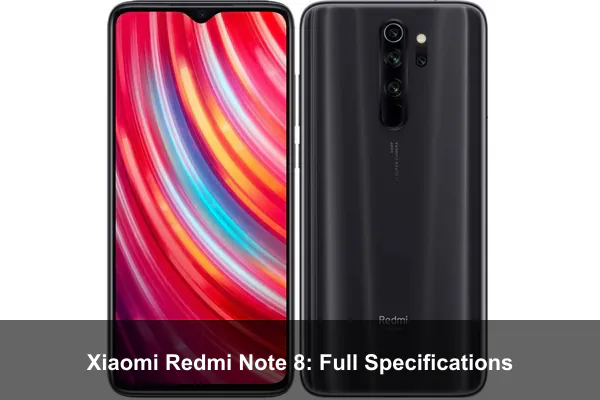
The Xiaomi Redmi Note 8 is a 2019 Android smartphone built around a 6.3-inch IPS LCD, Snapdragon 665 chipset, quad rear camera setup, and a 4000 mAh battery.
It is now discontinued, but its mix of expandable storage, USB-C, a headphone jack, infrared port, and Android 11 upgrade support still makes it useful for budget-focused comparisons.
Full Specifications
Network
| Technology | GSM / HSPA / LTE |
| 2G bands | GSM 850 / 900 / 1800 / 1900 |
| 3G bands | HSDPA 850 / 900 / 1700(AWS) / 1900 / 2100 |
| HSDPA 850 / 900 / 2100 | |
| 4G bands | 1, 2, 3, 4, 5, 7, 8, 20, 38, 40 |
| 1, 3, 5, 8, 38, 40, 41 | |
| Speed | HSPA 42.2/5.76 Mbps, LTE (4CA) Cat12 600/50 Mbps |
Launch
| Announced | 2019, August 29. Released 2019, October 16 |
| Status | Discontinued |
Body
| Dimensions | 158.3 x 75.3 x 8.4 mm (6.23 x 2.96 x 0.33 in) |
| Weight | 190 (6.70 oz) |
| Build | Glass front (Gorilla Glass 5), glass back (Gorilla Glass 5), plastic frame |
| SIM | Nano-SIM + Nano-SIM |
Display
| Type | IPS LCD |
| Size | 6.3 inches, 97.4 cm2 (~81.7% screen-to-body ratio) |
| Resolution | 1080 x 2340 pixels, 19.5:9 ratio (~409 ppi density) |
| Protection | Corning Gorilla Glass 5 |
Platform
| OS | Android 9.0 (Pie), upgradable to Android 11, MIUI 12.5 |
| Chipset | Qualcomm SDM665 Snapdragon 665 (11 nm) |
| CPU | Octa-core (4×2.0 GHz Kryo 260 Gold & 4×1.8 GHz Kryo 260 Silver) |
| GPU | Adreno 610 |
Memory
| Card slot | microSDXC (dedicated slot) |
| Internal | 32GB 3GB RAM, 64GB 4GB RAM, 64GB 6GB RAM, 128GB 4GB RAM, 128GB 6GB RAM |
| eMMC 5.1 |
Main Camera
| Quad | 48 MP, f/1.8, 26mm (wide), 1/2.0", 0.8µm, PDAF 8 MP, f/2.2, 120˚ (ultrawide), 1/4.0", 1.12µm 2 MP (macro) Auxiliary lens |
| Features | LED flash, HDR, panorama |
| Video | 4K@30fps, 1080p@30/60/120fps; gyro-EIS |
Selfie camera
| Single | 13 MP, f/2.0, (wide), 1/3.1", 1.12µm |
| Features | HDR, panorama |
| Video | 1080p@30fps |
Sound
| Loudspeaker | Yes |
| 3.5mm jack | Yes |
Comms
| WLAN | Wi-Fi 802.11 a/b/g/n/ac, dual-band, Wi-Fi Direct |
| Bluetooth | 4.2, A2DP, LE |
| Positioning | GPS, GLONASS, BDS |
| NFC | No |
| Infrared port | Yes |
| Radio | FM radio |
| USB | USB Type-C 2.0, OTG |
Features
| Sensors | Fingerprint (rear-mounted), accelerometer, gyro, proximity, compass |
Battery
| Type | Li-Po 4000 mAh, non-removable |
| Charging | 18W wired |
Misc
| Colors | Neptune Blue, Moonlight White, Space Black, Nebula Purple, Cosmic Purple |
| Models | M1908C3JH, M1908C3JG, M1908C3JI |
| SAR | 0.26 W/kg (head) 1.00 W/kg (body) |
| SAR EU | 0.19 W/kg (head) 1.09 W/kg (body) |
| Price | About 220 EUR |
Our Tests
| Performance | AnTuTu: 141915 (v7), 161572 (v8) GeekBench: 5590 (v4.4), 1339 (v5.1) GFXBench: 5.9fps (ES 3.1 onscreen) |
| Display | Contrast ratio: 1521:1 (nominal) |
| Camera | Photo / Video |
| Loudspeaker | Voice 78dB / Noise 72dB / Ring 81dB |
| Audio quality | Noise -94.0dB / Crosstalk -93.3dB |
| Battery (old) | Endurance rating 108h |
Price and Availability
The Xiaomi Redmi Note 8 offers a compelling combination of features and performance. While the base price is around €220, the actual cost may vary depending on your location and retailer. Below, you’ll find the approximate price of the Xiaomi Redmi Note 8 converted into various currencies. Please note that these are estimates based on recent exchange rates as of May 12, 2026 and may not reflect the exact price you’ll find at a retailer.
- United States: $259
- Japan: ¥40,716
- United Kingdom: £190
- Australia: A$358
- Canada: C$354
- Taiwan: NT$8,125
- Denmark: kr1.642
- Saudi Arabia: ﷼971
- South Korea: ₩381,493
- Germany: €220
- Brazil: R$1.268
- Vietnam: ₫6.746.613
- Kenya: KSh 33,420
- India: ₹24,682
- Indonesia: Rp 4.519.701
- Nigeria: ₦348,893
- Pakistan: ₨72,165
- Philippines: ₱15,777
- Bangladesh: ৳৩১,৮২৩
Why Should You Buy the Xiaomi Redmi Note 8?
The Redmi Note 8 is best viewed as an affordable everyday phone with balanced essentials. It offers LTE connectivity, a capable Snapdragon 665 processor, expandable storage, and a large battery, making it practical for calls, messaging, browsing, video streaming, and casual apps.
Design and Build Quality
Xiaomi used Gorilla Glass 5 on both the front and back, paired with a plastic frame. At 190 g and 8.4 mm thick, it feels substantial without being unusually bulky, while the rear-mounted fingerprint scanner keeps unlocking simple and reliable.
Display Experience
The 6.3-inch IPS LCD has a 1080 x 2340 resolution and around 409 ppi density, so text and interface details should look sharp. It is not an OLED panel, but the reported 1521:1 contrast ratio is solid for an LCD in this class.
Performance and Storage
The Snapdragon 665 with Adreno 610 is suitable for regular daily use and light gaming, though it is clearly below newer mid-range chips. Storage options range from 32GB to 128GB, and the dedicated microSDXC slot is a major advantage for users who keep many photos, videos, or offline files.
Camera Setup
The rear camera system is led by a 48 MP wide camera, joined by an 8 MP ultrawide, a 2 MP macro camera, and an auxiliary lens. It supports 4K video at 30fps and 1080p recording up to 120fps with gyro-EIS, while the 13 MP selfie camera handles standard front-facing photos and 1080p video.
Battery and Charging
The 4000 mAh battery is one of the phone’s strongest practical features, with an old endurance rating of 108 hours in the listed test data. Charging is handled through USB-C with 18W wired support, which is useful but not especially fast by current standards.
Software and Everyday Features
The phone launched with Android 9.0 Pie and is listed as upgradable to Android 11 with MIUI 12.5. It also includes useful extras such as a 3.5 mm headphone jack, FM radio, infrared port, gyro, compass, and rear fingerprint sensor.
Connectivity Trade-Offs
Connectivity covers GSM, HSPA, and LTE with Wi-Fi ac, Bluetooth 4.2, GPS, GLONASS, BDS, USB-C 2.0, and OTG support. The main limitation is the lack of NFC, so users who rely on contactless mobile payments should look elsewhere.
Who Should Buy the Xiaomi Redmi Note 8?
It makes the most sense for users who want a low-cost Xiaomi phone for basic apps, media playback, expandable storage, wired audio, and reliable battery life. It is less suitable for buyers who want 5G, newer software support, NFC payments, or stronger gaming performance.
Conclusion
The Xiaomi Redmi Note 8 remains a practical budget option if found in good condition, especially for users who value expandable storage, USB-C, a headphone jack, and dependable battery life. Buy it for basic everyday use, but choose a newer phone if long-term software support, NFC, or 5G matters.
