
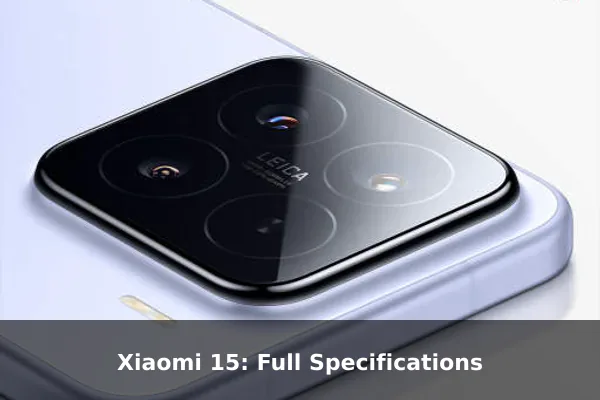
The Xiaomi 15 is a compact flagship built around the Snapdragon 8 Elite platform, a 6.36-inch LTPO AMOLED display, and a Leica-branded triple 50 MP rear camera system. It targets buyers who want top-tier hardware without moving into oversized ultra-phone territory.
This article focuses on the phone’s real-world specification story: how its size, display, chipset, camera setup, charging system, software policy, and connectivity package fit together. A separate full specifications table and price block can be used for quick reference.
Full Specifications
Network
| Technology: | GSM / HSPA / LTE / 5G |
| 2G bands: | GSM 850 / 900 / 1800 / 1900 |
| 3G bands: | HSDPA 800 / 850 / 900 / 1700(AWS) / 1900 / 2100 |
| 4G bands: | 1, 2, 3, 4, 5, 7, 8, 12, 13, 17, 18, 19, 20, 25, 26, 28, 32, 38, 39, 40, 41, 42, 48, 66 – International |
| 1, 2, 3, 4, 5, 7, 8, 12, 17, 18, 19, 20, 26, 28, 34, 38, 39, 40, 41, 42, 48, 66 – China | |
| 5G bands: | 1, 2, 3, 5, 7, 8, 12, 20, 25, 26, 28, 38, 40, 41, 48, 66, 75, 77, 78 SA/NSA – International |
| 1, 2, 3, 5, 12, 20, 26, 28, 38, 40, 41, 48, 66, 77, 78, 80, 81, 83, 84, 89 SA/NSA – China | |
| Speed: | HSPA, LTE, 5G |
Launch
| Announced: | 2024, October 29 |
| Status: | Available. Released 2024, October 29 |
Body
| Dimensions: | 152.3 x 71.2 x 8.1 / 8.4 / 8.5 mm |
| Weight: | 189 / 191 / 192 g (6.67 oz) |
| Build: | Glass front (Xiaomi Shield Glass), aluminum alloy frame (6M42) |
| SIM: | Nano-SIM + Nano-SIMNano-SIM + Nano-SIM + eSIM + eSIM (max 2 at a time) |
| IP68 dust tight and water resistant (immersible up to 1.5m for 30 min) |
Display
| Type: | LTPO AMOLED, 68B colors, 1920Hz PWM, 120Hz, Dolby Vision, HDR10+, 3200 nits (peak) |
| Size: | 6.36 inches, 97.6 cm2 (~90.0% screen-to-body ratio) |
| Resolution: | 1200 x 2670 pixels, 20:9 ratio (~460 ppi density) |
| Protection: | Xiaomi Shield Glass, Mohs level 6 |
Platform
| OS: | Android 15, up to 4 major Android upgrades, HyperOS 2 |
| Chipset: | Qualcomm SM8750-AB Snapdragon 8 Elite (3 nm) |
| CPU: | Octa-core (2×4.32 GHz Oryon V2 Phoenix L + 6×3.53 GHz Oryon V2 Phoenix M) |
| GPU: | Adreno 830 |
Memory
| Card slot: | No |
| Internal: | 256GB 12GB RAM, 256GB 16GB RAM, 512GB 12GB RAM, 512GB 16GB RAM, 1TB 16GB RAM |
| UFS 4.0 |
Main Camera
| Triple: | 50 MP, f/1.6, 23mm (wide), 1/1.31″, 1.2µm, dual pixel PDAF, OIS 50 MP, f/2.0, 60mm (telephoto), 1/2.76″, 0.64µm, PDAF (10cm – ∞), OIS, 2.6x optical zoom 50 MP, f/2.2, 14mm, 115˚ (ultrawide), 1/2.76″, 0.64µm |
| Features: | Laser AF, color spectrum sensor, Leica lens, Dual-LED dual-tone flash, HDR, panorama |
| Video: | 8K@24/30fps (HDR), 4K@24/30/60fps (HDR10+, 10-bit Dolby Vision HDR, 10-bit LOG), 1080p@30/60/120/240/960fps, 720p@1920fps, gyro-EIS |
Selfie camera
| Single: | 32 MP, f/2.0, 21mm (wide), 1/3.14″, 0.7µm |
| Features: | HDR, panorama |
| Video: | 4K@30/60fps, 1080p@30/60fps, HDR10+, gyro-EIS |
Sound
| Loudspeaker: | Yes, with stereo speakers |
| 3.5mm jack: | No |
| 24-bit/192kHz Hi-Res & Hi-Res wireless audio Qualcomm XPAN (24-bit/96kHz audio) |
Comms
| WLAN: | Wi-Fi 802.11 a/b/g/n/ac/6e/7, dual-band or tri-band, Wi-Fi Direct |
| Bluetooth: | 5.4/6.0, A2DP, LE, aptX HD, aptX Adaptive, LHDC 5 |
| Positioning: | GPS (L1+L5), GLONASS (G1), BDS (B1I+B1c+B2a), GALILEO (E1+E5a), QZSS (L1+L5) |
| NFC: | Yes |
| Infrared port: | Yes |
| Radio: | No |
| USB: | USB Type-C 3.2, Display Port, OTG |
Features
| Sensors: | Fingerprint (under display, ultrasonic), accelerometer, proximity, gyro, compass, barometer |
Battery
| Type: | Si/C Li-Ion 5240 mAh – GlobalSi/C Li-Ion 5400 mAh – China |
| Charging: | 90W wired, PD3.0, QC3+ 50W wireless 10W reverse wireless |
Misc
| Colors: | Black, White, Liquid Silver, Green, Lilac |
| Models: | 24129PN74G, 24129PN74I, 24129PN74C |
| SAR EU: | 0.99 W/kg (head) 1.00 W/kg (body) |
| Price: | € 659.99 / $ 655.46 / £ 639.00 / ₹ 64,998 |
Our Tests
| Performance: | AnTuTu: 2534638 (v10) GeekBench: 9419 (v6) 3DMark: 5980 (Wild Life Extreme) |
| Display: | 1517 nits max brightness (measured) |
| Loudspeaker: | -25.7 LUFS (Very good) |
| Battery: | Active use score 16:28h |
EU LABEL
| Energy: | Class A |
| Battery: | 63:26h endurance, 1000 cycles |
| Free fall: | Class C (90 falls) |
| Repairability: | Class C |
Price and Availability
The Xiaomi 15 offers a compelling combination of features and performance. While the base price is around €660, the actual cost may vary depending on your location and retailer. Below, you’ll find the approximate price of the Xiaomi 15 converted into various currencies. Please note that these are estimates based on recent exchange rates as of August 23, 2026 and may not reflect the exact price you’ll find at a retailer.
- United States: $771
- Japan: ¥122,507
- United Kingdom: £565
- Australia: A$1,078
- Canada: C$1,061
- Taiwan: NT$24,550
- Denmark: kr4.934
- Saudi Arabia: ﷼2,891
- South Korea: ₩1,069,562
- Germany: €660
- Brazil: R$4.005
- Vietnam: ₫20.142.147
- Kenya: KSh 99,838
- India: ₹73,849
- Indonesia: Rp 13.642.391
- Nigeria: ₦1,047,083
- Pakistan: ₨213,962
- Philippines: ₱47,613
- Bangladesh: ৳৯৪,১৯১
Value Position
The Xiaomi 15 sits in the premium Android segment, but its value angle is not simply about having the fastest chip or the highest charging number. Its stronger appeal is the combination of flagship-grade internals in a body that remains relatively manageable. Many high-end Android phones now push well beyond 6.7 inches, while this model keeps a 6.36-inch display and a width of 71.2 mm, making it easier to handle without giving up major performance hardware.
For buyers comparing it with larger flagship phones, the Xiaomi 15 looks like a practical alternative rather than a cut-down model. It still offers UFS 4.0 storage, up to 1 TB of internal capacity, up to 16 GB of RAM, 5G, Wi-Fi 7 support, IP68 protection, high-speed wired and wireless charging, and a serious camera system. That makes it most compelling for users who want premium components but do not want a phone that feels oversized in daily use.
Design And Durability
The body dimensions show Xiaomi aiming for a compact flagship profile rather than an ultra-thin statement design. Depending on version, the Xiaomi 15 measures 8.1 mm, 8.4 mm, or 8.5 mm thick and weighs between 189 g and 192 g. That is not featherweight, but it is reasonable for a phone with a large battery, metal frame, wireless charging, and IP68 dust and water resistance.
The build uses Xiaomi Shield Glass on the front and a 6M42 aluminum alloy frame. The official IP68 rating means the device is designed to resist dust and immersion in up to 1.5 meters of water for 30 minutes under tested conditions. As usual, that should be treated as protection against accidents rather than an invitation to use the phone underwater, especially because water resistance can degrade with age, impact, and repairs.
Display Quality
The 6.36-inch LTPO AMOLED panel is one of the phone’s most important strengths. It supports a 120 Hz refresh rate, Dolby Vision, HDR10+, 68 billion colors, and 1920 Hz PWM dimming. The resolution of 1200 x 2670 pixels gives it a sharp density of around 460 ppi, so text, icons, maps, and high-resolution photos should look crisp.
Xiaomi lists a very high 3200-nit peak brightness figure, while the provided test data records 1517 nits maximum measured brightness. The measured figure is the more useful number for real-world comparisons, because peak marketing figures usually apply only to limited display areas and specific HDR conditions. Even so, 1517 nits is strong enough for outdoor readability and puts the Xiaomi 15 in serious flagship display territory.
Performance And Hardware
The Snapdragon 8 Elite is the core reason the Xiaomi 15 belongs in the top performance class. The chipset uses Qualcomm’s Oryon CPU design, with two high-performance cores listed at 4.32 GHz and six additional cores at 3.53 GHz, paired with the Adreno 830 GPU. Storage is UFS 4.0 across the listed variants, which matters for app loading, large game installs, camera file handling, and long-term responsiveness.
The provided benchmark results are very high: AnTuTu v10 at 2,534,638, GeekBench 6 at 9,419, and 3DMark Wild Life Extreme at 5,980. Benchmarks are not a perfect prediction of sustained gaming or thermal behavior, but they confirm the Xiaomi 15 is positioned for demanding users. The absence of a microSD card slot means buyers should choose storage carefully, especially if they shoot 4K, 8K, or LOG video often.
Leica Triple Camera System
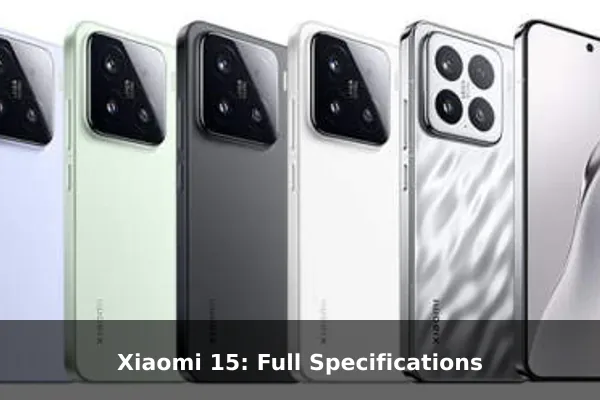
The rear camera setup is unusually balanced because all three cameras use 50 MP sensors. The main wide camera has an f/1.6 aperture, optical image stabilization, dual pixel PDAF, and a relatively large 1/1.31-inch sensor. The telephoto camera offers 2.6x optical zoom with OIS and a focusing range from 10 cm to infinity, while the ultrawide camera covers a 115-degree field of view.
The camera feature list includes Leica lenses, Laser AF, a color spectrum sensor, HDR, panorama, and dual-tone flash. Video support is especially strong, with 8K recording at 24 or 30 fps, 4K up to 60 fps with HDR10+, 10-bit Dolby Vision HDR, and 10-bit LOG. That gives the Xiaomi 15 more flexibility than a typical point-and-shoot flagship, particularly for users who edit color or want high-quality mobile video capture.
Selfie And Video Features
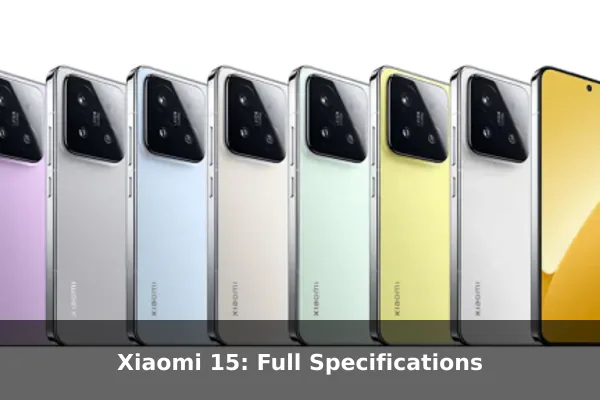
The front camera is a 32 MP wide unit with HDR, panorama, 4K recording at 30 or 60 fps, 1080p recording at 30 or 60 fps, HDR10+, and gyro-EIS. Those specifications are useful for creators, video calls, and social clips because the front camera is not limited to basic 1080p capture.
The more important practical detail is consistency. With stabilized rear video, high-end HDR formats, and a front camera that can also record 4K, the Xiaomi 15 is better suited to mixed shooting than phones that reserve strong video tools only for the main rear camera. Users who often switch between rear footage, selfie video, and short-form content should find the setup more flexible.
Battery And Charging
Battery capacity depends on region: the global model is listed with a 5240 mAh silicon-carbon lithium-ion battery, while the China version is listed at 5400 mAh. The active use score of 16 hours and 28 minutes suggests strong practical endurance, and the EU label data lists 63 hours and 26 minutes of endurance with 1000 battery cycles.
Charging is another major strength. The phone supports 90 W wired charging with PD3.0 and QC3+, 50 W wireless charging, and 10 W reverse wireless charging. That combination is useful because it does not force buyers to choose between cable speed and wireless convenience. For travel, desk use, and quick top-ups before leaving home, the charging package is one of the Xiaomi 15’s clearest everyday advantages.
Software And Updates
The Xiaomi 15 ships with Android 15 and HyperOS 2, with up to four major Android upgrades listed in the source data. That policy gives the phone a clearer long-term software path than older Xiaomi flagships that were less explicit about major version support.
HyperOS 2 is a major part of the experience, so buyers should consider whether they prefer Xiaomi’s interface style. The hardware gives the phone enough headroom for years of updates, but software preference still matters. Users coming from Pixel, Samsung, OnePlus, or iPhone devices may want to check how Xiaomi handles notifications, background apps, system tools, and preinstalled services in their region.
Connectivity And Extras
The connectivity list is broad and flagship-grade. The Xiaomi 15 supports GSM, HSPA, LTE, and 5G, with separate international and China band lists. It also includes Wi-Fi 802.11 a/b/g/n/ac/6e/7, dual-band or tri-band support depending on configuration, Bluetooth 5.4 or 6.0 depending on version, NFC, infrared, and USB Type-C 3.2 with DisplayPort and OTG.
Audio features include stereo speakers, Hi-Res and Hi-Res wireless audio, Qualcomm XPAN support, aptX HD, aptX Adaptive, and LHDC 5. There is no 3.5 mm headphone jack and no FM radio, which is normal for this class but still relevant for buyers with wired audio habits. The under-display ultrasonic fingerprint sensor is another welcome flagship detail, typically offering faster and more reliable unlocking than older optical scanners.
Who Should Buy The Xiaomi 15?
The Xiaomi 15 is best suited to buyers who want a compact Android flagship with very high performance, premium display technology, fast charging, and a versatile camera system. It is especially attractive if you value one-handed comfort but still want modern flagship features such as Snapdragon 8 Elite performance, 8K video, Wi-Fi 7, IP68 protection, and wireless charging.
It is less ideal for users who need expandable storage, a headphone jack, the largest possible display, or the longest software support available from any Android brand. Still, for a buyer comparing compact premium phones, the Xiaomi 15 has a rare balance: it is smaller than many rivals but does not feel like a lower-tier alternative on paper.
Conclusion
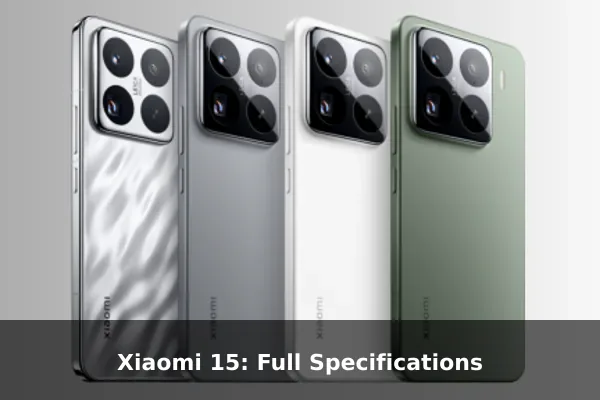
The Xiaomi 15 is a compact flagship with serious hardware depth: Snapdragon 8 Elite performance, a sharp LTPO AMOLED display, Leica triple 50 MP cameras, strong endurance, fast wired and wireless charging, and broad connectivity. Choose it if you want a smaller premium Android phone that still feels fully flagship.
References
- Xiaomi Global – Xiaomi 15 – Official manufacturer product page for Xiaomi 15, covering core claims such as display, chipset, camera system, battery, charging, IP68 notes, and HyperOS features.
- Xiaomi United Arab Emirates – Xiaomi 15 Specs – Official English Xiaomi specification sheet with structured details for processor, RAM/storage, dimensions, display, cameras, battery, charging, security, NFC, and connectivity.
- Xiaomi Global Support – User Guide – Official Xiaomi support area for user guides and safety/regulatory documents, useful for confirming model-specific usage, safety, warranty, and regulatory notes.
- Qualcomm – Xiaomi 15 Device Finder – Official Qualcomm device listing confirming Xiaomi 15 uses the Snapdragon 8 Elite Mobile Platform and related Qualcomm connectivity/audio platform details.
- Qualcomm – Snapdragon 8 Elite Mobile Platform – Official chipset specification source for the Snapdragon 8 Elite platform used in Xiaomi 15, including CPU/GPU, modem, Wi-Fi, Bluetooth, and process-node details.
