
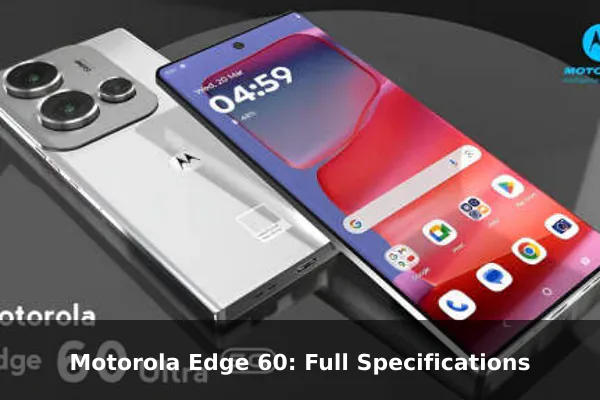
The Motorola Edge 60 is a premium-leaning Android phone built around a sharp P-OLED display, a versatile triple-camera system, durable protection, and a large battery. It sits in the competitive upper mid-range space, where screen quality, camera flexibility, software support, and day-to-day reliability matter more than headline-only performance.
Based on the supplied source data and approved Motorola reference anchors, this article focuses on how the Edge 60’s specifications translate into practical value. A separate full specifications table and price block will handle the complete raw spec listing and parsed currency details.
Full Specifications
Network
| Technology: | GSM / HSPA / LTE / 5G |
| 2G bands: | GSM 850 / 900 / 1800 / 1900 |
| 3G bands: | HSDPA 850 / 900 / 1700(AWS) / 1900 / 2100 |
| 4G bands: | 1, 2, 3, 4, 5, 7, 8, 12, 13, 17, 18, 19, 20, 25, 26, 28, 32, 34, 38, 39, 40, 41, 42, 43, 48, 66 |
| 5G bands: | 1, 2, 3, 5, 7, 8, 20, 26, 28, 38, 40, 41, 66, 75, 77, 78 SA/NSA/Sub6 |
| Speed: | HSPA, LTE, 5G |
Launch
| Announced: | 2025, April 24 |
| Status: | Available. Released 2025, April 25 |
Body
| Dimensions: | 161.2 x 73.1 x 7.9 mm or 8.2 mm |
| Weight: | 179 g or 181 g (6.31 oz) |
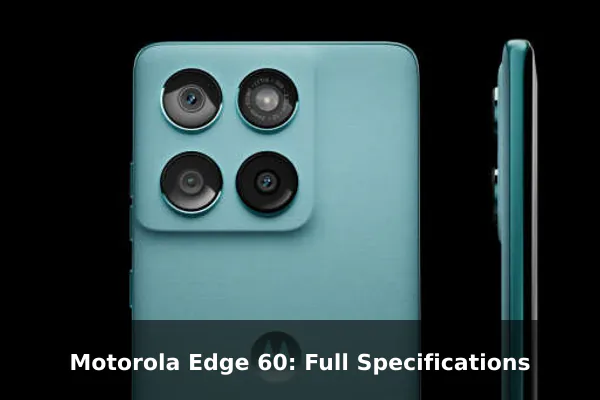
| Build: | Glass front (Gorilla Glass 7i), plastic frame, plastic back |
| SIM: | Nano-SIMNano-SIM + eSIMNano-SIM + Nano-SIM |
| IP68/IP69 dust tight and water resistant (high pressure water jets; immersible up to 1.5m for 30 min) MIL-STD-810H compliant* * does not guarantee ruggedness or use in extreme conditions |
Display
| Type: | P-OLED, 1B colors, 120Hz, 720Hz PWM, HDR10+, 4500 nits peak |
| Size: | 6.67 inches, 107.4 cm2 (~91.1% screen-to-body ratio) |
| Resolution: | 1220 x 2712 pixels, 20:9 ratio (~446 ppi density) |
| Protection: | Corning Gorilla Glass 7i, Mohs level 4 |
Platform
| OS: | Android 15, up to 3 major Android upgrades |
| Chipset: | Mediatek Dimensity 7300 (4 nm) – GlobalMediatek Dimensity 7400 (4 nm) – India |
| CPU: | Octa-core (4×2.5 GHz Cortex-A78 & 4×2.0 GHz Cortex-A55) – GlobalOcta-core (4×2.6 GHz Cortex-A78 & 4×2.0 GHz Cortex-A55) – India |
| GPU: | Mali-G615 MC2 |
Memory
| Card slot: | microSDXC |
| Internal: | 256GB 8GB RAM, 256GB 12GB RAM, 512GB 8GB RAM, 512GB 12GB RAM |
| UFS 4.0 |
Main Camera
| Triple: | 50 MP, f/1.8, 24mm (wide), 1/1.56″, 1.0µm, multi-directional PDAF, OIS 10 MP, f2.0, 73mm (telephoto), 1/3.94″, 1.0µm, PDAF, 3x optical zoom, OIS 50 MP, f/2.0, 12mm, 122˚ (ultrawide), 1/2.76″, 0.64µm, PDAF |
| Features: | LED flash, HDR, panorama |
| Video: | 4K@30fps, 1080p@30/60/120/240fps, gyro-EIS |
Selfie camera
| Single: | 50 MP, f/2.0, (wide), 0.64µm |
| Features: | HDR |
| Video: | 4K@30fps, 1080p@30/120fps |
Sound
| Loudspeaker: | Yes, with stereo speakers (with Dolby Atmos) |
| 3.5mm jack: | No |
Comms
| WLAN: | Wi-Fi 802.11 a/b/g/n/ac/6, dual-band |
| Bluetooth: | Yes |
| Positioning: | GPS, GLONASS, GALILEO |
| NFC: | Yes |
| Radio: | No |
| USB: | USB Type-C 2.0, OTG |
Features
| Sensors: | Fingerprint (under display, optical), accelerometer, gyro, proximity, compass |
| Smart Connect support |
Battery
| Type: | 5200 mAh (Global)5500 mAh (China, India) |
| Charging: | 68W wired |
Misc
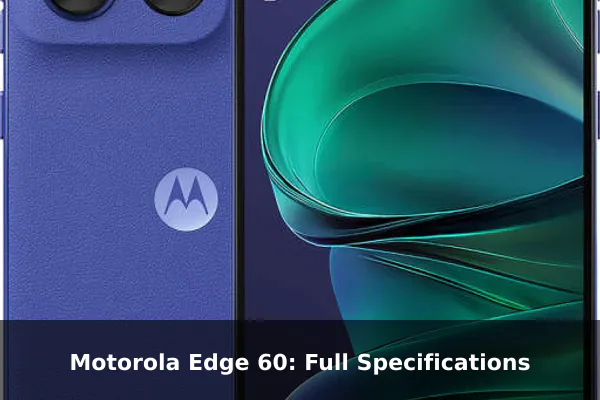
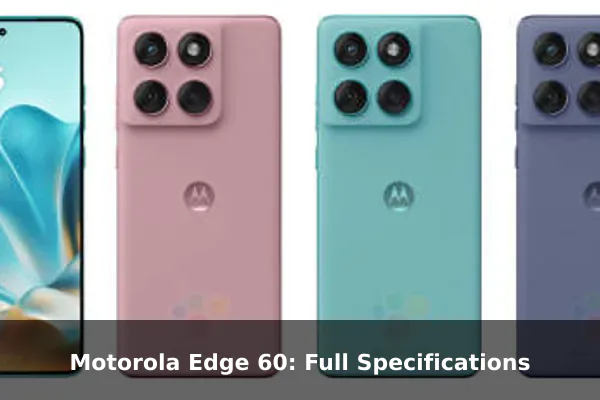
| Colors: | Pantone: Gibraltar sea, Shamrock, Plum perfect |
| Models: | XT2505-1, XT2505-4 |
| SAR EU: | 0.95 W/kg (head) 1.22 W/kg (body) |
| Price: | € 389.00 / £ 370.94 / ₹ 26,900 |
Our Tests
| Performance: | AnTuTu: 661808 (v10) GeekBench: 2999 (v6) 3DMark: 850 (Wild Life Extreme) |
| Display: | 1401 nits max brightness (measured) |
| Loudspeaker: | -22.5 LUFS (Excellent) |
| Battery: | Active use score 13:32h |
EU LABEL
| Energy: | Class A |
| Battery: | 58:54h endurance, 1000 cycles |
| Free fall: | Class B (180 falls) |
| Repairability: | Class B |
Price and Availability
The Motorola Edge 60 offers a compelling combination of features and performance. While the base price is around €389, the actual cost may vary depending on your location and retailer. Below, you’ll find the approximate price of the Motorola Edge 60 converted into various currencies. Please note that these are estimates based on recent exchange rates as of August 3, 2026 and may not reflect the exact price you’ll find at a retailer.
- United States: $449
- Japan: ¥70,902
- United Kingdom: £333
- Australia: A$637
- Canada: C$629
- Taiwan: NT$14,493
- Denmark: kr2.902
- Saudi Arabia: ﷼1,683
- South Korea: ₩644,877
- Germany: €389
- Brazil: R$2.266
- Vietnam: ₫11.716.478
- Kenya: KSh 57,898
- India: ₹42,705
- Indonesia: Rp 8.070.965
- Nigeria: ₦608,616
- Pakistan: ₨124,569
- Philippines: ₱27,468
- Bangladesh: ৳৫৫,৩৪৫
Value Positioning
The Motorola Edge 60 is best understood as a feature-dense mid-range phone rather than a stripped-down budget model. Its appeal comes from combining several premium signals in one package: a 1.5K-class P-OLED display, IP68/IP69 protection, a telephoto camera, expandable storage, fast wired charging, and a modern 5G chipset. That mix gives it a broader feature set than many phones that focus only on raw processor speed or camera megapixels.
The raw listed pricing places it in a segment where buyers expect meaningful upgrades over entry-level Android phones without paying flagship prices. The most important value point is balance. The Edge 60 does not rely on one standout specification while leaving the rest ordinary; instead, it spreads its strengths across display, durability, cameras, battery life, and storage flexibility.
Design and Durability
Motorola keeps the Edge 60 slim at 7.9 mm or 8.2 mm depending on configuration, with weight listed at 179 g or 181 g. That makes it reasonably light for a phone carrying a 6.67-inch display and a battery above 5000 mAh. The glass front uses Gorilla Glass 7i, while the frame and rear are plastic, a common tradeoff in this category to control weight and cost.
The durability specification is one of the phone’s strongest differentiators. IP68/IP69 dust and water resistance means the Edge 60 is rated for dust-tight protection, immersion up to 1.5 meters for 30 minutes, and resistance to high-pressure water jets. MIL-STD-810H compliance is also listed, though Motorola’s own type of wording should be read carefully: it does not mean the phone is guaranteed for extreme conditions. In practical terms, the Edge 60 is better protected than many similarly priced phones, but it should still be treated as a consumer smartphone, not a rugged field device.
Display Experience
The 6.67-inch P-OLED panel is one of the main reasons to consider the Motorola Edge 60. It supports 1 billion colors, a 120Hz refresh rate, 720Hz PWM dimming, HDR10+, and a quoted 4500-nit peak brightness. The supplied test figure of 1401 nits measured maximum brightness suggests strong outdoor usability, even if real-world full-screen brightness will not match peak marketing numbers.
The 1220 x 2712 pixel resolution works out to about 446 ppi, so text and interface elements should look crisp. The 20:9 aspect ratio is also useful for scrolling, social feeds, reading, and split-screen style use. Buyers sensitive to display comfort may appreciate the high PWM dimming figure, although comfort varies by person and lighting conditions.
Performance and Storage
The Edge 60 uses a MediaTek Dimensity 7300 chipset globally and a Dimensity 7400 variant for India, both built on a 4 nm process. The CPU layout is similar across both, with Cortex-A78 performance cores and Cortex-A55 efficiency cores, while graphics are handled by the Mali-G615 MC2. This is not positioned as a gaming flagship platform, but it is well suited to everyday Android use, multitasking, video streaming, navigation, and casual to moderate gaming.
The supplied benchmark results give useful context: AnTuTu 661808 on v10, GeekBench 2999 on v6, and 3DMark Wild Life Extreme 850. Those numbers point to solid mid-range performance rather than top-tier graphics power. Storage is a major plus, with 256GB and 512GB options, 8GB or 12GB RAM configurations, microSDXC support, and UFS 4.0 listed. Expandable storage is increasingly uncommon in this class, so it is a practical advantage for users with large media libraries.
Camera System
The rear camera system is more flexible than the typical wide-plus-ultrawide arrangement. The main camera is a 50 MP wide sensor with optical image stabilization, multi-directional PDAF, and a relatively large 1/1.56-inch sensor size. That gives the phone a strong base camera for everyday photography, especially where stabilization helps in lower light or with slower shutter speeds.
The 10 MP telephoto camera offers 3x optical zoom with OIS, which is a meaningful advantage for portraits, details, stage shots, and travel images. Many mid-range phones use digital zoom only, so the presence of an actual telephoto module makes the Edge 60 more useful for varied framing. The 50 MP ultrawide camera adds a 122-degree field of view and PDAF, making it more capable than fixed-focus low-resolution ultrawides. Video support reaches 4K at 30fps, with 1080p options up to 240fps and gyro-EIS.
Selfie and Video Notes
The front camera is also listed at 50 MP, with HDR support and video recording up to 4K at 30fps. That specification is useful for buyers who record social video, join video calls often, or want sharper front-camera stills than basic selfie cameras provide. The 1080p at 120fps option adds some flexibility for slow-motion front-camera clips.
As always, megapixel counts do not tell the full story. Image processing, skin tones, low-light behavior, stabilization, and shutter speed matter just as much. Still, on paper, the Edge 60 has one of the more complete camera layouts in its category because both front and rear systems are specified beyond the minimum.
Battery and Charging
Battery capacity depends on region: 5200 mAh globally and 5500 mAh for China and India. Both figures are strong for a slim phone, and the supplied active use score of 13:32h suggests dependable endurance for mixed daily use. The EU label data also lists Class A energy performance, 58:54h endurance, and 1000 battery cycles, which supports the phone’s long-term usability story.
Charging is rated at 68W wired. That should be fast enough for users who top up during the day, although the supplied data does not list wireless charging. The combination of large battery capacity and fast wired charging is likely to be more valuable for most buyers than niche charging extras.
Software and Smart Features
The Edge 60 ships with Android 15 and is listed for up to three major Android upgrades. That gives it a clearer software runway than older mid-range phones, though security patch timing and regional rollout schedules can still vary. For buyers keeping a phone for several years, the promised upgrade window is an important part of the value calculation.
Smart Connect support is also included. For Motorola users, that can make the phone more useful across screens and accessories, especially when moving files, extending workflows, or linking phone functions with compatible PCs and displays. The under-display optical fingerprint sensor keeps authentication modern without adding a side-mounted reader.
Connectivity and Audio
The network sheet is broad, covering GSM, HSPA, LTE, and 5G with SA and NSA Sub-6 support. The included LTE and 5G band lists are extensive, which is important for users who travel or buy unlocked phones, although final compatibility should still be checked with the local carrier before purchase.
Wireless connectivity includes Wi-Fi 6, Bluetooth, GPS, GLONASS, GALILEO, NFC, and USB Type-C 2.0 with OTG. Stereo speakers with Dolby Atmos are included, and the supplied loudspeaker test score of -22.5 LUFS is rated excellent. The missing 3.5 mm headphone jack is the main audio compromise, so wired headphone users will need USB-C audio or wireless earbuds.
Who Should Buy the Motorola Edge 60?
The Motorola Edge 60 suits buyers who want a well-rounded Android phone with a premium display, reliable battery life, strong durability ratings, expandable storage, and a more versatile camera system than the usual mid-range setup. It is particularly appealing if you value a real telephoto camera, IP68/IP69 protection, and a slim body more than flagship gaming performance.
It is less ideal for users who require the fastest graphics performance, a metal-and-glass flagship build, a headphone jack, or confirmed wireless charging. For most everyday users, though, the Edge 60’s strengths are practical: it looks modern, covers the major connectivity needs, has enough performance for regular use, and avoids several common mid-range compromises.
Conclusion
The Motorola Edge 60 is a strong upper mid-range choice with a sharp P-OLED display, useful triple cameras, long battery life, fast wired charging, broad connectivity, and better-than-average durability. Choose it if you want a balanced Android phone with premium everyday features at a restrained price point.
References
- Motorola Support US – Specifications: motorola edge 60 – Official Motorola specifications page with hardware, display, battery, camera, connectivity, bands, dimensions, and market-variation notes.
- Motorola Support UK – Specifications: motorola edge 60 – Official Motorola specs source useful for cross-checking regional variants, including storage, processor, battery, NFC, network bands, and dimensions.
- Motorola UK Product Page – motorola edge 60 – Official product page for headline features, display, camera, durability, battery, charging, processor, storage, and legal footnotes.
- Motorola News – motorola edge 60 Pressbox – Official Motorola media/press resource for product imagery and launch-related assets to support accurate article presentation.
- GSMArena – Motorola Edge 60 (www.gsmarena.com) – Well-known phone specifications database useful as a secondary cross-check against official Motorola specs and regional differences.
