
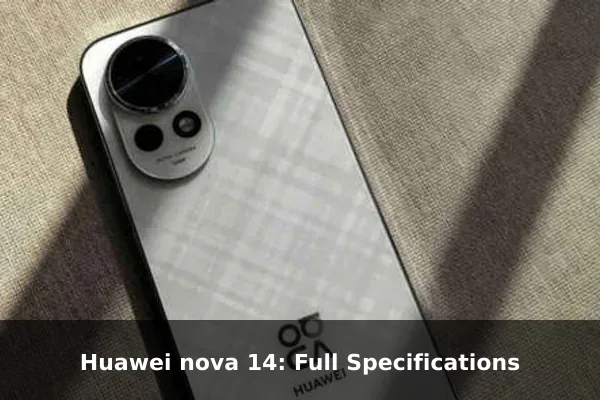
The Huawei nova 14 is a slim upper-midrange smartphone built around a 6.7-inch OLED display, HarmonyOS 5.0, a Kirin 8000 chipset, and a large 5500 mAh battery. It sits in an interesting position for buyers who want a stylish phone with fast charging, a capable camera setup, and modern 5G support without moving into full flagship pricing.
Instead of trying to be a gaming-first powerhouse, the nova 14 focuses on everyday polish: a bright 120Hz screen, a 50 MP front camera, a triple rear camera with optical zoom, stereo speakers, NFC, infrared, and IP65 protection. That combination makes it more useful as a daily phone than its thin 7.2 mm body might suggest.
Full Specifications
Network
| Technology: | GSM / CDMA / HSPA / CDMA2000 / LTE / 5G |
| 2G bands: | GSM 850 / 900 / 1800 / 1900 |
| CDMA 800 | |
| 3G bands: | HSDPA 800 / 850 / 900 / 1700(AWS) / 1900 / 2100 |
| CDMA2000 1x | |
| 4G bands: | LTE |
| 5G bands: | SA/NSA |
| Speed: | HSPA, LTE, 5G |
Launch
| Announced: | 2025, May 19 |
| Status: | Available. Released 2025, May 19 |
Body
| Dimensions: | 161.7 x 75.5 x 7.2 mm (6.37 x 2.97 x 0.28 in) |
| Weight: | 192 g (6.77 oz) |
| SIM: | Nano-SIM + Nano-SIM |
| IP65 dust tight and water resistant (low pressure water jets) |
Display
| Type: | OLED, 1B colors, HDR Vivid, 120Hz, 1100 nits (HBM) |
| Size: | 6.7 inches, 108.3 cm2 (~88.7% screen-to-body ratio) |
| Resolution: | 1084 x 2412 pixels, 20:9 ratio (~395 ppi density) |
| Protection: | Aluminosilicate glass |
Platform
| OS: | HarmonyOS 5.0 |
| Chipset: | Kirin 8000 (7 nm) |
| CPU: | Octa-core (1×2.4 GHz & 3×2.2 GHz & 4×1.84 GHz) |
| GPU: | Mali-G610 MP4 |
Memory
| Card slot: | No |
| Internal: | 256GB 12GB RAM, 512GB 12GB RAM |
Main Camera
| Triple: | 50 MP, f/1.9, 23mm (wide), 1/1.56″, Dual Pixel PDAF 12 MP, f/2.4, 69mm (telephoto), PDAF, OIS, 3x optical zoom 8 MP, f/2.2, 16mm, 112˚ (ultrawide), AF |
| Features: | Color spectrum sensor, LED flash, panorama, HDR |
| Video: | 4K, 1080p, gyro-EIS |
Selfie camera
| Single: | 50 MP, f/2.4, 1/2.5″ |
| Features: | HDR, panorama |
| Video: | 4K, 1080p, gyro-EIS |
Sound
| Loudspeaker: | Yes, with stereo speakers |
| 3.5mm jack: | No |
Comms
| WLAN: | Wi-Fi 802.11 a/b/g/n/ac/6, dual-band, Wi-Fi Direct |
| Bluetooth: | 5.2, A2DP, LE, L2HC (320-960 kbps HD audio) |
| Positioning: | GPS, GALILEO, GLONASS, BDS, QZSS |
| NFC: | Yes |
| Infrared port: | Yes |
| Radio: | No |
| USB: | USB Type-C 2.0, OTG |
Features
| Sensors: | Fingerprint (side-mounted), accelerometer, gyro, compass |
| Virtual proximity sensing |
Battery
| Type: | 5500 mAh |
| Charging: | 100W wired, SCP, UFCS, PD, PPS, QC 5W reverse wired |
Misc
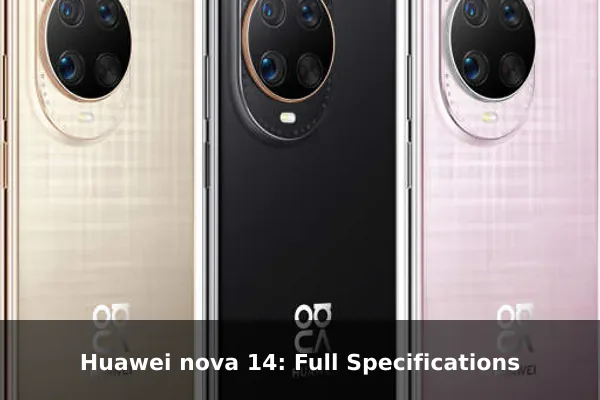
| Colors: | Black, White, Blue |
| Models: | TLR-AL00 |
| Price: | About 330 EUR |
Price and Availability
The Huawei nova 14 offers a compelling combination of features and performance. While the base price is around €330, the actual cost may vary depending on your location and retailer. Below, you’ll find the approximate price of the Huawei nova 14 converted into various currencies. Please note that these are estimates based on recent exchange rates as of July 28, 2026 and may not reflect the exact price you’ll find at a retailer.
- United States: $376
- Japan: ¥61,469
- United Kingdom: £282
- Australia: A$537
- Canada: C$530
- Taiwan: NT$12,132
- Denmark: kr2.463
- Saudi Arabia: ﷼1,408
- South Korea: ₩551,515
- Germany: €330
- Brazil: R$1.913
- Vietnam: ₫9.854.568
- Kenya: KSh 48,692
- India: ₹36,002
- Indonesia: Rp 6.776.907
- Nigeria: ₦512,102
- Pakistan: ₨104,319
- Philippines: ₱23,183
- Bangladesh: ৳৪৬,৩৪৫
Value Positioning
The Huawei nova 14 is best understood as a design-led midrange phone with a few premium touches. Its reported price of about 330 EUR places it near competitive models that usually offer large OLED screens, fast charging, and high-resolution cameras, but Huawei adds a few details that are still not guaranteed in this class. The 3x telephoto camera, 50 MP selfie camera, IP65 rating, infrared port, and 100W wired charging give the phone a broader feature set than many basic midrange alternatives.
The main value question is software fit. HarmonyOS 5.0 will appeal most to users already comfortable with Huawei services or living in a region where Huawei’s ecosystem is well supported. For buyers who depend heavily on Google Mobile Services, app availability and service compatibility should be checked before purchase.
Design and Build
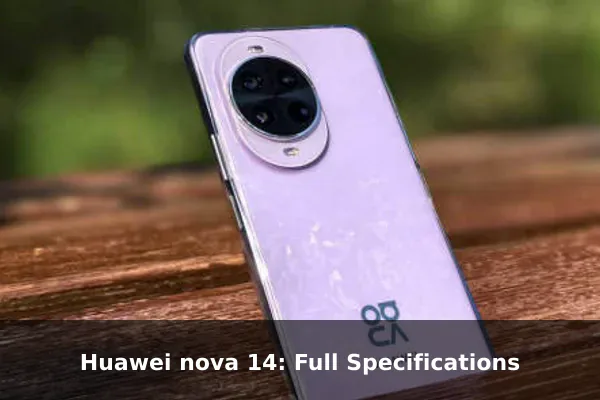
At 161.7 x 75.5 x 7.2 mm, the nova 14 is noticeably slim for a phone with a 5500 mAh battery. The 192 g weight is not ultra-light, but it is reasonable considering the battery capacity, large screen, and camera hardware. The flat, tall body should feel familiar to users upgrading from recent nova or mainstream Android-style phones.
The IP65 rating is a practical advantage. It means the device is dust tight and rated against low-pressure water jets, making it better protected against daily exposure than phones with no official ingress rating. It is still not the same as a higher IP68 rating for immersion, so it should not be treated as a phone for underwater use.
Display Experience
The 6.7-inch OLED display is one of the nova 14’s strongest everyday features. It supports 1 billion colors, HDR Vivid, a 120Hz refresh rate, and 1100 nits high brightness mode. Those numbers point to a screen designed for smooth scrolling, rich video playback, and readable outdoor use in bright conditions.
The 1084 x 2412 resolution works out to about 395 ppi, which is sharp enough for text-heavy reading, social apps, photos, and video. The 20:9 aspect ratio also gives the phone a modern tall-screen layout. Aluminosilicate glass protection is listed, although Huawei does not position it as a rugged phone, so a case and screen protector still make sense for long-term durability.
Performance and Storage
The Kirin 8000 chipset is paired with 12GB of RAM across both listed storage versions: 256GB and 512GB. That is a generous memory baseline for multitasking, camera use, browser tabs, and everyday productivity. The CPU layout combines one 2.4 GHz core, three 2.2 GHz cores, and four 1.84 GHz cores, with graphics handled by the Mali-G610 MP4.
For regular users, this hardware should be comfortable for messaging, streaming, navigation, photography, short video editing, and light to moderate gaming. However, users looking for top-tier sustained gaming performance should compare it carefully with phones using newer flagship-class chips. There is also no memory card slot, so choosing between 256GB and 512GB matters if you save a lot of video, offline media, or large app libraries.
Rear Camera Setup
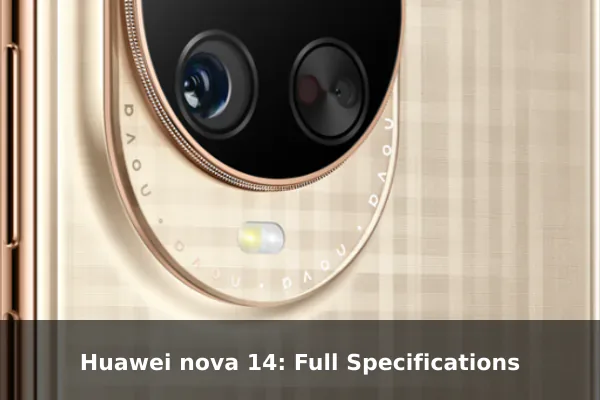
The Huawei nova 14 uses a triple rear camera system with a 50 MP wide camera, a 12 MP telephoto camera, and an 8 MP ultrawide camera. The main 50 MP sensor has an f/1.9 aperture, 23mm equivalent field of view, and Dual Pixel PDAF, which should help with faster focusing in common shooting situations. Huawei also lists a color spectrum sensor, which is intended to help with color and scene interpretation.
The 12 MP telephoto camera is a key differentiator because many phones in this price zone rely only on digital zoom. Here, Huawei lists PDAF, OIS, and 3x optical zoom, making the phone more flexible for portraits, travel details, signs, and distant subjects. The 8 MP ultrawide camera covers a 112-degree field of view and includes autofocus, which is useful for wide scenes and close-up creative framing. Video support reaches 4K and 1080p with gyro-EIS.
Selfie and Video Strength
The front camera is another major part of the nova 14’s identity. It uses a 50 MP sensor with an f/2.4 aperture and supports HDR, panorama, 4K video, 1080p video, and gyro-EIS. That makes it better suited than many midrange phones for selfie video, social clips, video calls, and creator-style front-camera recording.
For users who often shoot themselves rather than only rear-camera scenes, this is one of the more important specifications on the sheet. The high-resolution front camera and stabilized video support give the nova 14 a clear appeal for vlog-style clips and casual content creation.
Battery and Charging
The 5500 mAh battery is large for a phone this slim. Combined with a modern OLED screen and a 7 nm chipset, it should be built for full-day use for many owners, although actual endurance will depend on 5G use, brightness, camera activity, and gaming load.
Charging is a headline feature. The phone supports 100W wired charging with SCP, UFCS, PD, PPS, and QC compatibility listed, plus 5W reverse wired charging. That means the nova 14 is not only quick to recharge but also flexible with different charging standards. Reverse wired charging is modest in speed, but it can help top up small accessories or another phone in a pinch.
Software and Ecosystem
HarmonyOS 5.0 gives the nova 14 its software identity. Buyers should treat this as one of the most important parts of the decision, not just a line in the specifications. The interface, Huawei account services, app store experience, device pairing features, and regional service support can define how convenient the phone feels day to day.
For existing Huawei users, the software may be a strength because it fits into Huawei’s broader ecosystem of phones, tablets, wearables, and laptops. For users switching from a Google-heavy Android setup, the safer approach is to confirm essential apps, banking services, maps, messaging tools, and work apps before buying.
Connectivity and Everyday Features
The nova 14 supports GSM, CDMA, HSPA, CDMA2000, LTE, and 5G with SA and NSA modes listed. Wireless features include Wi-Fi 6, Bluetooth 5.2, NFC, GPS, GALILEO, GLONASS, BDS, QZSS, and Wi-Fi Direct. The presence of NFC and infrared makes the phone more convenient for payments, pairing, and remote-control use where supported.
Audio is handled by stereo speakers, but there is no 3.5 mm headphone jack. The USB-C port is USB 2.0 with OTG support, so it is fine for charging and accessories, though not aimed at high-speed wired data workflows. Sensors include a side-mounted fingerprint reader, accelerometer, gyro, compass, and virtual proximity sensing.
Who Should Buy It?
The Huawei nova 14 makes the most sense for buyers who want a stylish 5G phone with a strong display, fast charging, large battery, and unusually capable front and zoom cameras for the price segment. It is especially appealing for users who take many selfies, record front-camera video, or want optical zoom without paying flagship prices.
It is less ideal for buyers who need expandable storage, a headphone jack, the highest gaming performance, or guaranteed Google-first app behavior. The best version for most users is likely the 256GB model if cloud storage is part of the workflow, while the 512GB model is the safer choice for heavy photo, video, and offline media storage.
Conclusion
The Huawei nova 14 is a balanced midrange phone with a slim body, bright OLED display, 100W charging, strong selfie hardware, and a useful 3x telephoto camera. Buy it if Huawei’s software ecosystem fits your needs and you value camera versatility, charging speed, and design over expandable storage or a headphone jack.
References
- HUAWEI nova 14 Specifications – HUAWEI Levant – Official English specification page covering dimensions, display, processor, cameras, battery, charging, network bands, connectivity, sensors, OS, and box contents for the international nova 14 variant.
- HUAWEI nova 14 Specifications – HUAWEI China – Official China specification page useful for verifying the mainland model, HarmonyOS 5.0 details, storage options, camera hardware, charging, sensors, and included accessories.
- HUAWEI nova 14 Product Page – HUAWEI China – Official product page for feature context, official positioning, design details, camera claims, charging claims, and software feature notes.
- HUAWEI nova 14 User Guide – HUAWEI Support China – Official user guide for nova 14 TLR-AL00 on HarmonyOS 5.0, useful for confirming supported model variants and software/service details.
- Global Certification Forum – HUAWEI nova 14 TLR-LX9 – Independent certification listing for model TLR-LX9, useful for corroborating manufacturer, marketing name, certification date, and supported cellular bands.
