
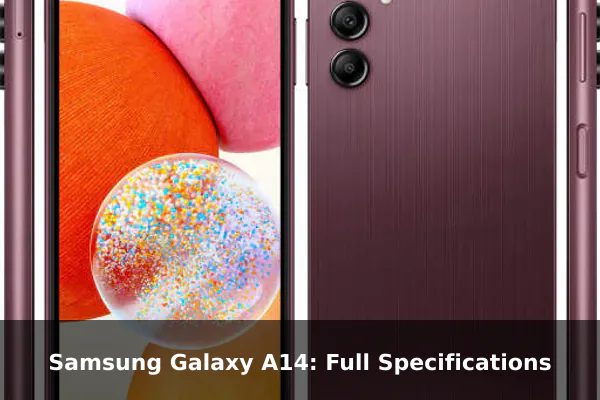
The Samsung Galaxy A14 is a budget-focused 4G Android phone built around practical basics: a large Full HD+ display, a 50 MP main camera, expandable storage, and a 5000 mAh battery. It sits in Samsung’s Galaxy A series as a straightforward option for buyers who want familiar software and essential hardware without moving into premium pricing.
This article focuses on the LTE Galaxy A14 model family, including SM-A145 variants, because it is separate from the Galaxy A14 5G. That distinction matters when comparing performance, network support, chipset choices, and long-term value.
Full Specifications
Network
| Technology: | GSM / HSPA / LTE |
| 2G bands: | GSM 850 / 900 / 1800 / 1900 |
| 3G bands: | HSDPA 850 / 900 / 2100 |
| 4G bands: | 1, 3, 5, 7, 8, 20, 28, 38, 40, 41 |
| Speed: | HSPA, LTE |
Launch
| Announced: | 2023, February 28 |
| Status: | Available. Released 2023, March 27 |
Body
| Dimensions: | 167.7 x 78 x 9.1 mm (6.60 x 3.07 x 0.36 in) |
| Weight: | 201 g (7.09 oz) |
| Build: | Glass front, plastic back, plastic frame |
| SIM: | Nano-SIMNano-SIM + Nano-SIM |
Display
| Type: | PLS LCD |
| Size: | 6.6 inches, 104.9 cm2 (~80.2% screen-to-body ratio) |
| Resolution: | 1080 x 2408 pixels, 20:9 ratio (~400 ppi density) |
Platform
| OS: | Android 13, upgradable to Android 15, One UI 7 |
| Chipset: | Mediatek MT6769 Helio G80 (12 nm) – Version AExynos 850 (8 nm) – Version B |
| CPU: | Octa-core (2×2.0 GHz Cortex-A75 & 6×1.8 GHz Cortex-A55) – Version AOcta-core (4×2.0 GHz Cortex-A55 & 4×2.0 GHz Cortex-A55) – Version B |
| GPU: | Mali-G52 MC2 |
Memory
| Card slot: | microSDXC (dedicated slot) |
| Internal: | 64GB 4GB RAM, 128GB 4GB RAM, 128GB 6GB RAM |
Main Camera
| Triple: | 50 MP, f/1.8, (wide), PDAF 5 MP, f/2.2, (ultrawide) 2 MP, f/2.4, (macro) |
| Features: | LED flash, panorama, HDR |
| Video: | 1080p@30fps |
Selfie camera
| Single: | 13 MP, f/2.0, (wide) |
| Video: | 1080p@30fps |
Sound
| Loudspeaker: | Yes |
| 3.5mm jack: | Yes |
Comms
| WLAN: | Wi-Fi 802.11 a/b/g/n/ac, dual-band, Wi-Fi Direct |
| Bluetooth: | 5.1 or 5.3, A2DP, LE |
| Positioning: | GPS, GALILEO, GLONASS, BDS, QZSS |
| NFC: | Yes (market/region dependent) |
| Radio: | Unspecified |
| USB: | USB Type-C 2.0 |
Features
| Sensors: | Fingerprint (side-mounted), accelerometer, proximity, compass |
Battery
| Type: | Li-Po 5000 mAh |
| Charging: | 15W wired |
Misc
| Colors: | Black, Dark Red, Silver, Green |
| Models: | SM-A145F, SM-A145F/DSN, SM-A145M, SM-A145M/DS, SM-A145P, SM-A145R |
| SAR EU: | 0.46 W/kg (head) 1.37 W/kg (body) |
| Price: | € 120.99 / $ 149.99 / £ 89.18 / ₹ 12,999 |
Price and Availability
The Samsung Galaxy A14 offers a compelling combination of features and performance. While the base price is around €121, the actual cost may vary depending on your location and retailer. Below, you’ll find the approximate price of the Samsung Galaxy A14 converted into various currencies. Please note that these are estimates based on recent exchange rates as of July 19, 2026 and may not reflect the exact price you’ll find at a retailer.
- United States: $138
- Japan: ¥22,475
- United Kingdom: £103
- Australia: A$198
- Canada: C$194
- Taiwan: NT$4,470
- Denmark: kr903
- Saudi Arabia: ﷼519
- South Korea: ₩205,635
- Germany: €121
- Brazil: R$706
- Vietnam: ₫3.628.182
- Kenya: KSh 17,916
- India: ₹13,326
- Indonesia: Rp 2.484.098
- Nigeria: ₦188,503
- Pakistan: ₨38,480
- Philippines: ₱8,527
- Bangladesh: ৳১৭,০৬০
Value Positioning
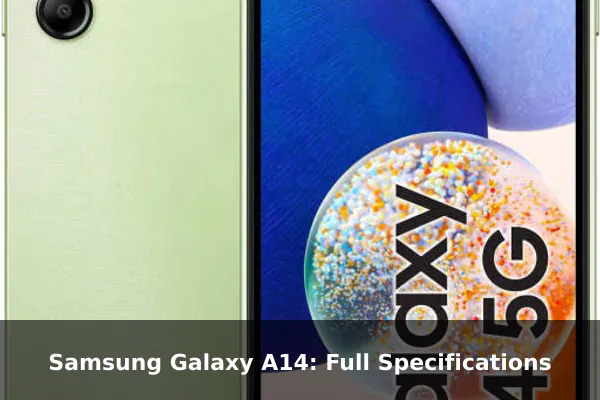
The Samsung Galaxy A14 is best understood as a value phone rather than a performance phone. Its appeal comes from a balanced mix of recognizable branding, a large screen, a dedicated microSDXC slot, a headphone jack, and Samsung’s One UI experience. The listed launch-era pricing places it in a competitive entry-level segment, although real availability and street prices can vary by market, storage configuration, and retailer.
For buyers comparing low-cost Android phones, the main advantage is predictability. The Galaxy A14 does not chase unusual hardware gimmicks. Instead, it gives users a familiar Samsung layout, mainstream app compatibility, and a specification sheet that covers daily communication, streaming, browsing, navigation, and social media use.
Design And Build
The phone measures 167.7 x 78 x 9.1 mm and weighs 201 g, so it is clearly a large device. That size makes sense for users who prioritize screen space and battery capacity, but it may feel bulky for one-handed use. The build uses a glass front with a plastic back and plastic frame, which is typical for this price class and helps keep costs controlled.
Samsung offers the Galaxy A14 in Black, Dark Red, Silver, and Green, giving the phone more personality than a basic black-only budget handset. The side-mounted fingerprint reader is also a practical choice, combining the power button and biometric unlock point in a position that is easy to reach for many users.
Display Experience
The 6.6-inch PLS LCD is one of the stronger everyday features of the Galaxy A14. Its 1080 x 2408 pixel resolution gives it a sharp pixel density of about 400 ppi, which is better than the lower-resolution panels still found on some entry-level phones. Text, app icons, web pages, and video interfaces should look reasonably crisp.
The 20:9 aspect ratio suits scrolling apps and widescreen video, while the roughly 80.2% screen-to-body ratio reflects a budget design with visible bezels. Because the source specifications list a PLS LCD panel rather than AMOLED, buyers should not expect the deep blacks and contrast of Samsung’s higher-end displays. The strength here is resolution and size, not premium panel technology.
Performance And Variants
The Galaxy A14 LTE has two chipset references in the supplied specification data: MediaTek Helio G80 for Version A and Exynos 850 for Version B. This means performance can depend on the exact regional model. The Helio G80 version uses two Cortex-A75 performance cores with six Cortex-A55 efficiency cores, while the Exynos 850 listing uses Cortex-A55 cores throughout.
That variant difference is important for spec-focused buyers. The Galaxy A14 should handle calls, messaging, web browsing, video playback, light multitasking, and common Android apps, but it is not designed as a heavy gaming phone. The Mali-G52 MC2 GPU is suitable for casual titles and basic graphics workloads, while demanding games may require lower settings.
Memory And Storage
Samsung lists the phone with 64GB 4GB RAM, 128GB 4GB RAM, and 128GB 6GB RAM configurations. For a better long-term experience, the 128GB versions are easier to recommend, especially for users who install many apps, keep offline media, or store a large photo library.
The dedicated microSDXC slot is a major practical advantage. Unlike hybrid SIM trays that force users to choose between a second SIM and a memory card, the listed configuration supports expandable storage in its own slot. That makes the Galaxy A14 more flexible for budget buyers who want to start with a lower internal storage variant and expand later.
Camera Setup
The rear camera system is led by a 50 MP wide camera with PDAF, supported by a 5 MP ultrawide camera and a 2 MP macro camera. The main camera is the most important sensor here and should be the focus for everyday photography. It is the camera most likely to deliver usable results for people, documents, food, daylight scenes, and quick social media shots.
The 5 MP ultrawide camera adds framing flexibility for landscapes, rooms, and group photos, though users should keep expectations realistic given the budget positioning. The 2 MP macro camera is more specialized and will be most useful for close-up experimentation in good light. Video recording is listed at 1080p at 30 fps from both the rear and front cameras, which is adequate for casual clips and video calls.
Battery And Charging
A 5000 mAh battery is one of the Galaxy A14’s most important selling points. Combined with LTE connectivity, an LCD display, and modest performance hardware, the battery capacity should suit users who want a phone that can last through a regular day of mixed use. Battery life will still depend on brightness, signal quality, app behavior, and whether the device is used heavily for navigation or video.
Charging is listed at 15W wired over USB Type-C 2.0. That is functional but not fast by current Android standards, so users moving from a phone with higher-wattage charging should expect longer top-up times. The practical benefit is reliability, not speed.
Software Experience
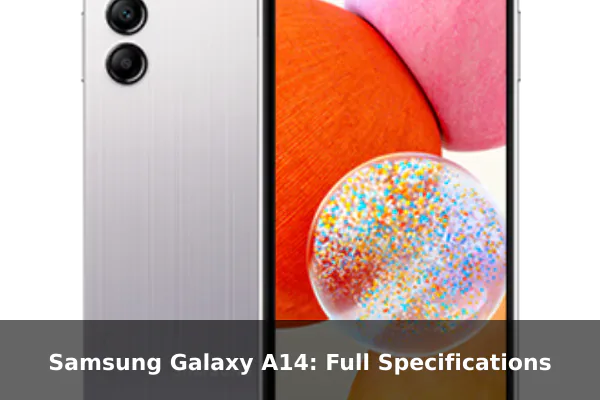
The supplied data lists Android 13 with upgrade availability to Android 15 and One UI 7. That software path is a meaningful part of the Galaxy A14’s value because the interface is familiar across Samsung devices and includes the core Android features most users expect.
One UI is also helpful for buyers who are already using Samsung services or accessories. The phone remains an entry-level device, so software smoothness may not match higher-end Galaxy models, but the overall experience should be accessible for calls, messaging, media, camera use, and everyday productivity.
Connectivity And Everyday Features
The Galaxy A14 supports GSM, HSPA, and LTE networks, with 4G bands listed across common European and international ranges. It does not belong in the same comparison bucket as the Galaxy A14 5G, so buyers who specifically need 5G should check the model name and network listing carefully before purchasing.
Wireless features include dual-band Wi-Fi 802.11 a/b/g/n/ac, Wi-Fi Direct, Bluetooth 5.1 or 5.3 depending on variant, and positioning through GPS, GALILEO, GLONASS, BDS, and QZSS. NFC is listed as market or region dependent, which means contactless payment support should be verified for the exact local model. The 3.5 mm headphone jack remains a useful inclusion for wired audio users.
Who Should Buy It?
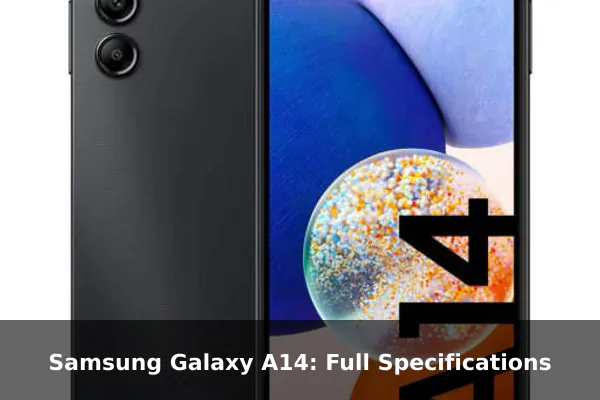
The Galaxy A14 is a sensible pick for students, first-time smartphone buyers, secondary-phone users, and anyone who wants a large-screen Samsung phone at a lower price. It is especially suitable for people who value expandable storage, a big battery, a headphone jack, and a clear Full HD+ display more than gaming power or premium materials.
It is less suitable for users who need 5G, fast charging, a high-refresh-rate AMOLED display, or strong gaming performance. For those priorities, a higher-tier Galaxy A model or a competing mid-range Android phone would be a better comparison point.
Conclusion
The Samsung Galaxy A14 is a practical 4G budget phone with a sharp 6.6-inch display, 5000 mAh battery, expandable storage, and a useful 50 MP main camera. Its biggest strength is everyday dependability at a restrained price, provided buyers confirm the exact regional chipset, NFC support, and storage version before purchase. Recommended for value-focused users who want a large, familiar Samsung phone without paying for 5G or premium extras.
References
- Samsung Mobile Press – Galaxy A14 5G Tech Specs – Official Samsung press/specification page for the Galaxy A14 5G, covering display, dimensions, cameras, memory, battery, OS, connectivity, and sensors.
- Samsung Bosnia and Herzegovina – Galaxy A14 SM-A145R Product Specifications – Official Samsung product page with detailed specifications for the 4G Galaxy A14 variant, useful for separating A14 LTE specs from A14 5G specs.
- Samsung Support UK – Galaxy A14 SM-A145R/DSN – Official Samsung support page with model number confirmation and user manual downloads for Galaxy A14, useful for verifying model identity and documentation.
- FCC Equipment Authorization – Samsung Galaxy A14 filings (fcc.gov) – Official U.S. regulator source for device certification filings, useful for verifying model numbers, wireless capabilities, and compliance details where available.
- GSMArena – Samsung Galaxy A14 – Established phone specification reference useful as a secondary cross-check for launch timing, chipset, display, camera, battery, storage, and regional variant differences.
