
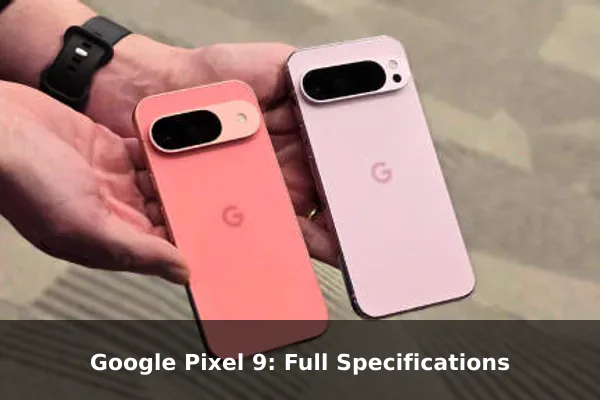
The Google Pixel 9 is the standard model in Google’s 2024 flagship phone family, positioned for buyers who want the latest Pixel camera processing, long software support, and premium durability without stepping up to the Pro line.
Its strongest appeal is balance: a 6.3-inch OLED display, Tensor G4 chipset, 12GB of RAM, dual rear cameras, IP68 protection, and Google’s extended Android upgrade policy in a body that remains easier to handle than many large-screen flagships.
Full Specifications
Network
| Technology: | GSM / HSPA / LTE / 5G |
| 2G bands: | GSM 850 / 900 / 1800 / 1900 |
| 3G bands: | HSDPA 800 / 850 / 900 / 1700(AWS) / 1900 / 2100 |
| 4G bands: | 1, 2, 3, 4, 5, 7, 8, 12, 13, 14, 17, 18, 19, 20, 25, 26, 28, 29, 30, 38, 40, 41, 48, 66, 71 – G2YBB |
| 1, 2, 3, 4, 5, 7, 8, 12, 13, 14, 17, 18, 19, 20, 21, 25, 26, 28, 29, 30, 32, 38, 39, 40, 41, 42, 48, 66, 71, 75 – GUR25 | |
| 5G bands: | 1, 2, 3, 5, 7, 8, 12, 14, 20, 25, 26, 28, 29, 30, 38, 40, 41, 48, 66, 70, 71, 77, 78, 258, 260, 261 SA/NSA/Sub6/mmWave – G2YBB |
| 1, 2, 3, 5, 7, 8, 12, 14, 20, 25, 26, 28, 30, 38, 40, 41, 66, 71, 75, 76, 77, 78, 79 SA/NSA/Sub6 – GUR25 | |
| Speed: | HSPA, LTE (CA), 5G |
Launch
| Announced: | 2024, August 13 |
| Status: | Available. Released 2024, August 22 |
Body
| Dimensions: | 152.8 x 72 x 8.5 mm (6.02 x 2.83 x 0.33 in) |
| Weight: | 198 g (6.98 oz) |
| Build: | Glass front (Gorilla Glass Victus 2), glass back (Gorilla Glass Victus 2), aluminum frame |
| SIM: | Nano-SIM + eSIM |
| IP68 dust tight and water resistant (immersible up to 1.5m for 30 min) |
Display
| Type: | OLED, 120Hz, HDR10+, 1800 nits (HBM), 2700 nits (peak) |
| Size: | 6.3 inches, 94.7 cm2 (~86.1% screen-to-body ratio) |
| Resolution: | 1080 x 2424 pixels, 20:9 ratio (~422 ppi density) |
| Protection: | Corning Gorilla Glass Victus 2, Mohs level 4 |
Platform
| OS: | Android 14, upgradable to Android 15, up to 7 major Android upgrades |
| Chipset: | Google Tensor G4 (4 nm) |
| CPU: | Octa-core (1×3.1 GHz Cortex-X4 & 3×2.6 GHz Cortex-A720 & 4×1.92 GHz Cortex-A520) |
| GPU: | Mali-G715 MC7 |
Memory
| Card slot: | No |
| Internal: | 128GB 12GB RAM, 256GB 12GB RAM |
| UFS 3.1 |
Main Camera
| Dual: | 50 MP, f/1.7, 25mm (wide), 1/1.31″, 1.2µm, dual pixel PDAF, OIS 48 MP, f/1.7, 123˚ (ultrawide), 1/2.55″, dual pixel PDAF |
| Features: | Single-zone Laser AF, LED flash, Pixel Shift, Ultra-HDR, panorama, Best Take |
| Video: | 4K@24/30/60fps, 1080p@24/30/60/120/240fps; gyro-EIS, OIS, 10-bit HDR |
Selfie camera
| Single: | 10.5 MP, f/2.2, 20mm (ultrawide), 1/3.1″, 1.22µm, PDAF |
| Features: | HDR, panorama |
| Video: | 4K@30/60fps, 1080p@30/60fps |
Sound
| Loudspeaker: | Yes, with stereo speakers |
| 3.5mm jack: | No |
Comms
| WLAN: | Wi-Fi 802.11 a/b/g/n/ac/6e/7, tri-band |
| Bluetooth: | 5.3, A2DP, LE, aptX HD |
| Positioning: | GPS (L1+L5), GLONASS, GALILEO, BDS, QZSS, NavIC |
| NFC: | Yes |
| Radio: | No |
| USB: | USB Type-C 3.2 |
Features
| Sensors: | Fingerprint (under display, ultrasonic), accelerometer, gyro, proximity, compass, barometer |
| Satellite SOS service Circle to Search |
Battery
| Type: | Li-Ion 4700 mAh |
| Charging: | 27W wired, PD3.0, PPS, 55% in 30 min 15W wireless (w/ Pixel Stand) 12W wireless (w/ Qi compatible charger) Reverse wireless Bypass charging |
Misc
| Colors: | Obsidian, Porcelain, Wintergreen, Peony |
| Models: | G2YBB, GUR25, G1B60 |
| SAR EU: | 0.99 W/kg (head) 1.40 W/kg (body) |
| Price: | € 486.00 / $ 519.95 / £ 436.36 / ₹ 61,025 |
Our Tests
| Performance: | AnTuTu: 1224020 (v10) GeekBench: 4489 (v6) 3DMark: 2587 (Wild Life Extreme) |
| Display: | 2232 nits max brightness (measured) |
| Loudspeaker: | -25.0 LUFS (Very good) |
| Battery: | Active use score 13:05h |
EU LABEL
| Energy: | Class A |
| Battery: | 49:12h endurance, 1000 cycles |
| Free fall: | Class A (270 falls) |
| Repairability: | Class B |
Price and Availability
The Google Pixel 9 offers a compelling combination of features and performance. While the base price is around €486, the actual cost may vary depending on your location and retailer. Below, you’ll find the approximate price of the Google Pixel 9 converted into various currencies. Please note that these are estimates based on recent exchange rates as of August 11, 2026 and may not reflect the exact price you’ll find at a retailer.
- United States: $561
- Japan: ¥89,230
- United Kingdom: £416
- Australia: A$795
- Canada: C$782
- Taiwan: NT$18,097
- Denmark: kr3.627
- Saudi Arabia: ﷼2,105
- South Korea: ₩795,503
- Germany: €486
- Brazil: R$2.859
- Vietnam: ₫14.599.221
- Kenya: KSh 72,869
- India: ₹53,497
- Indonesia: Rp 9.947.997
- Nigeria: ₦764,736
- Pakistan: ₨155,769
- Philippines: ₱34,093
- Bangladesh: ৳৬৯,৩৬২
Value Position
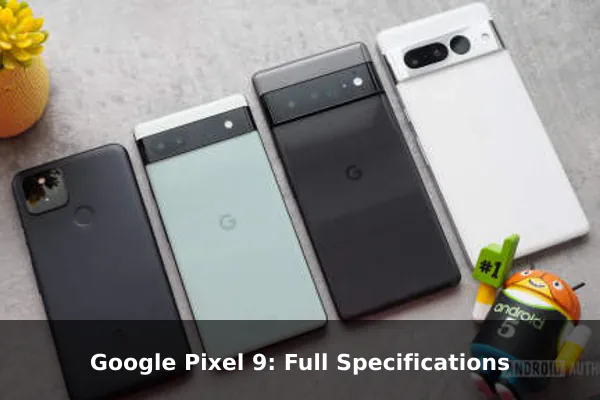
The Pixel 9 sits in an interesting part of the flagship market. It is not the most camera-heavy Pixel, because it skips the dedicated telephoto camera found on Pro models, but it still carries many of the features that make the current Pixel line attractive. The Tensor G4 processor, 12GB RAM configuration, bright OLED panel, premium glass-and-aluminum build, IP68 rating, and long software support give it a stronger flagship identity than the Pixel A-series.
For buyers comparing it with older Pixel phones, the Pixel 9 is a more mature package than the Pixel 8 in several everyday areas. The display is brighter, the memory allocation is more generous, the ultrawide camera is higher resolution, and the design feels more aligned with Google’s newer hardware language. It is best viewed as the mainstream Pixel for people who want the current experience without paying extra for Pro zoom hardware or a folding screen.
Design and Durability
The Google Pixel 9 uses a compact flagship footprint by modern standards, measuring 152.8 x 72 x 8.5 mm and weighing 198 g. That makes it dense rather than feather-light, but the size should still suit users who prefer a phone that is easier to pocket and operate than larger 6.7-inch devices. The flat sides, aluminum frame, and Gorilla Glass Victus 2 on both front and back give it a more premium construction than many mid-range Android phones.
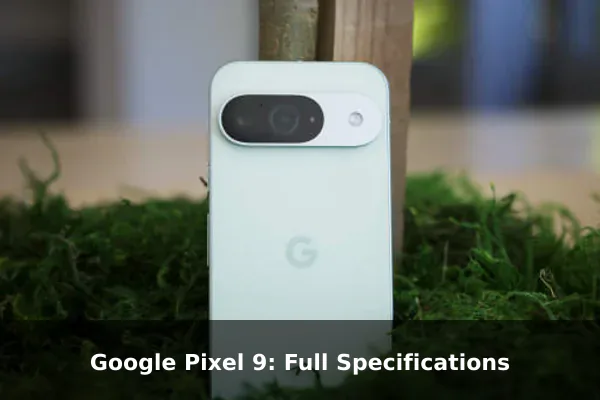
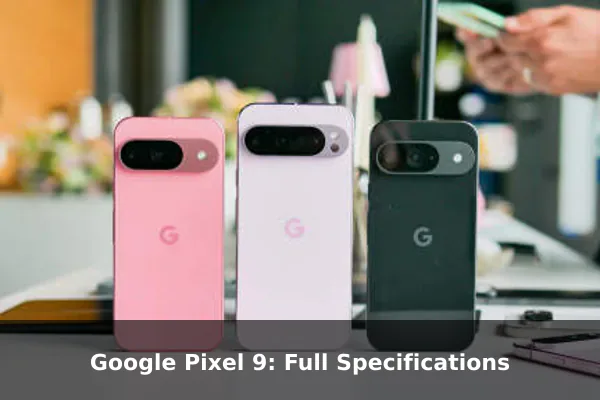
The IP68 rating is important for long-term ownership because it means the phone is dust tight and rated for immersion in water up to 1.5 meters for 30 minutes under controlled conditions. The available colors, Obsidian, Porcelain, Wintergreen, and Peony, give the phone a broader style range than a simple black-and-white launch. The Nano-SIM plus eSIM setup is also practical for travel or mixed personal and work lines.
Display Experience
The 6.3-inch OLED display is one of the Pixel 9’s strongest everyday features. It supports a 120Hz refresh rate, HDR10+, and high brightness levels, with the source data listing 1800 nits in high brightness mode and 2700 nits peak. In testing, the display reached 2232 nits maximum brightness, which points to excellent outdoor usability and a strong HDR viewing experience.
The 1080 x 2424 resolution works out to roughly 422 ppi, which is sharp enough for normal reading, browsing, and video streaming. Some premium competitors offer higher-resolution panels, but the Pixel 9’s display choice helps balance clarity, battery life, and smoothness. Gorilla Glass Victus 2 protection and the listed Mohs level 4 scratch resistance note add useful durability context, although a screen protector remains a sensible accessory for heavy users.
Tensor G4 Performance
The Pixel 9 runs on Google’s Tensor G4 chipset, built on a 4 nm process and paired with 12GB of RAM. The CPU uses a modern octa-core layout with a Cortex-X4 prime core, Cortex-A720 performance cores, and Cortex-A520 efficiency cores, while graphics are handled by the Mali-G715 MC7 GPU. This setup is designed less around topping every gaming benchmark and more around Google’s camera pipeline, AI features, voice processing, and daily Android responsiveness.
The supplied test scores are strong, including an AnTuTu v10 result above 1.2 million, GeekBench 6 at 4489, and a 3DMark Wild Life Extreme score of 2587. Those figures put the Pixel 9 firmly in flagship territory for general use, multitasking, photography, and demanding apps. Heavy gamers may still want to compare sustained performance against Snapdragon-based rivals, but the Pixel 9 has more than enough power for most users.
Camera System
The dual rear camera system combines a 50 MP wide camera with optical image stabilization and a 48 MP ultrawide camera with autofocus. That is a practical pairing for everyday photography because it covers the two most common shooting needs: standard scenes and wider landscapes, interiors, group shots, or close-up creative framing. The absence of a telephoto lens is the main hardware limitation, so users who regularly shoot distant subjects should look at the Pixel 9 Pro instead.
Google’s software processing remains a major part of the camera story. Features such as Pixel Shift, Ultra-HDR, panorama, Best Take, and single-zone Laser AF support the point-and-shoot experience that many Pixel buyers expect. Video recording is also well equipped, with 4K capture up to 60fps, 1080p slow-motion options up to 240fps, gyro-EIS, OIS, and 10-bit HDR. The 10.5 MP ultrawide selfie camera includes autofocus, which is useful for sharper front-facing photos and video calls.
Battery and Charging
The Pixel 9 has a 4700 mAh battery, and the listed active use score of 13:05 hours suggests dependable endurance for a compact flagship. The EU label data adds another useful angle, listing Class A energy performance, 49:12 hours of endurance, 1000 battery cycles, Class A free-fall performance, and Class B repairability. Those labels make the phone easier to compare for buyers who care about durability and longer ownership.
Charging is flexible rather than class-leading. Wired charging is rated at 27W with PD3.0 and PPS support, with the source data noting up to 55% in 30 minutes. Wireless charging reaches 15W with the Pixel Stand and 12W with Qi-compatible chargers. Reverse wireless charging and bypass charging round out the feature set, making the Pixel 9 convenient for desks, nightstands, and accessory top-ups.
Software Support
Software is one of the clearest reasons to choose the Pixel 9. It launched with Android 14, is listed as upgradable to Android 15, and carries support for up to seven major Android upgrades. That long update window makes the phone more attractive for users who keep a device for several years and want new platform features, security patches, and Pixel feature updates over time.
The Pixel experience also means faster access to Google’s own Android features than many third-party phones. Circle to Search and Satellite SOS service are listed among the feature highlights, while the ultrasonic under-display fingerprint sensor is a welcome practical upgrade for unlocking reliability. Buyers who value clean software, timely updates, and Google-first features will find the Pixel 9 easier to recommend than many Android alternatives with heavier skins.
Connectivity and Audio
The Pixel 9 is well covered for modern connectivity. It supports GSM, HSPA, LTE, and 5G, with extensive Sub-6 and model-dependent mmWave band support. The G2YBB variant includes mmWave bands, while the GUR25 listing focuses on Sub-6 5G. That distinction matters for buyers importing the phone or choosing between regional models, because 5G performance can vary by carrier and market.
Wi-Fi support includes Wi-Fi 6e and Wi-Fi 7 on tri-band networks, while Bluetooth 5.3 includes A2DP, LE, and aptX HD. Positioning support is broad, covering GPS with L1+L5, GLONASS, GALILEO, BDS, QZSS, and NavIC. NFC is included, radio is not, and the USB-C port uses USB 3.2. Audio is handled by stereo speakers, with testing listed at -25.0 LUFS and rated very good, but there is no 3.5 mm headphone jack.
Who Should Buy the Pixel 9?
The Pixel 9 is best for buyers who want a high-end Android phone with strong cameras, a bright display, long updates, and a manageable size. It makes particular sense for users upgrading from older Pixel phones, compact Android devices, or mid-range models that lack premium durability and long-term software support.
It is less ideal for users who need the best optical zoom, the largest display, the fastest charging, or the highest sustained gaming performance available. Those buyers should compare the Pixel 9 Pro, larger Android flagships, or gaming-focused phones. For most people, however, the regular Pixel 9 is the cleanest and most sensible model in the Pixel 9 lineup because it keeps the core experience without pushing too far into premium pricing or oversized hardware.
Conclusion
The Google Pixel 9 is a well-rounded flagship built around practical strengths: a bright 120Hz OLED screen, Tensor G4 performance, excellent everyday cameras, IP68 durability, strong connectivity, and long Android support. Choose it if you want the current Pixel experience in a balanced size and do not need a dedicated telephoto camera.
References
- Google Store – Pixel 9 Tech Specs – Primary manufacturer source for Pixel 9 display, dimensions, battery, RAM/storage, cameras, processor, connectivity, network bands, durability, colors, and in-box contents.
- Google Pixel Phone Help – Pixel phone hardware tech specs – Official Google support reference with detailed Pixel 9 family hardware specifications, regional notes, model details, and specification footnotes.
- Google Pixel Phone Help – Pixel software update policy – Official source for Pixel 9 OS, security update, and Pixel Drop support duration claims.
- Google Pixel Phone Help – Safety & regulatory guide for Pixel 9, Pixel 9 Pro & Pixel 9 Pro XL – Official safety, charging, RF exposure, SAR, FCC compliance, HAC, warranty, and regulatory information for the Pixel 9 series.
- Google Blog – Google Pixel 9 camera specs and AI photo features – Official launch-era explanation of Pixel 9 camera upgrades and AI photo/video features useful for feature descriptions beyond raw specs.
