
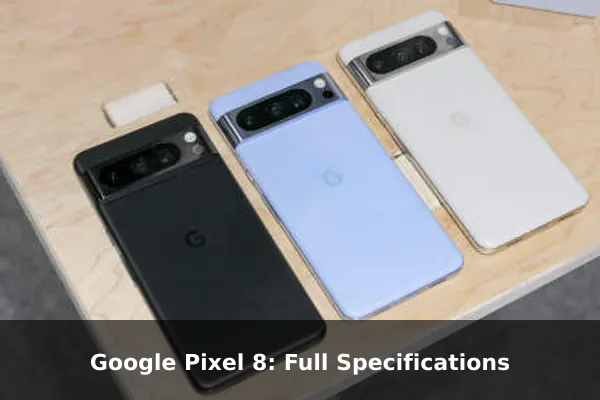
The Google Pixel 8 is Google’s compact 2023 flagship, built around the in-house Tensor G3 chip and a 6.2-inch OLED display that finally pushes to a 120Hz refresh rate. Announced on October 4, 2023 and released a little over a week later, it packs Google’s computational photography, a bright Actua panel, and one of the longest software support commitments in the Android world into a genuinely one-hand-friendly body.
This article breaks down what the Pixel 8 offers in real terms — its design, screen, performance, cameras, battery life, and software promise — and who it makes the most sense for. Rather than simply listing numbers, it focuses on how the hardware translates into everyday use and where the phone sits against rivals in its class.
Full Specifications
Network
| Technology: | GSM / HSPA / LTE / 5G |
| 2G bands: | GSM 850 / 900 / 1800 / 1900 |
| 3G bands: | HSDPA 800 / 850 / 900 / 1700(AWS) / 1900 / 2100 |
| 4G bands: | 1, 2, 3, 4, 5, 7, 8, 12, 13, 14, 17, 18, 19, 20, 25, 26, 28, 29, 30, 38, 40, 41, 46, 48, 66, 71 – GKWS6, G9BQD |
| 5G bands: | 1, 2, 3, 5, 7, 8, 12, 20, 25, 26, 28, 29, 30, 38, 40, 41, 48, 66, 70, 71, 77, 78, 258, 260, 261 SA/NSA/Sub6/mmWave – GKWS6 |
| 1, 2, 3, 5, 7, 8, 12, 20, 25, 26, 28, 29, 30, 38, 40, 41, 48, 66, 70, 71, 77, 78 SA/NSA/Sub6 – G9BQD | |
| Speed: | HSPA, LTE (CA), 5G |
Launch
| Announced: | 2023, October 04 |
| Status: | Available. Released 2023, October 12 |
Body
| Dimensions: | 150.5 x 70.8 x 8.9 mm (5.93 x 2.79 x 0.35 in) |
| Weight: | 187 g (6.60 oz) |
| Build: | Glass front (Gorilla Glass Victus), glass back (Gorilla Glass Victus), aluminum frame |
| SIM: | Nano-SIM + eSIM |
| IP68 dust tight and water resistant (immersible up to 1.5m for 30 min) |
Display
| Type: | OLED, 120Hz, HDR10+, 1400 nits (HBM), 2000 nits (peak) |
| Size: | 6.2 inches, 91.1 cm2 (~85.5% screen-to-body ratio) |
| Resolution: | 1080 x 2400 pixels, 20:9 ratio (~428 ppi density) |
| Protection: | Corning Gorilla Glass Victus |
Platform
| OS: | Android 14, upgradable to Android 15, up to 7 major Android upgrades |
| Chipset: | Google Tensor G3 (4 nm) |
| CPU: | Nona-core (1×3.0 GHz Cortex-X3 & 4×2.45 GHz Cortex-A715 & 4×2.15 GHz Cortex-A510) |
| GPU: | Immortalis-G715s MC10 |
Memory
| Card slot: | No |
| Internal: | 128GB 8GB RAM, 256GB 8GB RAM |
| UFS 3.1 |
Main Camera
| Dual: | 50 MP (12 MP eff.), f/1.7, 25mm (wide), 1/1.31″, 1.2µm, dual pixel PDAF, OIS 12 MP, f/2.2, 126˚ (ultrawide), 1/2.9″, 1.25µm, AF |
| Features: | Laser AF, Dual-LED flash, Pixel Shift, Ultra HDR, panorama, Best Take |
| Video: | 4K@24/30/60fps, 1080p@30/60/120/240fps; gyro-EIS, OIS, 10-bit HDR |
Selfie camera
| Single: | 10.5 MP, f/2.2, 20mm (ultrawide), 1/3.1″, 1.22µm |
| Features: | HDR, panorama |
| Video: | 4K@24/30/60fps, 1080p@30/60fps |
Sound
| Loudspeaker: | Yes, with stereo speakers |
| 3.5mm jack: | No |
Comms
| WLAN: | Wi-Fi 802.11 a/b/g/n/ac/6e/7, tri-band, Wi-Fi Direct |
| Bluetooth: | 5.3, A2DP, LE, aptX HD |
| Positioning: | GPS (L1+L5), GLONASS (G1), GALILEO (E1+E5a), QZSS (L1+L5) |
| NFC: | Yes |
| Radio: | No |
| USB: | USB Type-C 3.2 |
Features
| Sensors: | Fingerprint (under display, optical), accelerometer, gyro, proximity, compass, barometer |
| Circle to Search |
Battery
| Type: | Li-Ion 4575 mAh |
| Charging: | 27W wired, PD3.0, PPS, 50% in 30 min 18W wireless Reverse wireless Bypass charging |
Misc
| Colors: | Obsidian, Hazel, Rose, Mint |
| Models: | GKWS6, G9BQD, GA04851-US, GZPFO, GPJ41 |
| Price: | € 323.00 / $ 252.44 / £ 278.74 |
Our Tests
| Performance: | AnTuTu: 926801 (v9), 1158631 (v10) GeekBench: 3526 (v5), 4404 (v6) GFXBench: 73fps (ES 3.1 onscreen) |
| Display: | 1446 nits max brightness (measured) |
| Camera: | Photo / Video |
| Loudspeaker: | -26.0 LUFS (Very good) |
| Battery: | Active use score 11:17h |
| Battery (old): | Endurance rating 83h |
Price and Availability
The Google Pixel 8 offers a compelling combination of features and performance. While the base price is around €323, the actual cost may vary depending on your location and retailer. Below, you’ll find the approximate price of the Google Pixel 8 converted into various currencies. Please note that these are estimates based on recent exchange rates as of July 4, 2026 and may not reflect the exact price you’ll find at a retailer.
- United States: $369
- Japan: ¥59,592
- United Kingdom: £277
- Australia: A$533
- Canada: C$525
- Taiwan: NT$11,800
- Denmark: kr2.411
- Saudi Arabia: ﷼1,385
- South Korea: ₩566,253
- Germany: €323
- Brazil: R$1.918
- Vietnam: ₫9.612.242
- Kenya: KSh 47,735
- India: ₹35,208
- Indonesia: Rp 6.638.373
- Nigeria: ₦501,407
- Pakistan: ₨102,678
- Philippines: ₱22,704
- Bangladesh: ৳৪৫,৫৪২
Value and Positioning
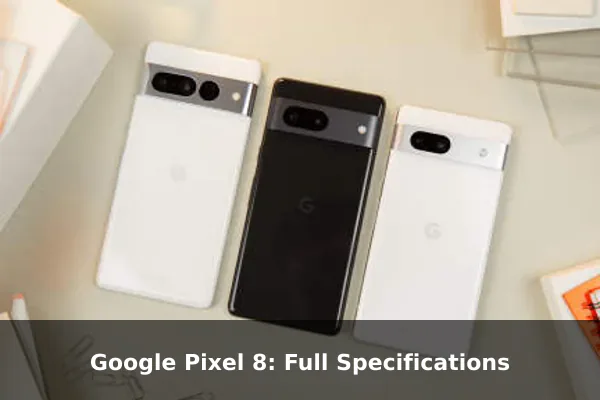
The Pixel 8 targets buyers who want a true flagship experience without stepping up to the larger, pricier Pro model. With a compact footprint, flagship silicon, and Google’s software features baked in, it competes directly with other premium compacts. Its standout value proposition is longevity: Google promises up to seven years of major Android upgrades and security patches, which meaningfully lowers the long-term cost of ownership compared with phones that receive only two or three years of updates.
Design and Build Quality
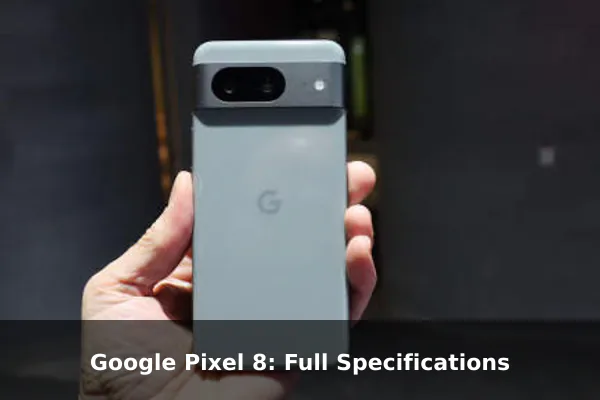
Measuring 150.5 x 70.8 x 8.9 mm and weighing 187 g, the Pixel 8 is compact and comfortable to hold. The build is genuinely premium: a glass front and back, both protected by Corning Gorilla Glass Victus, wrapped in an aluminum frame. The rounded edges and signature camera bar give it a distinctive, recognizable look. IP68 dust and water resistance means it can survive immersion up to 1.5 m for 30 minutes, and the color options — Obsidian, Hazel, Rose, and Mint — lean playful rather than conservative.
Display Experience
The 6.2-inch OLED panel is one of the biggest upgrades over previous non-Pro Pixels. It runs at a smooth 120Hz, supports HDR10+, and reaches 1400 nits in high brightness mode with a 2000 nits peak, so outdoor visibility is excellent — independent testing measured around 1446 nits. At 1080 x 2400 pixels with roughly 428 ppi, text and images stay crisp, and the 20:9 aspect ratio keeps the phone narrow and easy to use with one hand. Gorilla Glass Victus protects the front.
Performance and Software
Google’s Tensor G3, built on a 4 nm process, drives the Pixel 8 with a nine-core CPU layout and an Immortalis-G715s MC10 GPU. Tensor chips prioritize on-device machine learning over raw benchmark supremacy, and the numbers reflect that: AnTuTu scores of roughly 926,801 (v9) and 1,158,631 (v10) put it in upper-tier territory rather than at the outright top. In daily use it feels fast and fluid, and the AI-driven features — from voice typing to photo editing tools like Best Take and Circle to Search — are where it pulls ahead. It ships with Android 14, upgradable to Android 15 and beyond, backed by that seven-year update pledge.
Camera Capabilities
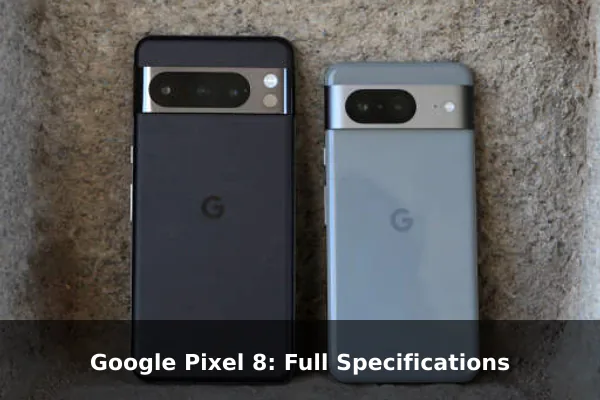
Photography remains the Pixel’s calling card. The main camera pairs a 50 MP wide sensor (f/1.7, 1/1.31″, dual pixel PDAF, OIS) with a 12 MP ultrawide (f/2.2, 126˚, autofocus). Google’s computational pipeline — including Pixel Shift, Ultra HDR, and Best Take — consistently produces natural color and strong dynamic range. Video tops out at 4K@60fps with 10-bit HDR, gyro-EIS, and OIS. The 10.5 MP ultrawide selfie camera captures group shots comfortably and also records 4K video. It is a two-lens system rather than a triple setup, but the results punch above the spec sheet.
Battery and Charging
A 4575 mAh Li-Ion battery keeps the compact frame going through a full day, with an active-use score of around 11 hours 17 minutes in testing. Charging is 27W wired with PD3.0 and PPS, reaching about 50% in 30 minutes, plus 18W wireless charging and reverse wireless charging for accessories. Charging speeds are modest next to some rivals, but the efficiency of the compact package keeps endurance respectable.
Connectivity
The Pixel 8 is well equipped for the future. It supports 5G (Sub6 and, on certain models, mmWave), Wi-Fi 7 with tri-band and 6e support, Bluetooth 5.3 with aptX HD and LE, and USB Type-C 3.2 for faster data transfer. Positioning covers dual-band GPS (L1+L5) alongside GLONASS, Galileo, and QZSS. There is NFC, stereo speakers, and an under-display optical fingerprint sensor, though there is no 3.5mm jack, no microSD expansion, and no FM radio.
Who Should Buy the Pixel 8
The Pixel 8 is ideal for buyers who value a compact form factor, class-leading point-and-shoot photography, and the longest software support in Android. It suits anyone upgrading from an older Pixel or a mid-range phone who wants a clean, AI-forward experience. Power users chasing peak gaming benchmarks, telephoto zoom, or the fastest charging may prefer the Pixel 8 Pro or a rival flagship, but for most people the standard Pixel 8 covers the essentials elegantly.
Conclusion
The Google Pixel 8 blends a compact, premium design with a bright 120Hz OLED, dependable Tensor G3 performance, and Google’s best-in-class camera software, all wrapped in an unmatched seven-year update promise. Charging speed and raw benchmark scores are its main compromises. If you want a smaller flagship that stays current for years and takes excellent photos with minimal effort, the Pixel 8 is an easy recommendation — verify current pricing, colors, and availability with official Google sources before buying.
References
- Google Pixel Phone Help – Pixel phone hardware tech specs – Official Google hardware specifications for Pixel phones, including Pixel 8 display, dimensions, battery, memory, processor, cameras, sensors, connectivity, network bands, colors, and materials.
- Google Store – Pixel 8 – Official manufacturer product page for Pixel 8, useful for confirming product positioning, official naming, colors, features, and retail-facing details.
- Google Pixel Phone Help – Pixel software update policy – Official Google source for Pixel update commitments, including the 7-year OS and security update policy for Pixel 8.
- FCC Equipment Authorization System (fcc.gov) – Primary U.S. regulator source for wireless device authorization records, useful for verifying Pixel 8 model variants, radio compliance, and certification details.
- Google Pixel security certifications on Android – Official Google reference for Pixel security certifications and components such as Titan M2 and Tensor-related security validation.
