
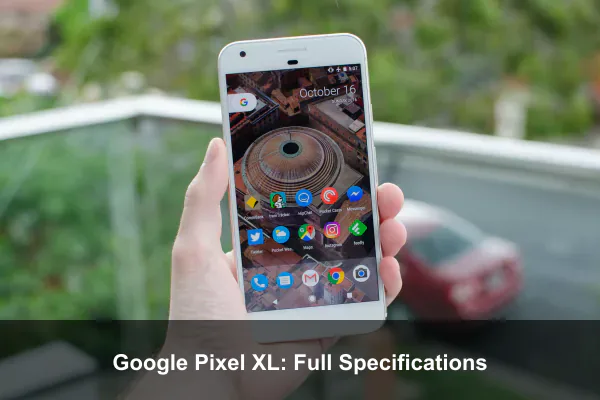
The Google Pixel XL stands as a landmark device in Google’s smartphone journey, marking the company’s first true flagship under its own Pixel brand. Launched in October 2016, this 5.5-inch handset positioned itself as a premium Android experience crafted entirely by Google, blending pure software with capable hardware aimed at enthusiasts who wanted a clean, fast, and camera-focused phone.
Even years after its release, the Pixel XL remains a fascinating reference point for understanding how Google approached mobile design at the dawn of the Pixel era. With its Snapdragon 821 chipset, QHD AMOLED display, and a single 12.3 MP rear camera that punched well above its weight, the device set the tone for the imaging-first philosophy that still defines the Pixel family today.
Full Specifications
Network
| Technology | GSM / HSPA / LTE |
| 2G bands | GSM 850 / 900 / 1800 / 1900 |
| HSDPA 800 / 850 / 900 / 1700(AWS) / 1900 / 2100 | |
| 4G bands | 1, 2, 3, 4, 5, 7, 8, 12, 13, 17, 18, 19, 20, 21, 26, 28, 32, 38, 39, 40, 41 |
| Speed | HSPA 42.2/5.76 Mbps, LTE (3CA) Cat9 450/50 Mbps or LTE (3CA) Cat11 600/75 Mbps |
| GPRS | Yes |
| EDGE | Yes |
Launch
| Announced | 2016, October 04. Released 2016, October 20 |
| Status | Discontinued |
Body
| Dimensions | 154.7 x 75.7 x 8.5 mm (6.09 x 2.98 x 0.33 in) |
| Weight | 168 g (5.93 oz) |
| Build | Glass front (Gorilla Glass 4), aluminum/glass back, aluminum frame |
| SIM | Nano-SIM |
| Water-repellent coating |
Display
| Type | AMOLED |
| Size | 5.5 inches, 83.4 cm2 (~71.2% screen-to-body ratio) |
| Resolution | 1440 x 2560 pixels, 16:9 ratio (~534 ppi density) |
| Protection | Corning Gorilla Glass 4 |
Platform
| OS | Android 7.1 (Nougat), upgradable to Android 10 |
| Chipset | Qualcomm MSM8996 Snapdragon 821 (14 nm) |
| CPU | Quad-core (2×2.15 GHz Kryo & 2×1.6 GHz Kryo) |
| GPU | Adreno 530 |
Memory
| Card slot | No |
| Internal | 32GB 4GB RAM, 128GB 4GB RAM |
| UFS 2.0 |
Main Camera
| Single | 12.3 MP, f/2.0, 1/2.3", 1.55µm, PDAF |
| Features | Laser AF, Dual-LED flash, HDR, panorama |
| Video | 4K@30fps, 1080p@60/120fps, 1080p@30fps (gyro-EIS), 720p@240fps |
Selfie camera
| Single | 8 MP, f/2.4, 1/3.2", 1.4µm |
| Video | 1080p@30fps |
Sound
| Loudspeaker | Yes |
| 3.5mm jack | Yes |
Comms
| WLAN | Wi-Fi 802.11 a/b/g/n/ac, dual-band, Wi-Fi Direct, DLNA |
| Bluetooth | 4.2, A2DP, LE, aptX |
| Positioning | GPS, GLONASS |
| NFC | Yes |
| Radio | No |
| USB | USB Type-C 3.0 |
Features
| Sensors | Fingerprint (rear-mounted), accelerometer, gyro, proximity, compass, barometer |
Battery
| Type | Li-Ion 3450 mAh, non-removable |
| Charging | 18W wired, PD |
| Stand-by | Up to 552 h (3G) |
| Talk time | Up to 32 h (3G) |
| Music play | Up to 130 h |
Misc
| Colors | Quite Black, Very Silver, Really Blue |
| SAR | 0.89 W/kg (head) 0.56 W/kg (body) |
| SAR EU | 0.25 W/kg (head) 0.44 W/kg (body) |
| Price | About 400 EUR |
Our Tests
| Performance | Basemark OS II 2.0: 2281Basemark X: 30861 |
| Display | Contrast ratio: Infinite (nominal), 4.164 (sunlight) |
| Camera | Photo / Video |
| Battery (old) | Endurance rating 78h |
Price and Availability
The Google Pixel XL offers a compelling combination of features and performance. While the base price is around €400, the actual cost may vary depending on your location and retailer. Below, you’ll find the approximate price of the Google Pixel XL converted into various currencies. Please note that these are estimates based on recent exchange rates as of May 25, 2026 and may not reflect the exact price you’ll find at a retailer.
- United States: $465
- Japan: ¥73,972
- United Kingdom: £346
- Australia: A$651
- Canada: C$642
- Taiwan: NT$14,609
- Denmark: kr2.984
- Saudi Arabia: ﷼1,744
- South Korea: ₩704,132
- Germany: €400
- Brazil: R$2.326
- Vietnam: ₫12.040.919
- Kenya: KSh 60,216
- India: ₹44,422
- Indonesia: Rp 8.209.774
- Nigeria: ₦634,910
- Pakistan: ₨129,694
- Philippines: ₱28,597
- Bangladesh: ৳৫৭,০১৯
Design and Build Quality
The Pixel XL adopts a distinctive two-tone back, pairing an aluminum frame with a glass panel covering the upper third of the rear. Measuring 154.7 x 75.7 x 8.5 mm and weighing 168 g, it strikes a comfortable balance between heft and hand feel. The water-repellent coating offers light protection, though it lacks a formal IP rating found on competing flagships of the era.
AMOLED Display Experience
The 5.5-inch AMOLED panel delivers a sharp 1440 x 2560 resolution at roughly 534 ppi, protected by Corning Gorilla Glass 4. Colors are punchy and contrast is effectively infinite thanks to the AMOLED technology, with measured sunlight legibility around a 4.164 contrast ratio. The 16:9 aspect ratio reflects its 2016 design DNA, offering generous space for video and reading.
Performance and Chipset
Powered by the Qualcomm Snapdragon 821 built on a 14 nm process, the Pixel XL pairs a quad-core Kryo CPU (2×2.15 GHz + 2×1.6 GHz) with the Adreno 530 GPU. Benchmarks like Basemark OS II 2.0 score of 2281 and Basemark X of 30861 reflect strong performance for its generation. With 4 GB of RAM and UFS 2.0 storage in either 32 GB or 128 GB, daily multitasking and gaming remain responsive.
Camera Capabilities
The single 12.3 MP rear camera with f/2.0 aperture, 1.55µm pixels, laser autofocus, and PDAF was widely celebrated at launch. It records 4K at 30fps, 1080p at up to 120fps, and 720p slow motion at 240fps, with gyro-EIS smoothing handheld clips. The 8 MP f/2.4 front camera handles selfies and 1080p video calls competently.
Battery Life and Charging
A 3450 mAh non-removable Li-Ion battery powers the Pixel XL, supporting 18W USB Power Delivery charging through its USB Type-C 3.0 port. Endurance ratings reach around 78 hours of mixed use, with up to 32 hours of 3G talk time and 130 hours of music playback, comfortably lasting a full day for most users.
Software and Updates
The Pixel XL launched with Android 7.1 Nougat and was officially upgraded all the way to Android 10, providing a clean, bloat-free Google experience. The stock interface, fast security patches during its support window, and tight integration with Google Assistant gave it a software advantage over many contemporaries.
Connectivity Options
Connectivity is comprehensive for its era: Wi-Fi 802.11 a/b/g/n/ac dual-band, Bluetooth 4.2 with aptX, NFC, GPS with GLONASS, and USB Type-C 3.0 for fast data transfers. LTE Cat9 or Cat11 with carrier aggregation enables download speeds up to 600 Mbps, and a 3.5mm headphone jack remains for wired audio fans.
Who Should Consider the Pixel XL
Today, the Pixel XL is best suited for collectors, secondary-device users, or enthusiasts curious about the origin of the Pixel line. Photographers who appreciate Google’s computational imaging legacy and minimalists who want a clean Android experience will find it especially nostalgic, even if mainstream buyers will gravitate toward newer Pixels.
Conclusion
The Google Pixel XL remains a meaningful chapter in smartphone history, blending a quality AMOLED display, dependable Snapdragon 821 performance, and a class-leading camera for its time. While its hardware has been outpaced by modern devices, it is still a worthwhile pick for fans of early Pixel design and pure Android, especially at its current secondary-market price point.
