
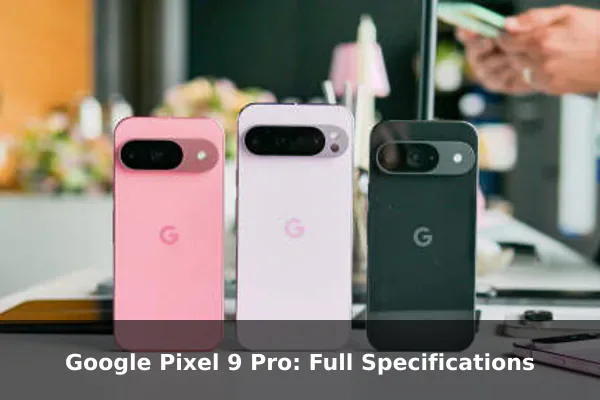
The Google Pixel 9 Pro is the compact flagship in Google’s 2024 Pro lineup, pairing a 6.3-inch LTPO OLED display with the Tensor G4 chipset, 16GB of RAM, and a triple rear camera system led by a 50MP main sensor.
This article focuses on how the Pixel 9 Pro reads as a practical specification package: display quality, camera flexibility, software support, connectivity, battery behavior, and overall value compared with larger or more gaming-focused flagship phones.
Full Specifications
Network
| Technology: | GSM / HSPA / LTE / 5G |
| 2G bands: | GSM 850 / 900 / 1800 / 1900 |
| 3G bands: | HSDPA 800 / 850 / 900 / 1700(AWS) / 1900 / 2100 |
| 4G bands: | 1, 2, 3, 4, 5, 7, 8, 12, 13, 14, 17, 18, 19, 20, 25, 26, 28, 29, 30, 38, 40, 41, 48, 66, 71 – GR83Y |
| 1, 2, 3, 4, 5, 7, 8, 12, 13, 14, 17, 18, 19, 20, 21, 25, 26, 28, 29, 30, 32, 38, 39, 40, 41, 42, 48, 66, 71, 75 – GEC77 | |
| 5G bands: | 1, 2, 3, 5, 7, 8, 12, 14, 20, 25, 26, 28, 29, 30, 38, 40, 41, 48, 66, 70, 71, 77, 78, 258, 260, 261 SA/NSA/Sub6/mmWave – GR83Y |
| 1, 2, 3, 5, 7, 8, 12, 14, 20, 25, 26, 28, 30, 38, 40, 41, 66, 71, 75, 76, 77, 78, 79 SA/NSA/Sub6 – GEC77 | |
| Speed: | HSPA, LTE (CA), 5G |
Launch
| Announced: | 2024, August 13 |
| Status: | Available. Released 2024, September 09 |
Body
| Dimensions: | 152.8 x 72 x 8.5 mm (6.02 x 2.83 x 0.33 in) |
| Weight: | 199 g (7.02 oz) |
| Build: | Glass front (Gorilla Glass Victus 2), glass back (Gorilla Glass Victus 2), aluminum frame |
| SIM: | Nano-SIM + eSIM |
| IP68 dust tight and water resistant (immersible up to 1.5m for 30 min) |
Display
| Type: | LTPO OLED, 120Hz, HDR10+, 2000 nits (HBM), 3000 nits (peak) |
| Size: | 6.3 inches, 96.3 cm2 (~87.6% screen-to-body ratio) |
| Resolution: | 1280 x 2856 pixels, 20:9 ratio (~495 ppi density) |
| Protection: | Corning Gorilla Glass Victus 2, Mohs level 4 |
Platform
| OS: | Android 14, upgradable to Android 15, up to 7 major Android upgrades |
| Chipset: | Google Tensor G4 (4 nm) |
| CPU: | Octa-core (1×3.1 GHz Cortex-X4 & 3×2.6 GHz Cortex-A720 & 4×1.92 GHz Cortex-A520) |
| GPU: | Mali-G715 MC7 |
Memory
| Card slot: | No |
| Internal: | 128GB 16GB RAM, 256GB 16GB RAM, 512GB 16GB RAM, 1TB 16GB RAM |
| UFS 3.1 |
Main Camera
| Triple: | 50 MP, f/1.7, 25mm (wide), 1/1.31″, 1.2µm, dual pixel PDAF, OIS 48 MP, f/2.8, 113mm (periscope telephoto), 1/2.55″, dual pixel PDAF, OIS, 5x optical zoom 48 MP, f/1.7, 123˚ (ultrawide), 1/2.55″, dual pixel PDAF |
| Features: | Multi-zone Laser AF, LED flash, Pixel Shift, Ultra-HDR, panorama, Best Take, Zoom Enhance |
| Video: | 8K@30fps (via cloud-based upscaling), 4K@24/30/60fps, 1080p@24/30/60/120/240fps; gyro-EIS, OIS, 10-bit HDR |
Selfie camera
| Single: | 42 MP, f/2.2, 17mm (ultrawide), PDAF |
| Features: | HDR, panorama |
| Video: | 4K@30/60fps, 1080p@30/60fps |
Sound
| Loudspeaker: | Yes, with stereo speakers |
| 3.5mm jack: | No |
Comms
| WLAN: | Wi-Fi 802.11 a/b/g/n/ac/6e/7, tri-band |
| Bluetooth: | 5.3, A2DP, LE, aptX HD |
| Positioning: | GPS (L1+L5), GLONASS, GALILEO, BDS, QZSS, NavIC |
| NFC: | Yes |
| Radio: | No |
| USB: | USB Type-C 3.2 |
Features
| Sensors: | Fingerprint (under display, ultrasonic), accelerometer, gyro, proximity, compass, barometer, thermometer (skin temperature) |
| Ultra Wideband (UWB) support Satellite SOS service Circle to Search |
Battery
| Type: | Li-Ion 4700 mAh |
| Charging: | 27W wired, PD3.0, PPS, 55% in 30 min 21W wireless (w/ Pixel Stand) 12W wireless (w/ Qi compatible charger) Reverse wireless Bypass charging |
Misc
| Colors: | Porcelain, Rose Quartz, Hazel, Obsidian |
| Models: | GR83Y, GEC77, GWVK6 |
| SAR EU: | 0.99 W/kg (head) 1.37 W/kg (body) |
| Price: | € 578.90 / $ 579.95 / £ 719.04 |
Our Tests
| Performance: | AnTuTu: 838931 (v9), 1088917 (v10) GeekBench: 3850 (v5), 4728 (v6) 3DMark: 2574 (Wild Life Extreme) |
| Display: | 2331 nits max brightness (measured) |
| Loudspeaker: | -24.3 LUFS (Very good) |
| Battery: | Active use score 13:11h |
EU LABEL
| Energy: | Class A |
| Battery: | 50:44h endurance, 1000 cycles |
| Free fall: | Class A (270 falls) |
| Repairability: | Class C |
Price and Availability
The Google Pixel 9 Pro offers a compelling combination of features and performance. While the base price is around €579, the actual cost may vary depending on your location and retailer. Below, you’ll find the approximate price of the Google Pixel 9 Pro converted into various currencies. Please note that these are estimates based on recent exchange rates as of July 26, 2026 and may not reflect the exact price you’ll find at a retailer.
- United States: $659
- Japan: ¥107,889
- United Kingdom: £494
- Australia: A$943
- Canada: C$928
- Taiwan: NT$21,305
- Denmark: kr4.320
- Saudi Arabia: ﷼2,470
- South Korea: ₩964,526
- Germany: €579
- Brazil: R$3.345
- Vietnam: ₫17.308.079
- Kenya: KSh 85,403
- India: ₹63,604
- Indonesia: Rp 11.796.147
- Nigeria: ₦896,833
- Pakistan: ₨182,974
- Philippines: ₱40,726
- Bangladesh: ৳৮১,২৯২
Why Should You Buy the Google Pixel 9 Pro?
The main reason to consider the Google Pixel 9 Pro is that it brings most of Google’s highest-end phone hardware into a smaller body than the Pixel 9 Pro XL. It is not a budget phone, but its specification balance is unusual: a compact 6.3-inch frame, 16GB of RAM across all storage versions, a full triple-camera setup, Wi-Fi 7, UWB, satellite SOS support, and a long Android update commitment. For buyers who want a flagship Android phone without moving to a very large screen, this is the core appeal.
The raw price data places it near premium midrange and older-flagship territory in some markets, which makes its value more interesting. The phone is best judged as a camera-first, software-first flagship rather than a pure benchmark leader. Tensor G4 is capable, but the Pixel 9 Pro’s stronger identity comes from imaging features, Google services, display quality, and long-term software support.
Design and Durability
The Pixel 9 Pro has a measured 152.8 x 72 x 8.5 mm body and weighs 199 g, so it is compact by modern Pro-phone standards but not especially light. The 199 g weight comes from a premium material mix: Gorilla Glass Victus 2 on the front and back, plus an aluminum frame. That combination gives it the expected flagship feel while keeping it more pocketable than many Ultra-sized competitors.
Durability is also a strong point. The IP68 rating means the phone is dust tight and water resistant up to 1.5 meters for 30 minutes under rated test conditions. The display glass is listed as Corning Gorilla Glass Victus 2 with Mohs level 4 resistance, so users still should not treat it as scratch-proof, but the protection level is appropriate for a premium Android device. Color options include Porcelain, Rose Quartz, Hazel, and Obsidian, giving the phone both muted and softer finishes.
Display Quality
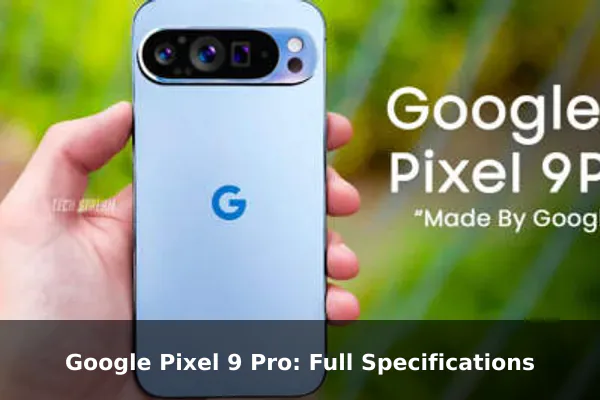
The 6.3-inch LTPO OLED panel is one of the Pixel 9 Pro’s strongest specification areas. It supports a 120Hz refresh rate, HDR10+, a 1280 x 2856 resolution, and a sharp density of about 495 ppi. The 20:9 aspect ratio keeps the phone narrow enough for one-handed grip while still giving enough vertical space for reading, camera controls, and multitasking.
Brightness is a clear highlight. The official source data lists 2000 nits in high-brightness mode and 3000 nits peak, while the measured test figure reaches 2331 nits maximum brightness. That makes the Pixel 9 Pro suitable for outdoor use, navigation, photography in sunlight, and HDR viewing. LTPO technology also matters because it can scale refresh behavior more efficiently than a fixed high-refresh panel.
Performance and Storage
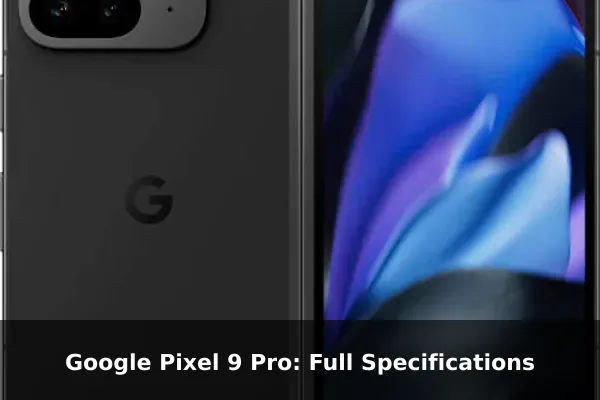
The Pixel 9 Pro runs on Google Tensor G4, a 4 nm chipset with an octa-core CPU using one Cortex-X4 core, three Cortex-A720 cores, and four Cortex-A520 cores. Graphics are handled by the Mali-G715 MC7. The benchmark figures are respectable, with AnTuTu scores listed at 838,931 on v9 and 1,088,917 on v10, plus GeekBench scores of 3,850 on v5 and 4,728 on v6.
For daily use, the more important detail may be memory. Every listed storage version includes 16GB of RAM, whether buyers choose 128GB, 256GB, 512GB, or 1TB. That gives the Pixel 9 Pro generous headroom for multitasking and long-term software demands. The storage standard is UFS 3.1, and there is no memory card slot, so buyers should choose capacity carefully at purchase.
Camera System
The rear camera setup is a true Pro-grade configuration rather than a simple wide-plus-ultrawide arrangement. It includes a 50MP wide camera with dual pixel PDAF and OIS, a 48MP periscope telephoto camera with OIS and 5x optical zoom, and a 48MP ultrawide camera with dual pixel PDAF. This gives the Pixel 9 Pro real flexibility for portraits, landscapes, travel, close framing, and distant subjects.
Google’s camera feature set is also central to the phone’s identity. The listed features include Multi-zone Laser AF, Pixel Shift, Ultra-HDR, panorama, Best Take, and Zoom Enhance. Video support is broad, with 4K at up to 60fps, 1080p at up to 240fps, gyro-EIS, OIS, and 10-bit HDR. The 8K mode is noted as 8K at 30fps via cloud-based upscaling, so it should be understood differently from native on-device 8K capture.
The front camera is unusually strong on paper, using a 42MP ultrawide sensor with PDAF. It supports HDR, panorama, 4K video at 30 or 60fps, and 1080p at 30 or 60fps. That makes the phone well suited for group selfies, video calls, and creator-style front-camera recording.
Battery and Charging
The Pixel 9 Pro uses a 4700 mAh Li-Ion battery. In the provided test data, it reaches an active use score of 13 hours and 11 minutes, which is a solid result for a compact premium phone with a high-resolution LTPO OLED screen. The EU label data also lists 50 hours and 44 minutes of endurance and 1000 battery cycles, though real battery life will vary with signal strength, brightness, camera use, and 5G activity.
Charging is flexible rather than class-leading. Wired charging is rated at 27W with PD3.0 and PPS, with a listed 55% charge in 30 minutes. Wireless charging reaches 21W with the Pixel Stand and 12W with Qi-compatible chargers. Reverse wireless charging and bypass charging are also listed. Buyers who prioritize extremely fast wired charging may find rivals more aggressive, but the Pixel 9 Pro covers the main premium charging options.
Software and Long-Term Support
The phone ships with Android 14 and is listed as upgradable to Android 15, with up to seven major Android upgrades. That support promise is one of the Pixel 9 Pro’s strongest buying arguments because it extends the useful life of the device beyond the usual short upgrade cycle. For buyers who keep phones for several years, software support can matter as much as chipset speed.
The software story is also shaped by Google-first features. Circle to Search is listed, and the camera feature set includes tools such as Best Take and Zoom Enhance. The under-display ultrasonic fingerprint sensor is a welcome hardware detail, moving the phone away from older optical approaches. Other sensors include accelerometer, gyro, proximity, compass, barometer, and a thermometer for skin temperature.
Connectivity and Network Coverage
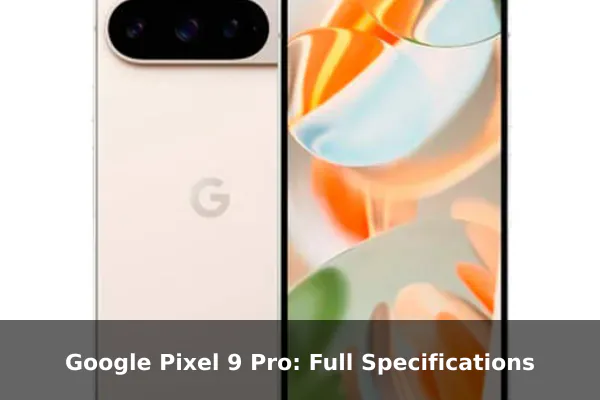
The Pixel 9 Pro supports GSM, HSPA, LTE, and 5G, with extensive LTE and 5G band coverage across listed models. The GR83Y variant includes Sub-6 and mmWave 5G bands, while the GEC77 listing focuses on Sub-6 5G. This model distinction matters for buyers importing the phone or switching carriers, because band support can affect coverage, speed, and 5G availability.
Local connectivity is equally strong. The phone includes tri-band Wi-Fi 802.11 a/b/g/n/ac/6e/7, Bluetooth 5.3 with A2DP, LE, and aptX HD, NFC, USB Type-C 3.2, and Ultra Wideband support. Positioning support includes GPS L1+L5, GLONASS, GALILEO, BDS, QZSS, and NavIC. There is no FM radio and no 3.5mm headphone jack, which is expected for this class but still worth noting.
Who Should Buy This Phone?
The Pixel 9 Pro is best for users who want a smaller flagship Android phone with a serious camera system, bright display, long software support, and advanced connectivity. It makes the most sense for photography-focused buyers, frequent travelers, Android purists, and users who want premium features without moving to a very large handset.
It is less ideal for buyers who want expandable storage, a headphone jack, the fastest possible charging, or a gaming phone built around maximum sustained performance. It also requires careful model selection for network bands, especially where mmWave 5G support matters. Compared with the Pixel 9a or older Pixel models, the Pixel 9 Pro is the more complete hardware package, especially because of its telephoto camera, brighter display, and 16GB RAM configuration.
Conclusion
The Google Pixel 9 Pro stands out as a compact premium Android phone with a bright LTPO OLED screen, full triple-camera hardware, generous RAM, strong connectivity, IP68 protection, and long software support. Its charging speed and lack of expandable storage are the main trade-offs, but the overall package is highly competitive for users who want Google’s best phone experience in a smaller format. Recommended for camera-focused Android buyers who want a long-lasting flagship without choosing an oversized device.
References
- Google Store – Pixel 9 Pro & Pixel 9 Pro XL Tech Specs – Primary product page for official Pixel 9 Pro specifications, including display, dimensions, battery, memory, processor, cameras, colors, and pricing.
- Google Pixel Phone Help – Hardware Tech Specs – Official Google support reference for Pixel hardware specifications, useful for verifying regional notes, network bands, charging details, durability, sensors, SIM support, and footnotes.
- Google Blog – Pixel 9, Pixel 9 Pro and Pixel 9 Pro XL Announcement – Official launch announcement confirming release timing, product positioning, Tensor G4, AI features, camera highlights, update promise, and launch pricing.
- Google Pixel Phone Help – Software Update Policy – Official source for Pixel OS, security, and Pixel Drop update support period, including the seven-year update policy for Pixel 9 Pro.
- Google Product Documentation – Pixel 9 Safety and Regulatory Guide – Official regulatory and safety documentation for Pixel 9, Pixel 9 Pro, and Pixel 9 Pro XL, including model numbers, FCC compliance, SAR, HAC, and radio-frequency information.
