
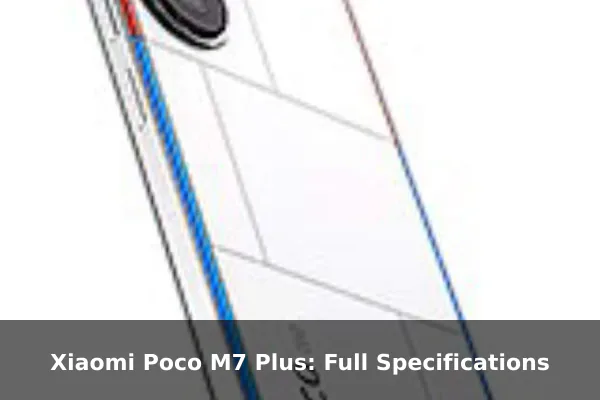
The Xiaomi Poco M7 Plus is a large-screen 5G smartphone built around endurance, smooth scrolling, and practical everyday hardware. It combines a 6.9-inch 144Hz IPS LCD, Snapdragon 6s Gen 3 platform, dual SIM support, and a very large 7000 mAh silicon-carbon battery.
Rather than chasing flagship extras, this phone focuses on the essentials that matter in a value-focused Android handset: long runtime, expandable storage, modern 5G bands, splash resistance, and a clean enough camera setup for daily photos and video calls.
Full Specifications
Network
| Technology: | GSM / HSPA / LTE / 5G |
| 2G bands: | GSM 850 / 900 / 1800 / 1900 |
| 3G bands: | HSDPA 850 / 900 / 2100 |
| 4G bands: | 1, 3, 5, 8, 20, 28, 40, 41 |
| 5G bands: | 1, 3, 5, 8, 20, 28, 40, 78 SA/NSA |
| Speed: | HSPA, LTE, 5G |
Launch
| Announced: | 2025, August 13 |
| Status: | Coming soon. Exp. release 2025, August 19 |
Body
| Dimensions: | 168.5 x 80.5 x 8.4 mm (6.63 x 3.17 x 0.33 in) |
| Weight: | 217 g (7.65 oz) |
| SIM: | Nano-SIM + Nano-SIM |
| IP64 dust tight and water resistant (water splashes) |
Display
| Type: | IPS LCD, 144Hz, 700 nits (typ), 850 nits (HBM) |
| Size: | 6.9 inches, 116.9 cm2 (~86.2% screen-to-body ratio) |
| Resolution: | 1080 x 2340 pixels, 19.5:9 ratio (~374 ppi density) |
| Protection: | Corning Gorilla Glass 3 |
Platform
| OS: | Android 15, up to 2 major Android upgrades, HyperOS 2 |
| Chipset: | Qualcomm SM6375 Snapdragon 6s Gen 3 (6 nm) |
| CPU: | Octa-core (2×2.3 GHz Cortex-A78 & 6×2.0 GHz Cortex-A55) |
| GPU: | Adreno 619 |
Memory
| Card slot: | microSDXC (uses shared SIM slot) |
| Internal: | 128GB 6GB RAM, 128GB 8GB RAM |
Main Camera
| Dual: | 50 MP, f/1.8, (wide), PDAF Auxiliary lens |
| Features: | LED flash, HDR |
| Video: | 1080p@30fps |
Selfie camera
| Single: | 8 MP, f/2.0, (wide) |
| Features: | HDR |
| Video: | 1080p@30fps |
Sound
| Loudspeaker: | Yes |
| 3.5mm jack: | No |
Comms
| WLAN: | Wi-Fi 802.11 a/b/g/n/ac, dual-band |
| Bluetooth: | 5.1, A2DP, LE |
| Positioning: | GPS, GLONASS, GALILEO, BDS |
| NFC: | Yes (market/region dependent) |
| Infrared port: | Yes |
| Radio: | No |
| USB: | USB Type-C 2.0 |
Features
| Sensors: | Fingerprint (side-mounted), accelerometer, compass |
| Virtual proximity sensing |
Battery
| Type: | Si/C Li-Ion 7000 mAh |
| Charging: | 33W wired 18W reverse wired |
Misc
| Colors: | Chrome Silver, Aqua Blue, Carbon Black |
| SAR: | 0.86 W/kg (head) 0.81 W/kg (body) |
| Price: | About 140 EUR |
Price and Availability
The Xiaomi Poco M7 Plus offers a compelling combination of features and performance. While the base price is around €140, the actual cost may vary depending on your location and retailer. Below, you’ll find the approximate price of the Xiaomi Poco M7 Plus converted into various currencies. Please note that these are estimates based on recent exchange rates as of September 1, 2026 and may not reflect the exact price you’ll find at a retailer.
- United States: $163
- Japan: ¥25,970
- United Kingdom: £120
- Australia: A$227
- Canada: C$225
- Taiwan: NT$5,151
- Denmark: kr1.047
- Saudi Arabia: ﷼609
- South Korea: ₩222,386
- Germany: €140
- Brazil: R$842
- Vietnam: ₫4.210.673
- Kenya: KSh 21,017
- India: ₹15,463
- Indonesia: Rp 2.880.757
- Nigeria: ₦219,564
- Pakistan: ₨45,137
- Philippines: ₱10,131
- Bangladesh: ৳২০,০১০
Value Position
The Poco M7 Plus stands out as a budget-oriented 5G phone with a specification sheet shaped around battery life and screen size. Its most distinctive feature is the 7000 mAh Si/C Li-Ion battery, which is larger than what many phones in this class offer. For buyers comparing affordable Android phones, that capacity gives the M7 Plus a clear practical identity: it is made for long daily use, travel, hotspot sharing, and heavy messaging or streaming sessions.
The Snapdragon 6s Gen 3 chipset also keeps the phone in a sensible performance tier. It is not positioned as a gaming flagship, but it should be adequate for social apps, browsing, navigation, video playback, and lighter games. The two memory options, 6GB RAM or 8GB RAM with 128GB storage, give users a choice between basic multitasking and a little more headroom. The shared microSD slot is helpful, although it means users must choose between expandable storage and the second SIM slot.
Design and Build
At 168.5 x 80.5 x 8.4 mm and 217 g, the Poco M7 Plus is clearly a large phone. The size suits users who prefer bigger displays, but it will not feel compact in one hand. The 217 g weight is understandable given the battery capacity, and buyers should treat the phone more as a media and endurance device than a slim lifestyle handset.
The IP64 rating is a useful durability detail. It means the phone is dust tight and resistant to water splashes, which helps with day-to-day confidence around light rain or accidental splashes. It is not a full waterproof rating, so users should still avoid submersion. Color choices include Chrome Silver, Aqua Blue, and Carbon Black, giving the phone both brighter and more restrained finishes.
Display Experience
The 6.9-inch IPS LCD is one of the biggest reasons to consider the Poco M7 Plus. Its 1080 x 2340 pixel resolution gives it a sharp enough 374 ppi density, while the 19.5:9 aspect ratio keeps it suited to streaming, reading, and split-screen style use. The approximate 86.2 percent screen-to-body ratio also helps the front look modern for the segment.
The 144Hz refresh rate is a strong point for scrolling fluidity. Menus, feeds, and supported games can feel smoother than on conventional 60Hz budget phones. Brightness is listed at 700 nits typical and 850 nits in high brightness mode, which should be adequate for many outdoor conditions, though IPS LCD contrast will not match OLED panels. Corning Gorilla Glass 3 adds basic scratch and drop resistance, but a case and screen protector still make sense for a phone this large.
Performance and Storage
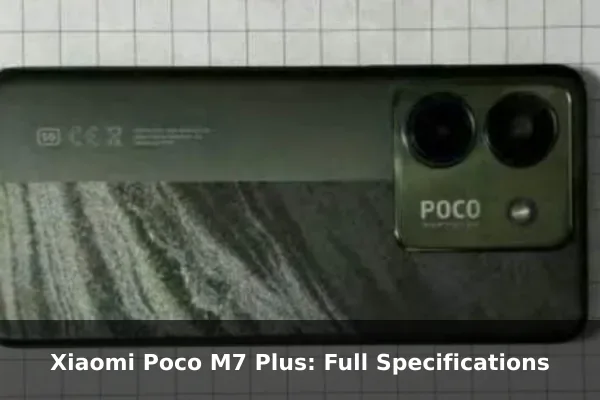
The Qualcomm Snapdragon 6s Gen 3 is a 6 nm chipset with an octa-core CPU using two Cortex-A78 cores at 2.3GHz and six Cortex-A55 cores at 2.0GHz. That arrangement favors a balance of responsiveness and efficiency. The Adreno 619 GPU should handle routine graphics work and casual gaming, but users expecting high frame rates in demanding 3D titles should keep expectations realistic.
The 128GB internal storage capacity is reasonable for the price class, especially because the phone supports microSDXC expansion through a shared SIM slot. The 8GB RAM model is the better pick for users who keep many apps open, while the 6GB version should be enough for simpler use. This is a phone for reliable everyday speed, not for benchmark-focused buyers.
Camera Setup
The rear camera system is simple: a 50 MP wide camera with f/1.8 aperture, PDAF, LED flash, HDR, and an auxiliary lens. That main sensor should be the camera users rely on most, especially in daylight. The auxiliary lens is not specified as an ultrawide, macro, or depth unit in the source data, so it should not be treated as a major creative camera feature.
Video recording tops out at 1080p at 30fps on both the rear and front cameras. The 8 MP f/2.0 selfie camera also supports HDR and 1080p video. This makes the phone suitable for casual selfies, social media clips, and video calls, but it is not aimed at creators who need 4K recording, advanced stabilization, or multiple focal lengths.
Battery and Charging
Battery life is the headline feature. The 7000 mAh silicon-carbon battery gives the Poco M7 Plus a clear advantage for users who dislike charging during the day. Silicon-carbon chemistry allows larger capacity in a phone body that remains relatively manageable, though the device is still heavier than many standard midrange phones.
Charging is rated at 33W wired, which is practical but not especially aggressive for such a large battery. Full charges may take longer than on smaller phones with faster adapters, but the tradeoff is extended runtime. The phone also supports 18W reverse wired charging, so it can top up accessories or another phone in a pinch.
Software and Updates
The Poco M7 Plus ships with Android 15 and HyperOS 2. The source data lists up to two major Android upgrades, which gives buyers a clearer expectation for software support. HyperOS is Xiaomi’s current Android interface, so users can expect Xiaomi-style customization, system tools, and ecosystem features layered over Android.
For long-term buyers, the update promise matters. Two major Android upgrades should carry the phone beyond its launch software, though security patch timing can vary by market. Anyone buying the phone for three or more years should still check local software support details when the device becomes available in their region.
Connectivity and Daily Features
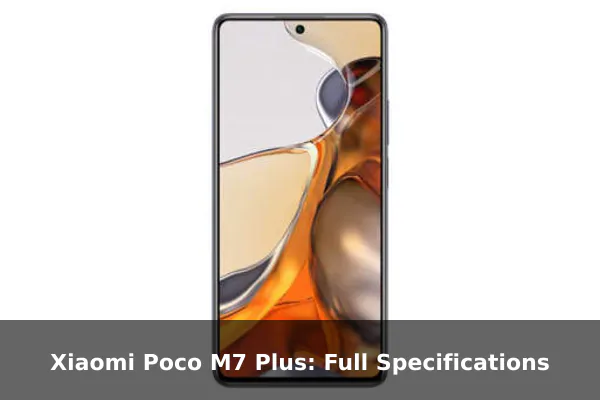
The Poco M7 Plus supports GSM, HSPA, LTE, and 5G, with both SA and NSA 5G bands listed. The band set includes common sub-6GHz bands such as n1, n3, n5, n8, n20, n28, n40, and n78, making the phone better prepared for modern networks than a 4G-only alternative. Wi-Fi 802.11 a/b/g/n/ac dual-band, Bluetooth 5.1, and multi-system positioning with GPS, GLONASS, GALILEO, and BDS cover the expected basics.
NFC is listed as market or region dependent, so buyers should verify their local model if contactless payments are important. The infrared port is a welcome extra for controlling compatible appliances, while the lack of FM radio and 3.5mm headphone jack may disappoint some users. USB Type-C 2.0 handles charging and wired connectivity, and the side-mounted fingerprint sensor is a practical placement for quick unlocking.
Who Should Buy It
The Poco M7 Plus is best for users who want a large display, very long battery life, 5G connectivity, and expandable storage without stepping into premium pricing. It suits students, commuters, delivery workers, travelers, and anyone who streams, reads, chats, or navigates for long periods each day.
It is less ideal for buyers who want a compact body, OLED display, advanced camera versatility, 4K video, or a headphone jack. For the right user, however, the combination of a 144Hz 6.9-inch screen and 7000 mAh battery gives the M7 Plus a practical edge over many ordinary entry-level 5G phones.
Conclusion
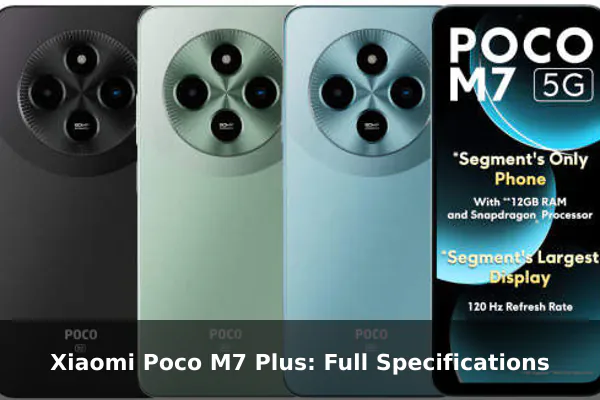
The Xiaomi Poco M7 Plus is a battery-first 5G smartphone with a large 144Hz display, Snapdragon 6s Gen 3 performance, Android 15 with HyperOS 2, and useful extras such as IP64 protection, infrared, NFC availability in some markets, and reverse wired charging. Its size, weight, simple camera system, and missing headphone jack are the main compromises. Recommended for buyers who prioritize screen size, endurance, and everyday 5G value over compact design or camera flexibility.
References
- POCO India – M7 Plus official product page – Primary manufacturer source for official POCO M7 Plus product information, imagery, specifications tab, and buying links.
- Qualcomm Snapdragon 6s Gen 3 Mobile Platform – Official chipset reference to verify Snapdragon 6s Gen 3 platform details, CPU clock, modem, Wi-Fi, and charging capabilities.
- Gadgets 360 – Poco M7 Plus 5G specifications – Established technology reference page with launch date, price, variants, dimensions, display, cameras, battery, software, connectivity, and sensors for cross-checking specs.
- FoneArena – POCO M7 Plus 5G launch and specifications – Reputable mobile industry publication with a detailed launch report and compact specification list useful for validating hardware, network bands, and India availability.
- Flipkart – POCO M7 Plus 5G retail listing – Major official retail channel for India availability, live variants, pricing, warranty information, and seller-facing product highlights.
